
Inside the worksheet
Unlocks after purchase
What does identifying triggers mean?
In this worksheet, a trigger means a cue or situation associated with a noticeable reaction. It might be a comment, an interaction, a memory, an image, or a physical sensation.
This is a broad, practical use of the word. A cue that comes before a reaction does not, by itself, establish what caused the reaction, reveal another person’s intentions, or prove a trauma history.
Not every strong feeling has one clear cause. Sometimes several circumstances contribute, and sometimes you remain unsure. The worksheet supports exploration, not certainty.
If it helps to see how situations, thoughts, feelings and actions fit together, The CBT Model is a companion MLC guide.
Why reflect on a specific moment?
A specific moment is easier to understand than a broad verdict. A judgement such as “I always overreact” tells you very little about what happened. A specific description does more: “I received a late request, noticed tension, and agreed before checking my workload.”
A specific account gives you something concrete to explore: the event, what it meant to you, the reaction, what you did, and the circumstances around it.
These parts can influence each other. They do not always follow a fixed order, and a conscious thought does not necessarily come before every feeling or physical reaction.
The purpose is to understand the experience more clearly and identify what could help.
When might this worksheet be useful?
It may be useful when a reaction seems stronger, quicker or more confusing than you expected. Examples include:
- Feeling anxious after receiving feedback or another work request.
- Becoming upset during a disagreement.
- Feeling overwhelmed when several demands accumulate.
- Noticing an urge to withdraw, argue, or agree immediately.
- Wondering why a similar situation felt more difficult on one occasion than another.
Choose one recent, manageable example. You do not need to provoke a reaction, search for distressing memories, or begin with your most painful experience. There is no expectation to complete it daily, and it is best not to do it while you feel overwhelmed.
Who is this resource for?
The resource is intended for adults and older adolescents who find reflective writing or discussion useful, and for therapists and counsellors who use it collaboratively with clients. This describes intended use. It is not a validated age range.
No diagnosis is required, and the worksheet cannot establish one.
Someone may talk through the prompts aloud, use short phrases, or ask for help recording their own words. A practitioner can adjust the language and pace to the person’s understanding and readiness. It will not suit everyone, and it is not designed for young children.
What is included in the two-page PDF?
The PDF has two A4 pages: a guide with an example, then a reflection page with writing spaces. It is designed to be printed and written on. It is not digitally fillable.
Page 1: Guide and example
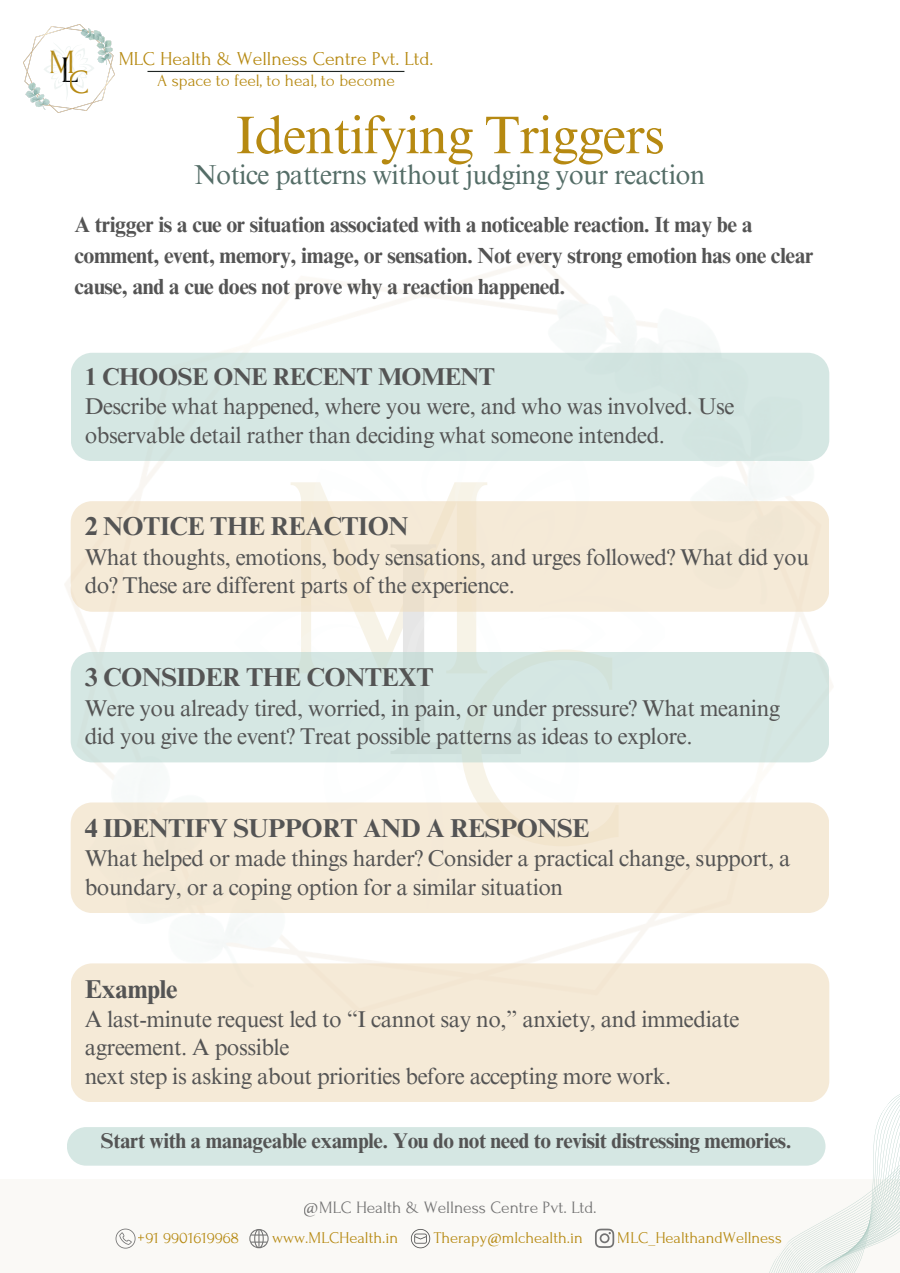
The first page, titled Identifying Triggers, contains:
- A short explanation of what a trigger means, including that not every strong emotion has one clear cause and that a cue does not prove why a reaction happened.
- Four reflection steps: choose one recent moment, notice the reaction, consider the context, and identify support and a response.
- A short example about a last-minute work request.
- A reminder to start with a manageable example and that you do not need to revisit distressing memories.
Page 2: Personal reflection
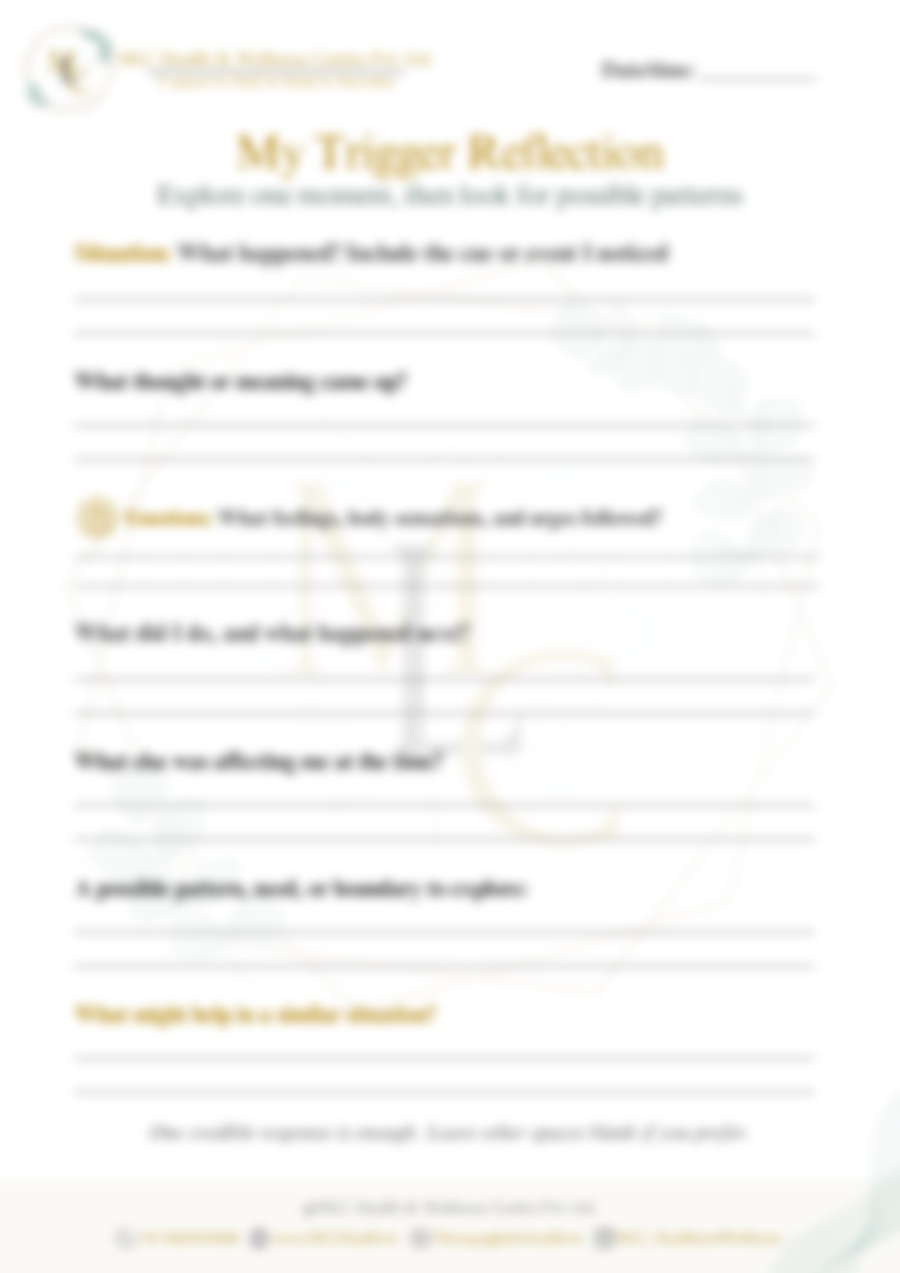
The second page, titled My Trigger Reflection, has a date and time line and seven writing areas:
- The situation: what happened, including the cue or event you noticed.
- The thought or meaning that came up.
- Feelings, body sensations, and urges that followed.
- What you did, and what happened next.
- What else was affecting you at the time.
- A possible pattern, need, or boundary to explore.
- What might help in a similar situation.
What it is not
It is a reflection sheet for one moment, not a tracking calendar. You can use another copy for a different situation, but the PDF has no scores, no emotion ratings and no longitudinal monitoring system. You can leave fields blank or return to them later.
How to complete the worksheet
Work through one situation at a time. The steps below follow the writing areas on page 2.
- Describe the event. Record what happened, where you were, and who was involved. Separate observable details from assumptions about intentions.
- Notice the thought or meaning. Write any words, image, prediction or interpretation that came up. “I am not sure” is an acceptable answer.
- Describe the different parts of the reaction. Record feelings, body sensations and urges separately where possible. An urge does not mean that an action occurred.
- Record what you did and what followed. Describe actions and consequences without labelling yourself “bad”, “weak” or “dramatic”.
- Consider the context. Note circumstances that seemed relevant, such as tiredness, pain, worry, time pressure or competing demands.
- Suggest a possible pattern, need or boundary. Treat it as a working idea. One reflection does not establish a recurring pattern.
- Identify support or a response. Consider a practical change, a request for information, a coping option, support from someone else, or a feasible boundary.
You can leave fields blank, pause, or return to them later. You do not need to remember every detail perfectly.
A completed example
Illustrative example. This is an original example written for this website. It is not a real client’s story, and it is not an additional completed page in the PDF.
Situation
“At 4:45 pm, my manager asked me to complete another task before the end of the day.”
Thought or meaning
“If I ask about the deadline, they will think I am not committed.”
Feelings, body sensations, and urges
“Anxiety; tight shoulders; an urge to agree immediately.”
What I did and what happened next
“I said yes without checking my existing deadlines. I then rushed between tasks and stayed late.”
Other influences
“I had slept poorly and already had two tasks due.”
Possible pattern, need, or boundary
“I may agree quickly when I expect disapproval. I need clearer priorities and a realistic workload.”
What might help
“I could ask, ‘Which task should I prioritise, and when is the new task needed?’ If that feels difficult in this workplace, I could first discuss a feasible approach with someone I trust.”
How to read this example
This is one possible interpretation. It does not establish the manager’s intentions, and it does not guarantee that the suggested response will be feasible in every workplace.
Distinguishing the parts of a reaction
A reaction has several parts that are easy to blur together. Noticing the differences can take practice. The table separates them using the example above.
| Part of the experience | Example |
|---|---|
| Event | Someone asks me to complete another task. |
| Thought or meaning | “They will think badly of me if I ask a question.” |
| Emotion | Anxiety. |
| Body sensation | Tight shoulders. |
| Urge | Agree immediately. |
| Action | Saying yes without checking my workload. |
An urge is a pull towards an action. It is not proof that the action happened, or that it must happen. A physical sensation is not automatically an emotion, and it is not automatically evidence of danger.
The worksheet heading on page 2 says “Emotions”, but the question underneath asks about feelings, body sensations and urges together. This guide treats them as distinct aspects of a reaction. The table is additional website guidance. The PDF does not have six separate fields matching it.
If you find it hard to name a feeling, the Feelings Wheel & Emotional Check-In can help. For noticing where a feeling shows up in the body, see the Body Map of Emotions.
What else may influence a reaction?
Considering the wider context helps you see the situation as more than a single moment. Depending on the person, relevant influences might include fatigue, pain, hunger, stress, sensory demands, unresolved conflict, or a cumulative workload.
Use cautious language when you write these down. Listing an influence does not prove that it caused the reaction, and it is not a judgement. No one has caused their distress by failing to sleep, eat or look after themselves properly.
A need or a boundary also cannot be worked out with certainty from one emotion. Treat it as something to explore in the wider situation, perhaps with someone you trust.
For a short check on basic needs such as hunger, tiredness and feeling alone, the HALT check-in is a companion MLC guide.
Looking for patterns without jumping to conclusions
One worksheet captures one experience. Similarities across several situations may suggest a theme, while differences can reveal useful context. No fixed number of entries proves a pattern.
If you complete more than one, these optional questions may help:
- What seems similar across these moments?
- When did a similar situation feel more manageable?
- What was different about the circumstances or support?
- Is there another explanation worth considering?
- What do I still not know?
The aim is understanding, not constant monitoring. It is not necessary to search for certainty, or to treat every uncomfortable sensation as a warning signal.
What can you do with what you notice?
Noticing a cue can lead to a range of practical responses. Depending on the situation, you might:
- Clarify expectations or ask for information.
- Adjust a workload or environmental demand where possible.
- Seek practical or emotional support.
- Pause before responding, when feasible.
- Consider a realistic boundary.
- Discuss an uncertain pattern with a therapist.
- Choose a coping option suited to you and the situation.
Identifying a cue does not automatically mean avoiding it. There is no blanket rule, and what is right depends on safety, context and support.
Actual danger or mistreatment may need protection and support, and discomfort alone does not establish danger. This worksheet does not ask you to confront unsafe people, to deliberately provoke distress, or to start self-directed trauma exposure.
If you would like a way to pause and settle, 5-4-3-2-1 Grounding is one option. To separate what you can influence from what you cannot, see My Circles of Control.
Guidance for therapists and context-sensitive adaptations
The worksheet works best as a collaborative reflection aid. These suggestions help keep it that way:
- Invite reflection rather than requiring disclosure.
- Start with a manageable example chosen by the client.
- Validate the reaction without assuming an interpretation is fact.
- Explore practical constraints, power differences, sensory needs and available support.
- Separate observations from hypotheses.
- Use the client’s words rather than supplying their meaning.
- Distinguish feelings and urges from actions.
- Review whether the exercise felt useful, repetitive, frustrating or overwhelming.
Context matters. In Indian and other settings, relevant examples might include examination pressure, workplace hierarchy, caregiving responsibilities, shared housing and family expectations. These are possible contexts, not stereotypes, and they will not apply to everyone.
Respect relationships, interdependence, language preferences and practical limits. Direct confrontation is not always necessary or feasible, and a fair response may work within a relationship rather than against it.
The worksheet can support an initial discussion. It does not replace a detailed functional assessment or a full DBT chain analysis.
When to pause, and who created this resource
You do not need to revisit distressing memories to use this worksheet. If reflection becomes overwhelming, pause, return attention to your immediate surroundings, or complete it with a practitioner. Persistent or severe distress deserves individual support.
This resource is an educational reflection aid. It is not a diagnostic tool, and it does not replace assessment or treatment.
Created by MLC Health & Wellness Centre Pvt. Ltd. The explanations, examples, design, and practice prompts were developed by MLC, informed by established psychological literature. Supporting references are provided below.
Frequently asked questions
Supporting references and evidence context
The books below support the cognitive and behavioural principles informing this resource. They do not establish that this specific MLC worksheet has been independently tested or validated.
- Beck, J. S. (2021). Cognitive behavior therapy: Basics and beyond (3rd ed.). Guilford Press. https://www.guilford.com/books/Cognitive-Behavior-Therapy/Judith-Beck/9781462544196 Relevance: a clinical reference for CBT case conceptualisation and for exploring situations, meanings, emotional responses and behaviour. It supports the underlying principles, not MLC’s particular headings or sequence.
- Linehan, M. M. (2015). DBT skills training manual (2nd ed.). Guilford Press. https://www.guilford.com/books/DBT-Skills-Training-Manual/Marsha-Linehan/9781462556359/prior-editions Relevance: a source for the behavioural exploration of prompting events, vulnerability factors, links in an experience, consequences and possible alternatives. MLC’s brief reflection worksheet is not a full DBT chain analysis. The publisher page is for the newer revised edition and lists the 2015 second edition (ISBN 9781462516995) under prior editions.
Platform disclaimer: this is a reflection and planning tool. It is not a diagnostic instrument or a substitute for therapy. If you are in distress, call Tele-MANAS at 14416.