
Inside the worksheet
Unlocks after purchase
What is My Circles of Control?
A two-page visual guide and worksheet for separating the choices available to you from things you can influence and things you cannot decide. Reflect on one situation, identify a manageable next step, and consider the support you need.
My Circles of Control is a visual reflection tool for looking at a difficult situation in smaller parts.
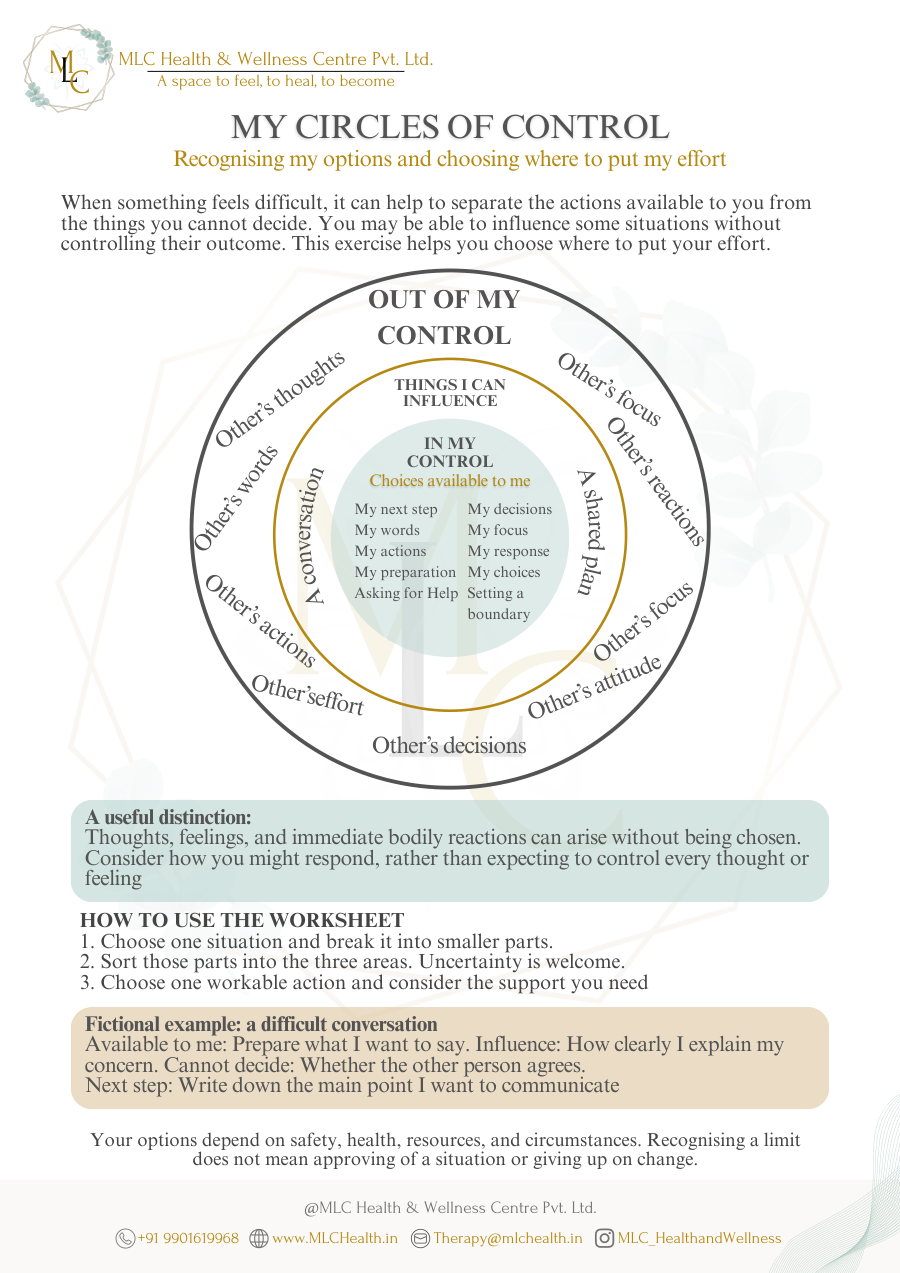
It separates three areas: choices and actions available to you, things you may be able to influence, and things you cannot decide or guarantee.
The aim is to help you identify where your effort could be useful and choose a workable next step. It does not ask you to control every feeling or accept responsibility for everything that happens.
What can this resource help me explore?
The worksheet offers space to consider:
- Which actions are available to you in this situation.
- What you might influence without controlling the outcome.
- What depends on other people or circumstances.
- What you cannot change about the past.
- Which practical support or resources you may need.
You can use it when a situation feels tangled or when you are spending a lot of energy trying to secure an outcome you cannot guarantee.
What is included in the PDF?
Page 1: Visual guide
The first page contains an introduction, an illustrated diagram with three labelled areas, a distinction between unchosen experiences and possible responses, three instructions for using the worksheet, and a fictional example about a difficult conversation. It also acknowledges that available options depend on safety, health, resources, and circumstances.
Page 2: Finding My Next Step
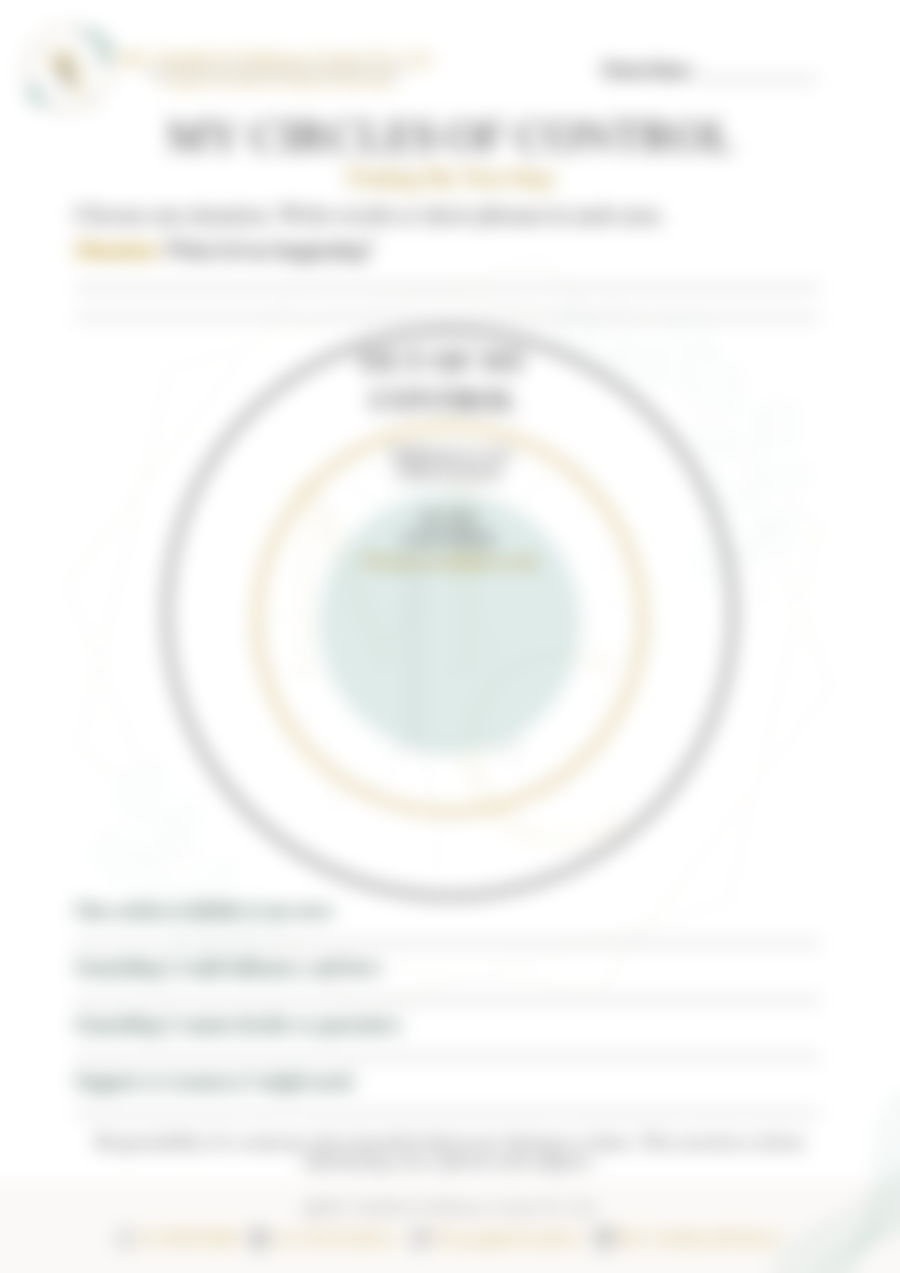
The second page contains:
- Date and time.
- A situation prompt: “What is/was happening?”
- A large blank diagram with the same three areas.
- “One action available to me now.”
- “Something I could influence, and how.”
- “Something I cannot decide or guarantee.”
- “Support or resources I might need.”
- A closing reminder that responsibility for someone else’s harmful behaviour belongs to them.
How do the three areas work?
In my control: choices available to me
Use the centre for actions you can realistically choose or attempt in your present circumstances. Examples may include preparing, communicating a need, asking for help, or choosing a small next step.
Things I can influence
Use the middle area for situations where your contribution may make a difference but cannot determine the result. The guide includes a conversation and a shared plan.
Out of my control
Use the outer area for things you cannot decide for yourself, such as another person’s thoughts, choices, or reactions.
Areas can change
Your influence and available choices may change as circumstances change.
How do I complete the worksheet?
Reflecting on one situation takes approximately 5–10 minutes on your own, or 10–15 minutes with discussion. These are practical estimates, not validated completion times.
- Choose one situation and briefly describe what is or was happening.
- Break it into smaller parts rather than sorting the entire situation into one category.
- Place those parts in the three areas.
- Identify one action available to you now.
- Consider what you could influence and how.
- Name an outcome you cannot decide or guarantee.
- Record any support or resources you might need.
Short phrases are enough. You can leave something uncertain, place it near a boundary, or return to it later.
Are my thoughts, feelings, and reactions completely under my control?
No. Thoughts, emotions, bodily sensations, and immediate reactions can arise without being chosen.
The centre of the diagram is best understood as a reminder of possible choices and skills to practise. It is not a promise that attention, words, behaviour, or responses are equally accessible in every moment.
For example, “my focus” can mean gently bringing attention back when you notice it has wandered. “My response” can mean considering what you do next when you have enough space and support.
The worksheet should not become another reason to criticise yourself for struggling.
What is the difference between influence and control?
Influence means your actions may contribute to what happens. Control would mean being able to determine it.
For example, you can prepare your words and explain a concern. That may influence how clearly you are understood, but it cannot guarantee agreement.
Separating these can help you recognise a useful contribution without treating the final outcome as entirely your responsibility.
Something can matter deeply to you even when you cannot decide it.
What might a completed example look like?
Fictional example: a difficult conversation
- Situation: I need to discuss a concern with someone important to me.
- Choices available to me: Prepare the main point I want to communicate and ask for a suitable time.
- Things I can influence: How clearly I explain my concern and how I contribute to the conversation.
- Things I cannot decide: Whether the other person agrees or responds as I hope.
- One action available now: Write down my main point.
- Support I might need: Help organising my thoughts or deciding how to approach the conversation safely.
This is an illustration, not a requirement to have a difficult conversation regardless of the circumstances.
How do I choose a manageable next step?
Choose a step that is specific enough to recognise and realistic enough to attempt.
“Make everything better” is difficult to act on. “Write one question,” “ask for information,” or “identify someone who could help” gives you a clearer starting point.
Your next step may involve preparation, rest, seeking support, delaying a decision, or taking practical action. It does not have to solve the whole situation.
Consider whether the step fits your safety, capacity, resources, and priorities.
Does recognising a limit mean giving up?
No. Recognising what you cannot decide does not mean approving of unfairness, abandoning your needs, or stopping efforts towards change.
You may still seek help, raise a concern, make a complaint, advocate for change, or work with other people.
The distinction is between choosing your contribution and expecting to guarantee the result.
Accepting that a limit exists can sit alongside taking action.
What if the situation involves harm or unequal power?
Start with safety and realistic options.
People do not have equal freedom, resources, or power in every situation. A boundary may be difficult to communicate or enforce, and asking for help may require planning.
Responsibility for another person’s harmful behaviour belongs to them. The worksheet should not imply that choosing different words or responses would necessarily have prevented that behaviour.
Support, protection, and changes to the surrounding situation may be more important than individual coping.
How can I use this in therapy or over time?
You can complete the worksheet independently or discuss it with a therapist.
A therapist can help you separate the different parts of the situation, notice where you may be taking too much responsibility, and identify support or realistic options.
You can revisit the worksheet when circumstances change. Something previously outside your influence may become more workable, or a planned action may need adjustment.
There is no required frequency, score, or correct distribution of answers across the circles.
About this resource
Created by MLC Health & Wellness Centre Pvt. Ltd. The explanations, examples, design, and practice prompts were developed by MLC, informed by established psychological literature. Supporting references are provided below.
This resource is intended for reflection and psychoeducation. It is not a diagnostic assessment or a substitute for individualised care.
Frequently asked questions
Psychological background and supporting reference
Acceptance-based approaches distinguish between attempts to control internal experiences and choosing actions that fit a person’s values and circumstances. This provides relevant conceptual background for the worksheet’s emphasis on acknowledging limits and identifying available action.
The reference below supports that broader background. It does not establish the origin of the circles diagram, validate this specific MLC worksheet, or demonstrate that completing it treats a psychological condition.
- Hayes, S. C., Strosahl, K. D., & Wilson, K. G. (2011). Acceptance and commitment therapy: The process and practice of mindful change (2nd ed.). Guilford Press. https://www.guilford.com/books/Acceptance-and-Commitment-Therapy/Hayes-Strosahl-Wilson/9781462528943 Relevance: Established clinical background on acceptance, psychological flexibility, and committed action. This is not a study of the MLC resource.
Platform disclaimer: this is a reflection and planning tool. It is not a diagnostic instrument or a substitute for therapy. If you are in distress, call Tele-MANAS at 14416.