
Inside the worksheet
Unlocks after purchase
What is 3-Minute Mindful Breathing?
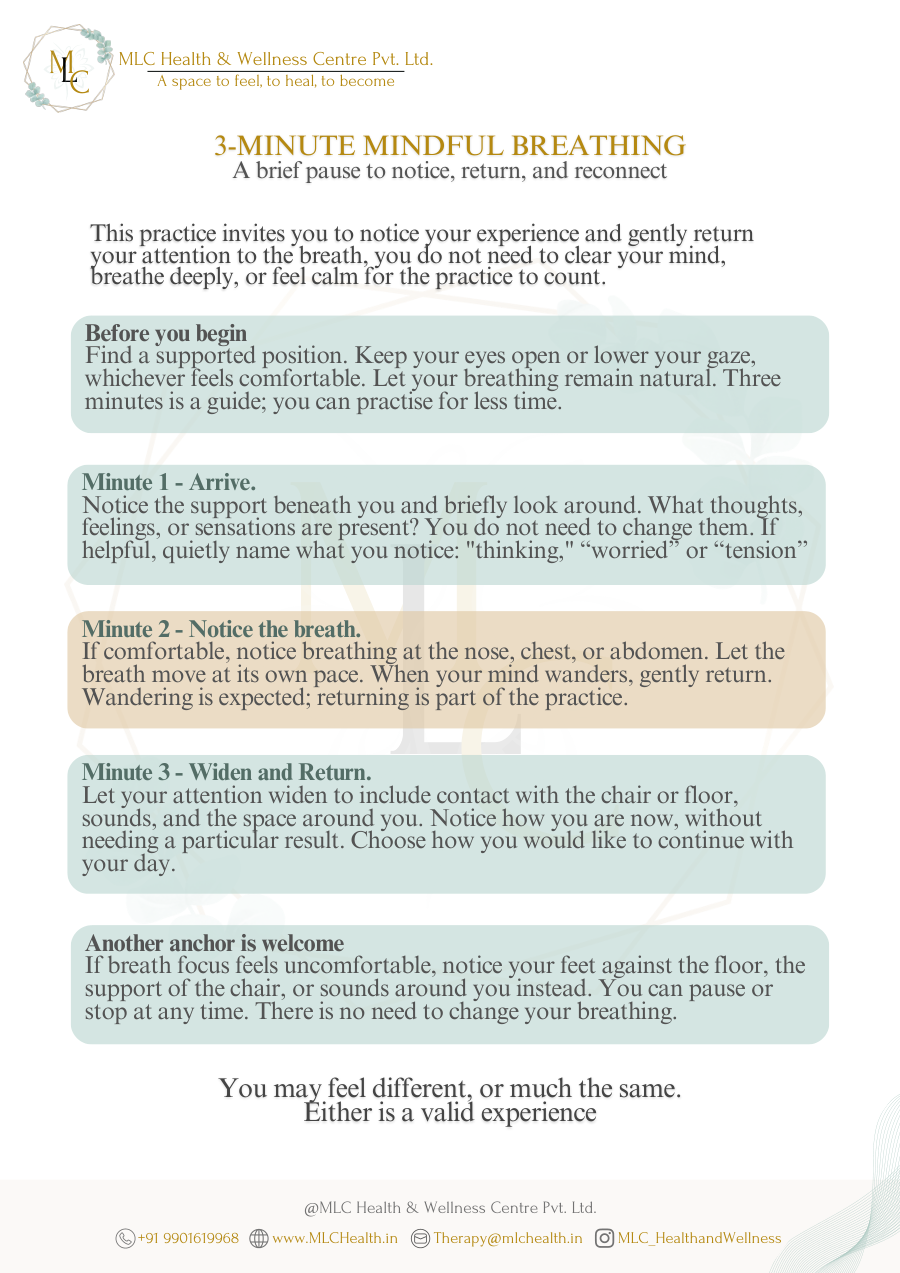
3-Minute Mindful Breathing is a short practice for noticing your experience, gently gathering your attention, and reconnecting with your surroundings.
The guide moves through three stages: arriving, noticing the breath, and widening attention before returning to your day.
- Minute 1 - Arrive: notice the support beneath you, look around, and notice which thoughts, feelings or sensations are present.
- Minute 2 - Notice the breath: if comfortable, notice your natural breathing at the nose, chest or abdomen, and gently return when your mind wanders.
- Minute 3 - Widen and Return: let your attention widen to the chair or floor, sounds and the space around you, then choose how to continue with your day.
You do not need to clear your mind, breathe deeply, or feel calm. The practice invites you to notice what is present and return your attention when it wanders.
What can this resource help me practise?
This resource offers a simple structure for practising:
- Recognising thoughts, feelings, and sensations.
- Choosing an anchor for your attention.
- Noticing when your mind has wandered.
- Returning without needing to criticise yourself.
- Widening awareness to your body’s contact with its surroundings.
- Choosing how to continue with your day.
It provides an opportunity to practise these skills. It does not guarantee that distress will reduce or that you will feel differently afterwards.
What is included in the PDF?
Page 1: The guided practice
The first page includes an introduction, preparation guidance, and three stages:
- Minute 1 - Arrive.
- Minute 2 - Notice the breath.
- Minute 3 - Widen and Return.
Also on page 1
Alternative anchors, and a reminder that feeling different or much the same are both valid experiences.
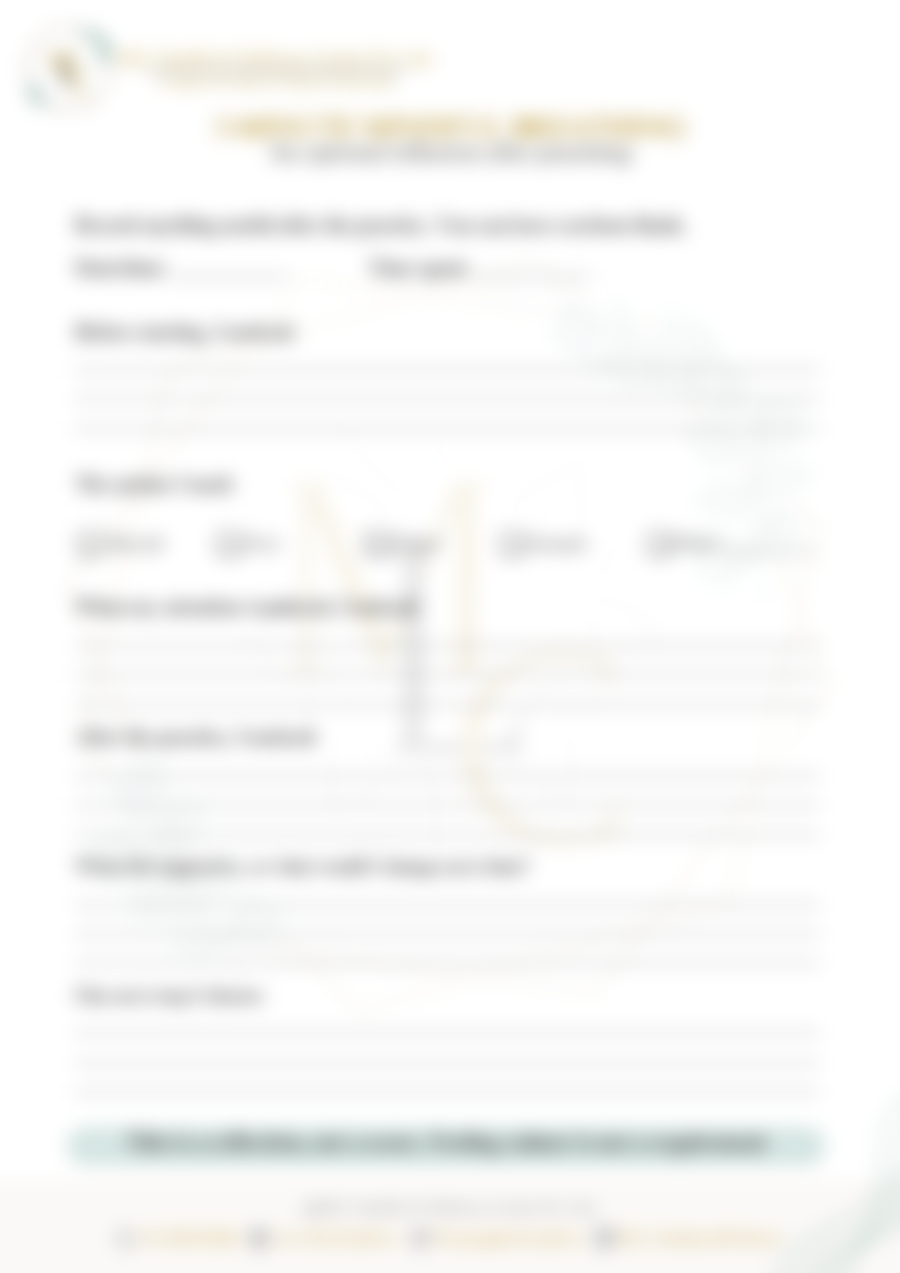
Page 2: Optional reflection
The second page includes:
- Date and time.
- Time spent.
- “Before starting, I noticed.”
- Anchor checkboxes: Breath, Feet, Chair, Sounds, and Other.
- “When my attention wandered, I noticed.”
- “After the practice, I noticed.”
- “What felt supportive, or what would I change next time?”
- “One next step I choose.”
End of page 2
The worksheet closes with a reminder that reflection is not a score and feeling calmer is not a requirement.
How do I prepare?
Find a position that feels supported. You can sit or choose another comfortable position that allows you to remain aware of your surroundings.
Keep your eyes open or lower your gaze, whichever feels more comfortable. Let your breathing remain natural.
Read through the guide before starting if that helps. A gentle timer is optional; you do not need to divide the practice into exact sixty-second intervals.
Three minutes is a guide. You can practise for less time or stop whenever you choose.
What do I do during Minute 1 - Arrive?
Notice the support beneath you and briefly look around.
Ask yourself what thoughts, feelings, or sensations are present. You do not need to change them or explain why they are there.
If helpful, use a simple label such as “thinking,” “worried,” or “tension.” These labels are possibilities rather than instructions about what you should notice.
If nothing stands out clearly, that is also something you can acknowledge.
What do I do during Minute 2 - Notice the breath?
If it feels comfortable, notice breathing at the nose, chest, or abdomen.
Choose one place where the movement or sensation of breathing is reasonably easy to notice. Let the breath move at its own pace.
When you realise your attention has wandered, gently bring it back. You do not need to finish a thought or push it away before returning.
There is no required breathing rate, inhale count, breath hold, or extended exhale in this resource.
What do I do during Minute 3 - Widen and Return?
Let your attention widen beyond the breath.
Notice contact with the chair or floor, sounds, and the space around you. You can look around and become aware of where you are.
Notice how you feel now without checking whether you achieved the “right” result.
Then consider how you would like to continue with your day. The next step may be small and practical.
What if my mind keeps wandering?
Wandering is expected. Noticing it and returning are part of the practice.
You might become caught up in planning, remembering, judging the exercise, or checking the time. When you notice, acknowledge that gently and return to your chosen anchor.
You do not need uninterrupted concentration for the practice to count. Repeatedly returning is still practising.
If the exercise feels too demanding, shorten it or choose an anchor that is easier to notice.
What if focusing on breathing feels uncomfortable?
Choose another anchor.
The PDF suggests noticing your feet against the floor, the support of the chair, or surrounding sounds. You can also record a different anchor in the “Other” space.
You may keep your eyes open, look around, pause, or stop. There is no need to force attention inward or change your breathing.
If an exercise repeatedly feels unsettling, consider exploring a more suitable practice with a therapist.
Is this the same as deep breathing or paced breathing?
This resource focuses on noticing natural breathing.
Deep-breathing and paced-breathing exercises ask you to change some aspect of breathing, such as its depth, timing, or rhythm. This practice does not prescribe those changes.
You do not need to make your breathing slower, larger, or more regular. If you notice yourself working hard to breathe “correctly,” allow the breath to return to its ordinary rhythm or use another anchor.
How do I use the reflection worksheet?
Complete it after practising, if you find that useful.
Record what you noticed before starting, which anchor you used, and what happened when your attention wandered. Then describe your experience afterwards.
You can also note what felt supportive, what you would change, and one next step you choose.
Short phrases are enough, and you may leave sections blank. You do not need to interrupt the practice to make notes or remember every detail.
The worksheet records your experience; it does not measure how successfully you practised.
What might a completed reflection look like?
Fictional example
- Date/time: Monday, 4:00 p.m.
- Time spent: About two minutes.
- Before starting, I noticed: I was thinking about several unfinished tasks and feeling restless.
- The anchor I used: Feet and sounds.
- When my attention wandered, I noticed: I started planning tomorrow. When I noticed, I returned to the feeling of my feet against the floor.
- After the practice, I noticed: I still had the same tasks to do. I was more aware of how rushed I felt.
- What felt supportive, or what would I change next time? Keeping my eyes open helped. Next time I would choose a quieter spot.
- One next step I choose: Write down the first task I want to begin.
This illustrates one possible experience. Feeling calmer or becoming more aware is not a required outcome.
About this resource
Created by MLC Health & Wellness Centre Pvt. Ltd. The explanations, examples, design, and practice prompts were developed by MLC, informed by established psychological literature. Supporting references are provided below.
This resource is intended for mindfulness practice and psychoeducation. It is not a diagnostic assessment or a substitute for individualised care.
Frequently asked questions
Psychological background and supporting reference
Brief practices that involve noticing current experience, gathering attention around breathing, and widening awareness are discussed within the mindfulness-based cognitive therapy literature.
This provides relevant background for the MLC practice. The reference below describes a broader clinical programme and its mindfulness practices; it does not validate this particular script or reflection worksheet.
Findings about a complete MBCT programme should not be transferred to this standalone three-minute resource.
Relevance: Established clinical background on mindfulness practice and the three-minute breathing space. This reference does not establish the effectiveness of the specific MLC resource.
- Segal, Z. V., Williams, J. M. G., & Teasdale, J. D. (2013). Mindfulness-based cognitive therapy for depression (2nd ed.). Guilford Press. https://www.guilford.com/books/Mindfulness-Based-Cognitive-Therapy-for-Depression/Segal-Williams-Teasdale/9781462537037
Platform disclaimer: this is a reflection and planning tool. It is not a diagnostic instrument or a substitute for therapy. If you are in distress, call Tele-MANAS at 14416.