
Inside the worksheet
Unlocks after purchase
Unlocks after purchase
What is assertive communication?
Assertive communication means expressing your needs, views, or limits clearly and respectfully while recognising that the other person can respond differently.
It can involve making a request, asking for information, expressing disagreement, or stating a limit. It does not require you to be certain, confident, loud, or emotionally calm throughout.
It is a communication approach to practise, not a fixed personality type and not a guarantee of agreement. The same person may communicate differently with a friend, a manager, or a relative, and that is ordinary.
If putting a feeling into words is the harder part, the Feelings Wheel is an MLC companion for finding more precise language.
How is assertiveness different from leaving a need unsaid or attacking the person?
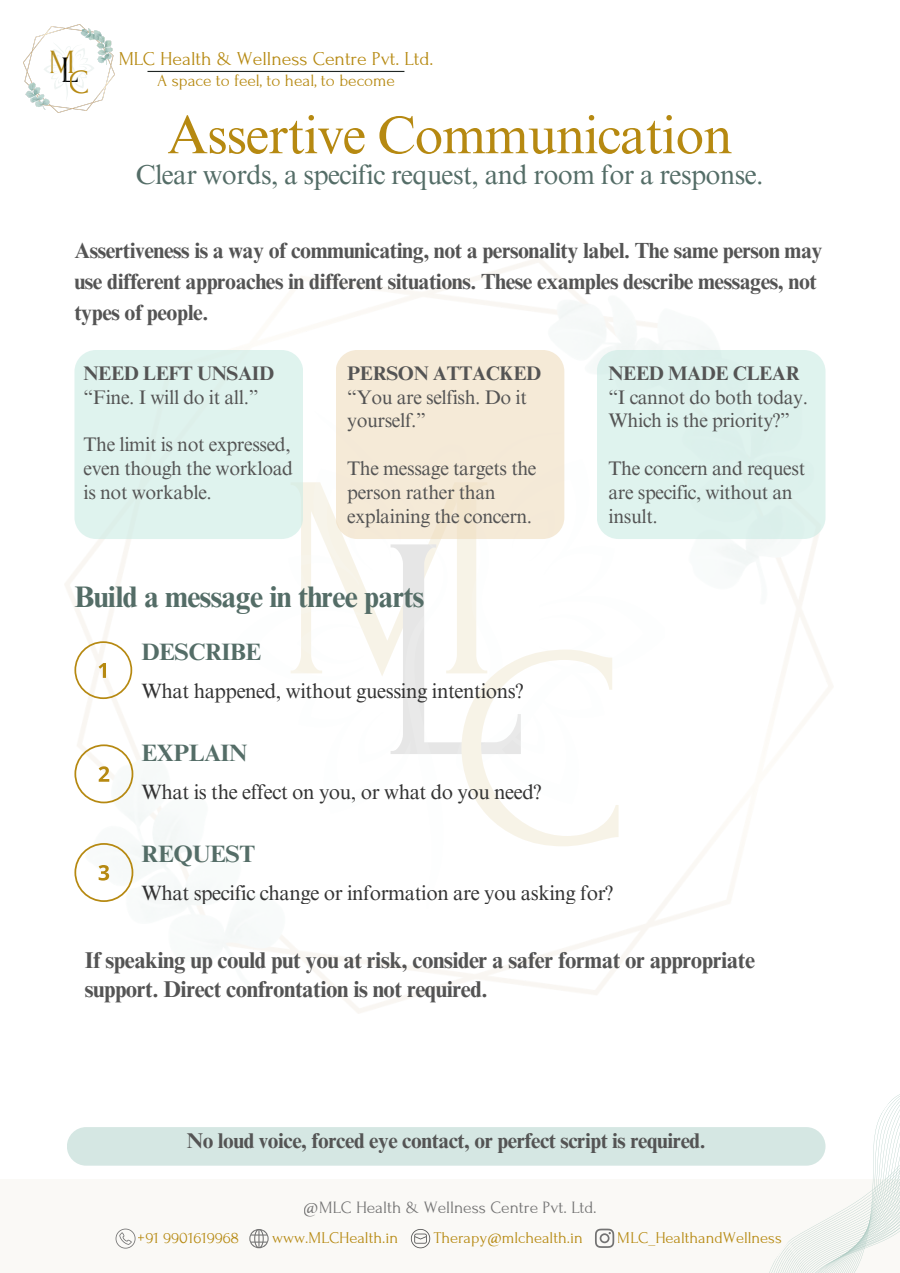
Assertiveness differs from both by being specific about the concern and the request, without insulting the other person. Page 1 of the PDF compares three messages about a workload that is not workable:
| Message | What it communicates |
|---|---|
| Need left unsaid: “Fine. I will do it all.” | The limit is not expressed, even though the workload is not workable. |
| Person attacked: “You are selfish. Do it yourself.” | The message targets the person rather than explaining the concern. |
| Need made clear: “I cannot do both today. Which is the priority?” | The concern and request are specific, without an insult. |
These are examples of messages, not labels for people. Nobody is “the quiet one” or “the aggressive one” because of a single sentence.
Staying quiet can sometimes be a deliberate or protective choice, particularly where there are power differences or risks. The resource does not describe anyone as weak, difficult, or unhealthy because they did not speak up.
When might this resource be useful?
It can help when you want to prepare one specific message before a conversation. Situations where people often find it useful include:
- Asking which task to prioritise.
- Requesting clarification.
- Addressing repeated interruptions.
- Explaining the effect of late changes to plans.
- Asking for a different arrangement.
- Expressing a need before resentment builds.
- Preparing a conversation that feels difficult to organise.
The worksheet focuses on preparing one message. Complex disputes may need more discussion, more support, or a different process. It is not a universal conflict-resolution tool, and the list above describes possible contexts of use, not established treatment indications.
Who is it for?
It is written for adults and older adolescents who want a structured way to prepare a message, and for therapists and counsellors using it collaboratively with clients. The age range is a practical suggestion, not a validated one.
You do not need a diagnosis or a particular communication style to use it. You can write short phrases, discuss the prompts aloud, or ask someone to help you record your own words.
It will not suit everyone, and it has not been validated for particular ages, diagnoses, or cultural groups.
Allow approximately 15 to 20 minutes to read the guide and prepare one message. This is a practical estimate, not a research-established duration, and it does not include having the conversation itself.
What is included in the three-page PDF?
The PDF has three A4 pages: a guide, a worked example, and a personal worksheet. It is designed to be printed and written on. It has no scores, no communication-style result, no confidence ratings, no conversation log, and no fillable form fields.
Page 1: Understand the skill
The first page, titled Assertive Communication, has the subtitle “Clear words, a specific request, and room for a response.”
- A comparison of three messages: need left unsaid, person attacked, and need made clear.
- A note that assertiveness is a way of communicating, not a personality label, and that the examples describe messages, not types of people.
- The three-part “Build a message in three parts” structure: Describe, Explain, Request.
- Two reminders: no loud voice, forced eye contact, or perfect script is required, and if speaking up could put you at risk, consider a safer format or appropriate support, because direct confrontation is not required.
Page 2: See a worked example
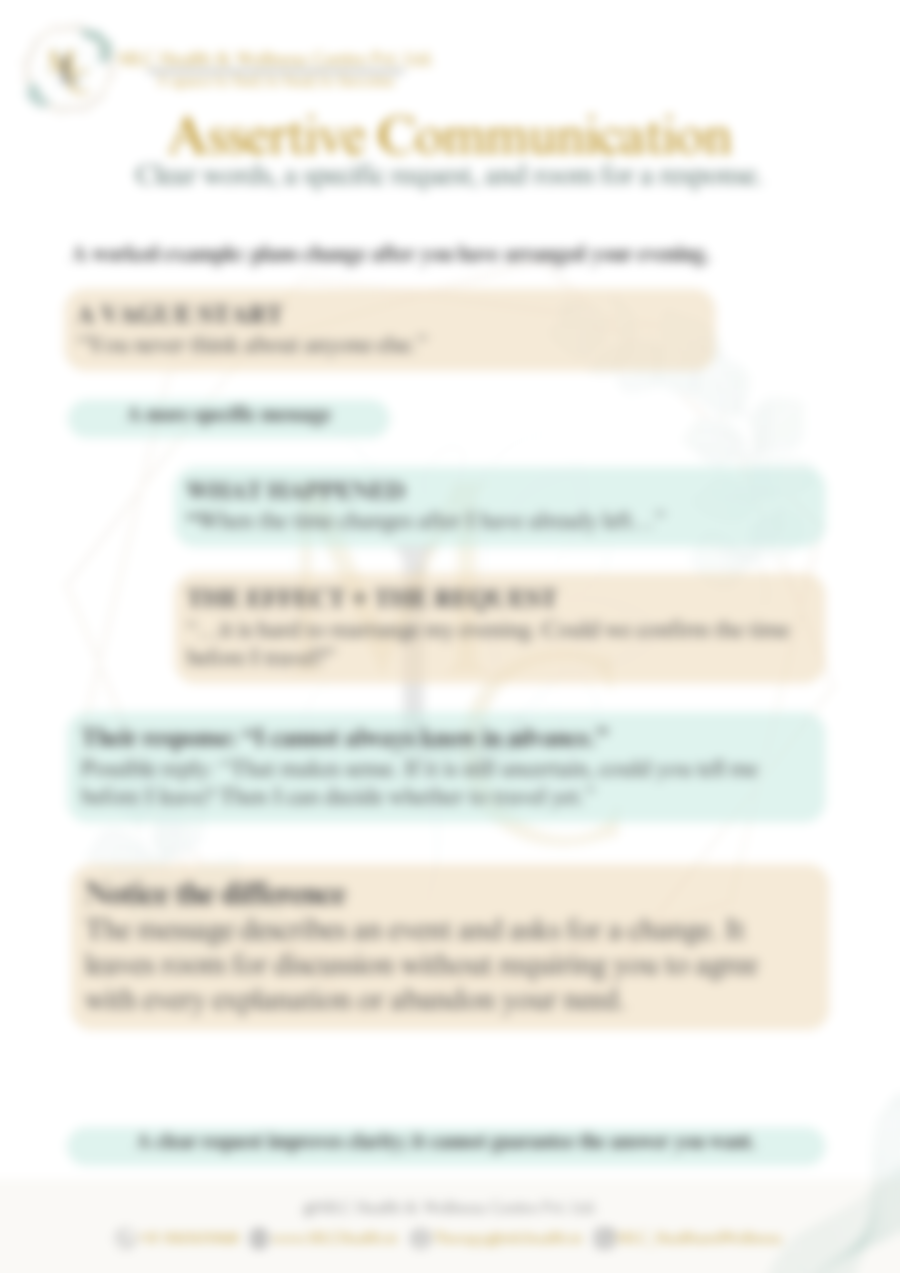
The second page follows a situation where plans change after you have arranged your evening.
- A vague start, a more specific message, and the difference between them.
- A possible response from the other person, and a possible reply to it.
- A reminder that a clear request improves clarity but cannot guarantee the answer you want.
Page 3: Build your own message
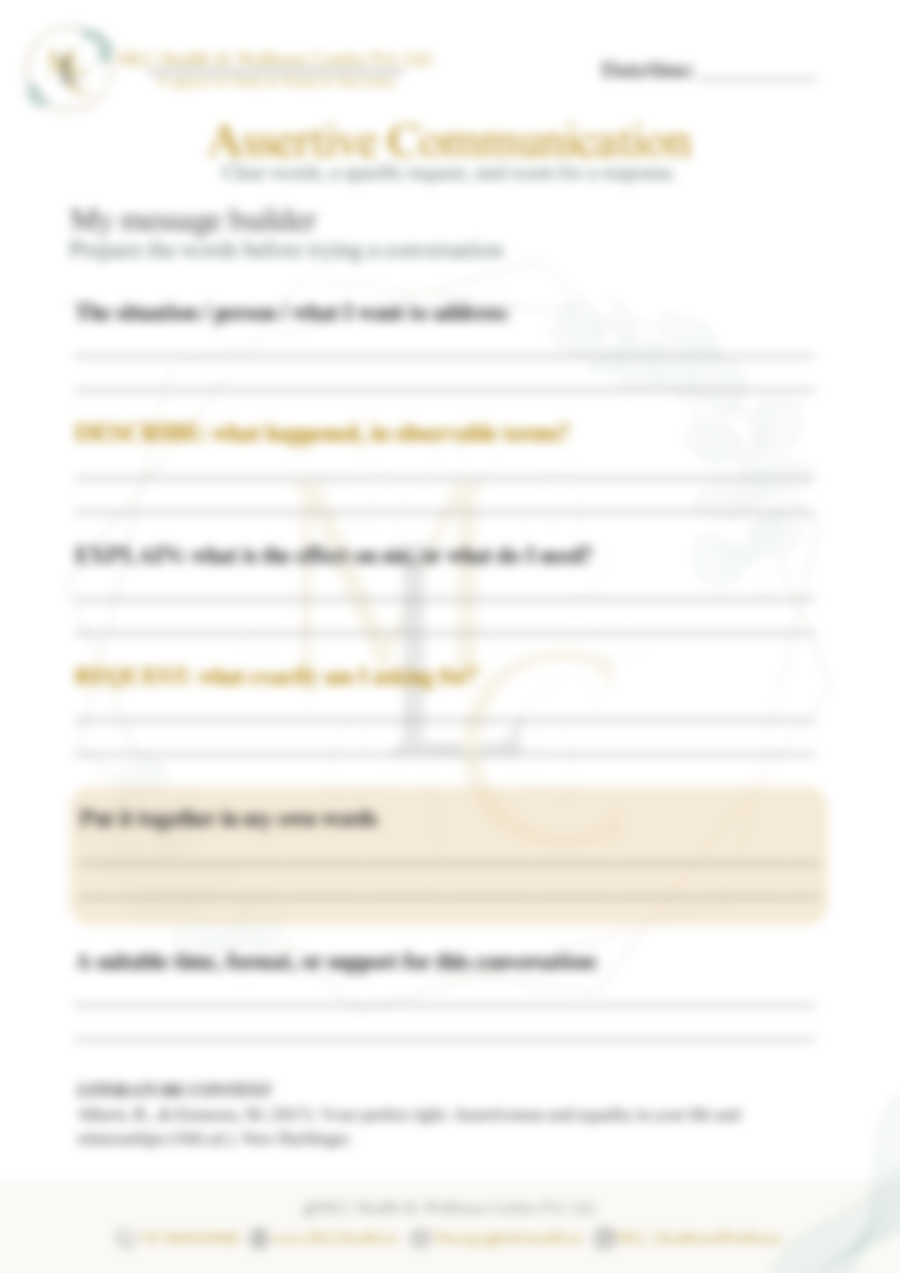
The third page, titled My message builder, has the line “Prepare the words before trying a conversation”, a date and time field, and six writing areas:
- The situation, the person, or what I want to address.
- Describe: what happened, in observable terms.
- Explain: what is the effect on me, or what do I need.
- Request: what exactly am I asking for.
- Put it together in my own words.
- A suitable time, format, or support for this conversation.
What it does not include
There is no fourth page, no separate rehearsal worksheet, and no review page in the PDF. Page 3 also carries a short literature-context line naming Alberti and Emmons. The questions and examples on this web page go beyond the PDF, and none of them is printed in it.
Step one: how do you describe what happened?
Describe what happened in observable terms, without guessing intentions or making broad judgements about someone’s character. Questions to try:
- What happened?
- When did it happen?
- What detail matters to this conversation?
- What can I describe without claiming to know someone’s motives?
| Kind of statement | Example |
|---|---|
| Interpretation | “You do not respect my time.” |
| Observable description | “The meeting time changed after I had already left.” |
The interpretation may be understandable, and you may well feel it. The description gives the other person a specific event to respond to.
An accurate description does not guarantee a fair response. It simply gives the conversation a clearer starting point.
Step two: how do you explain the effect or your need?
Name a practical effect, an emotional experience, or a relevant need. Examples:
- “It is difficult to rearrange my evening.”
- “I lose track of what I am saying when I am interrupted.”
- “I need to know which task is the priority.”
- “I feel uncertain about what is expected.”
You do not have to disclose private feelings to make a valid request. A practical explanation can be enough.
Putting “I feel” in front of an accusation does not make it assertive. “I feel that you are selfish” is still a judgement about the person. Describing your own experience or need is what shifts the message.
Step three: how do you make a specific request?
A request tells the other person what change or information you are asking for. Examples of specific requests:
- “Could I finish this point before we move on?”
- “Which task should I complete first?”
- “Could we agree on a time to discuss this?”
- “Could you explain which part needs changing?”
| Kind of request | Example |
|---|---|
| Vague | “Be more considerate.” |
| Specific | “Could you tell me before I leave if the time is still uncertain?” |
A specific request can still be declined or negotiated. It does not give you control over the other person’s response, and you do not have to treat every limit of yours as negotiable.
A worked example from the resource
Worked example from the resource. It follows page 2 of the PDF and is an illustrative conversation. It is not a real client’s account and not a promise that others will respond similarly.
Situation
Plans change after someone has already arranged their evening and started travelling.
A vague start
“You never think about anyone else.”
Describe
“When the time changes after I have already left…”
Explain
“…it is hard to rearrange my evening.”
Request
“Could we confirm the time before I travel?”
The other person says
“I cannot always know in advance.”
Possible reply
“That makes sense. If it is still uncertain, could you tell me before I leave? Then I can decide whether to travel yet.”
What to notice
The speaker acknowledges the practical difficulty while keeping the need for useful information. The message describes an event and asks for a change. It leaves room for discussion without requiring you to agree with every explanation or abandon your need.
How to use “My message builder”
The structure is a starting point, not a script you must follow word for word. Keep the message short: not every conversation needs three separate sentences.
- Identify the situation and the person. Write what you want to address in a few words.
- Write the observable description. Say what happened without guessing at motives.
- Explain the effect or your need. A practical reason is enough.
- State the specific request. Say exactly what change or information you are asking for.
- Put it together in words that sound natural to you. Use your own language and phrasing.
- Consider the time, the format, and the support you need. Choose when, where, and how the conversation could work, and who could help.
You can revise the draft, read it aloud if that helps, or practise it with a practitioner. These are optional ways to use the worksheet, not extra printed exercise pages.
Describe, Explain, Request is this resource’s practical structure. It is not a formally validated MLC treatment protocol and it is not the same as a complete named therapy skill.
What if the other person disagrees?
Disagreement does not automatically mean your message was unclear or that you communicated badly. A clear request improves clarity, but it cannot guarantee the answer you want. Options include:
- Clarifying your request.
- Listening to relevant information.
- Considering a workable alternative.
- Restating a limit.
- Asking for time to think.
- Ending or postponing the discussion when appropriate.
- Seeking support.
You can acknowledge someone’s perspective without agreeing with every explanation or abandoning your need. You do not have to keep explaining until the other person agrees.
A specific request and a boundary are related but different. A request asks for a response. A boundary also concerns your own participation or choices, such as what you will do next if the situation continues.
What about timing, safety, culture, and communication preferences?
The last writing area on page 3 asks for a suitable time, format, or support because how and when you speak can matter as much as the words. Things to consider:
- Whether there is time and privacy for the conversation.
- Workplace hierarchy or financial dependence.
- Shared housing and caregiving responsibilities.
- Language preferences.
- Whether written or spoken communication is more workable.
- Accessibility, processing time, and sensory needs.
- Whether a trusted person or practitioner could help with preparation.
In Indian and other contexts, these considerations may involve family responsibilities, joint households, workplace hierarchy, or respect for elders. These are possibilities, not stereotypes. Many people value relationships and interdependence, and assertiveness does not have to mean confrontation or dismissing family and community responsibilities.
The worksheet does not require eye contact, a firm tone, a particular posture, or the absence of anxiety.
If speaking up could expose you to harm or retaliation, prioritise appropriate support and a safer approach. Direct confrontation is not required.
If the difficulty is partly about what is yours to decide and what is not, the Circles of Control resource is a companion worth looking at.
Guidance for therapists, and the limits of this resource
For therapists and counsellors, the page works best as a collaborative preparation aid. Some practical suggestions:
- Ask what the client wants from the conversation.
- Understand their context before recommending direct expression.
- Help separate observations, interpretations, needs, and requests.
- Preserve the client’s wording and preferred communication style.
- Offer rehearsal collaboratively.
- Avoid judging success only by whether the other person agrees.
- Review clarity, feasibility, and the client’s experience.
- Explore practical support when communication alone cannot address the problem.
Reviewing the message with a client is an optional verbal step in therapy. The PDF has no separate review worksheet and no rehearsal page.
This resource is an educational communication aid. It is not a diagnostic assessment, a complete assertiveness-training programme, or a replacement for individual assessment and support.
One worksheet does not resolve relationship conflict, treat anxiety, or change another person’s behaviour.
Frequently asked questions
Created by MLC and supporting references
Created by MLC Health & Wellness Centre Pvt. Ltd. The explanations, examples, design, and practice prompts were developed by MLC, informed by established psychological literature. Supporting references are provided below.
The references below support the broader assertiveness principles informing this resource. They do not identify external authors as creators of the MLC worksheet, imply endorsement, or establish that this specific three-page resource has been independently tested or validated. The PDF itself names Alberti and Emmons. The review by Speed and colleagues is added here as supporting context and is not printed in the PDF.
- Alberti, R., & Emmons, M. (2017). Your perfect right: Assertiveness and equality in your life and relationships (10th ed.). New Harbinger Publications. https://www.newharbinger.com/9781626259607/your-perfect-right/ Relevance: an established practice-oriented book on assertiveness and respectful self-expression. It supports the broader principles. It does not validate MLC’s exact examples or message-builder structure.
- Speed, B. C., Goldstein, B. L., & Goldfried, M. R. (2018). Assertiveness training: A forgotten evidence-based treatment. Clinical Psychology: Science and Practice, 25(1), Article e12216. https://doi.org/10.1111/cpsp.12216 Relevance: a peer-reviewed review discussing assertiveness training and its clinical literature. It is not a trial of this MLC resource, and its findings do not show that completing this worksheet produces treatment outcomes.
Platform disclaimer: this is a reflection and planning tool. It is not a diagnostic instrument or a substitute for therapy. If you are in distress, call Tele-MANAS at 14416.