
Inside the worksheet
Unlocks after purchase
Unlocks after purchase

Unlocks after purchase
What is an ADHD task-planning worksheet?
An ADHD task-planning worksheet helps turn a broad task into a specific starting action, a manageable result for the current attempt, and a practical support plan.
This MLC resource focuses on starting and restarting. It is not a way of organising every responsibility in a full calendar. It works with one task at a time. Its core elements are:
- One chosen task.
- “Enough for now”: what will count for this attempt.
- A visible first action.
- A few next steps, if they are useful.
- Materials and environmental support.
- A restart cue.
- Reflection and adjustment.
It is a planning aid. It is not a diagnostic tool, and it is not a guaranteed solution to difficulties with starting tasks.
How does task planning relate to executive functioning in ADHD?
Executive functioning is an umbrella term for the processes involved in organising activity and directing it towards a goal. This page uses it in a plain, practical sense, and the worksheet does not assess it.
For this resource, the relevant demands are everyday ones:
- Deciding where to begin.
- Keeping the next step available.
- Organising materials.
- Managing competing demands.
- Returning after an interruption.
Writing a plan down gives you an external reference. You can look at it, rather than needing to hold every step in mind. That is the reason the worksheet asks for short, written entries and a restart note.
People with ADHD do not all experience the same executive-function difficulties, and these difficulties are not unique to ADHD. They can also be affected by stress, sleep, low mood, anxiety, pain, and the demands of the situation. The worksheet offers a place to practise a few planning skills. It does not change how the brain works, and it makes no claim about any underlying cause.
ADHD task initiation, procrastination, and feeling stuck
Task initiation means beginning the relevant action. It is different from knowing the task matters or wanting to finish it. You can care a great deal about a task and still find the first move hard to make.
A person may delay because the task is unclear, too large, emotionally difficult, competing with other demands, or missing something needed to begin, such as information or materials. These possibilities are worth separating rather than assuming a single explanation.
Some people use the phrase “ADHD paralysis” for the experience of feeling stuck or overwhelmed. It is an informal expression. It is not a separate diagnosis, and feeling this way is not proof of ADHD.
This resource asks what could make the entry point more workable. It does not ask you to prove that you care by trying harder.
Not all procrastination is a sign of ADHD, and not every delay is an executive-function symptom. Delay can also come from fear of failure, low mood, an unclear instruction, or a task that really is too much for the time available.
Who is this resource for, and how does it fit within ADHD support?
It is written mainly for adults with ADHD who want to practise organising one task, and for therapists and counsellors supporting them. Older adolescents may use it with adapted guidance. The adult literature that informs the resource has not been tested with that age group, so the age range is a practical suggestion and not a validated one.
Structured planning and organisation skills can form part of broader ADHD-focused CBT or practical support. A worksheet gives you a place to practise selected skills. It does not deliver a complete treatment programme. It does not replace assessment, medication review where relevant, individual therapy, workplace or academic accommodations, or other appropriate support.
You do not need an ADHD diagnosis to try a planning aid. Task breakdown can be useful to many people. Finding it helpful does not confirm a diagnosis, and difficulty with starting alone does not establish ADHD.
Allow approximately 10 to 15 minutes to read the guide and prepare one task plan. Doing the task and reviewing the attempt happen separately. This is a practical estimate, not a research-established duration.
What is included in the four-page PDF?
The PDF has four A4 pages: a guide, a page of supports, and two practice pages. It is designed to be printed and written on. It has no scores, no ADHD screening, no fillable form fields, and no extra pages.
Page 1: Make the task visible
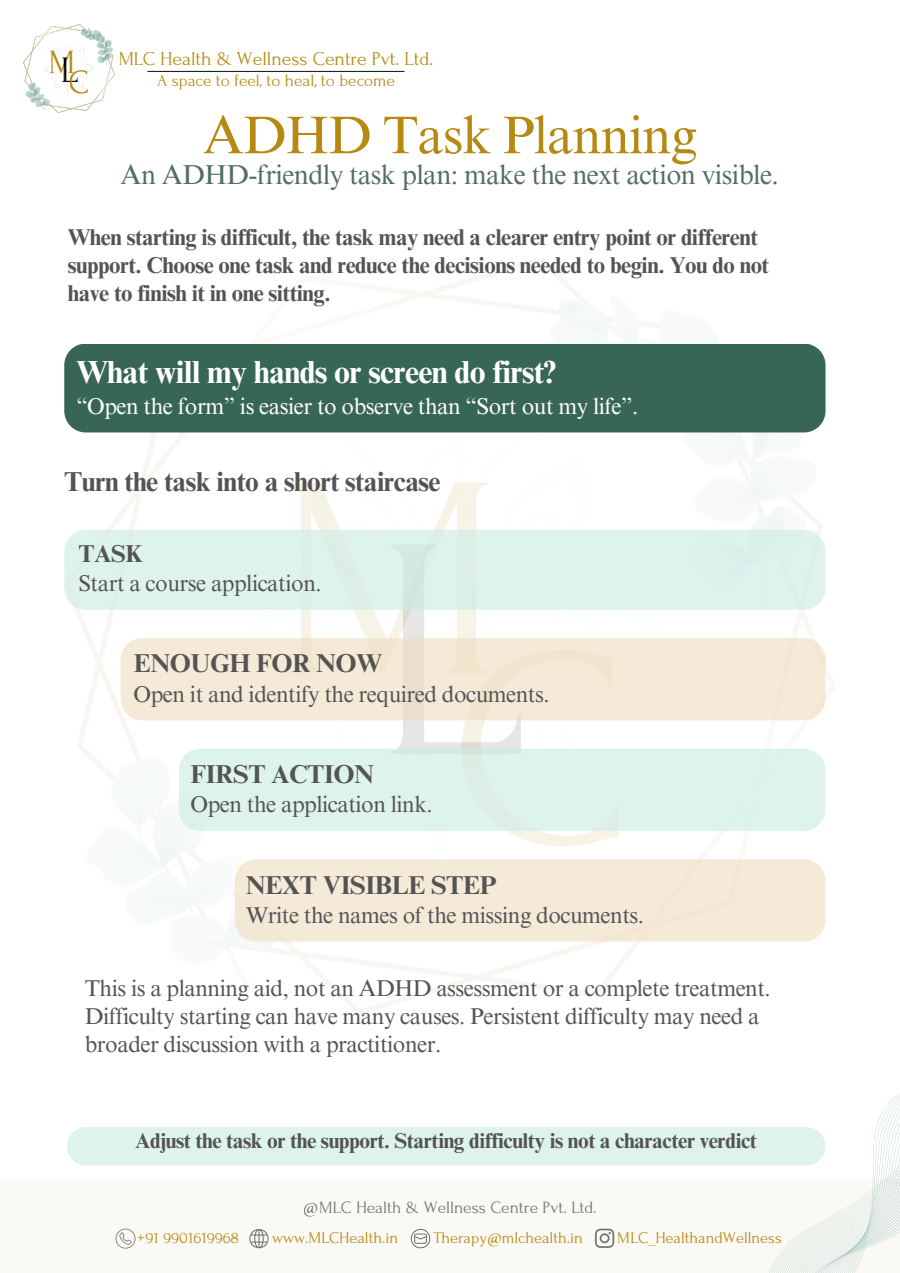
The first page, titled ADHD Task Planning, has the subtitle “An ADHD-friendly task plan: make the next action visible.”
- A short note that when starting is difficult, the task may need a clearer entry point or different support, and that you do not have to finish it in one sitting.
- The question “What will my hands or screen do first?”, with the note that “Open the form” is easier to observe than “Sort out my life”.
- A task staircase for the example of starting a course application: the task, what is enough for now, the first action, and the next visible step.
- A reminder that this is a planning aid, not an ADHD assessment or a complete treatment, and that persistent difficulty may need a broader discussion with a practitioner.
- The closing line “Adjust the task or the support. Starting difficulty is not a character verdict.”
Page 2: Match support to the barrier
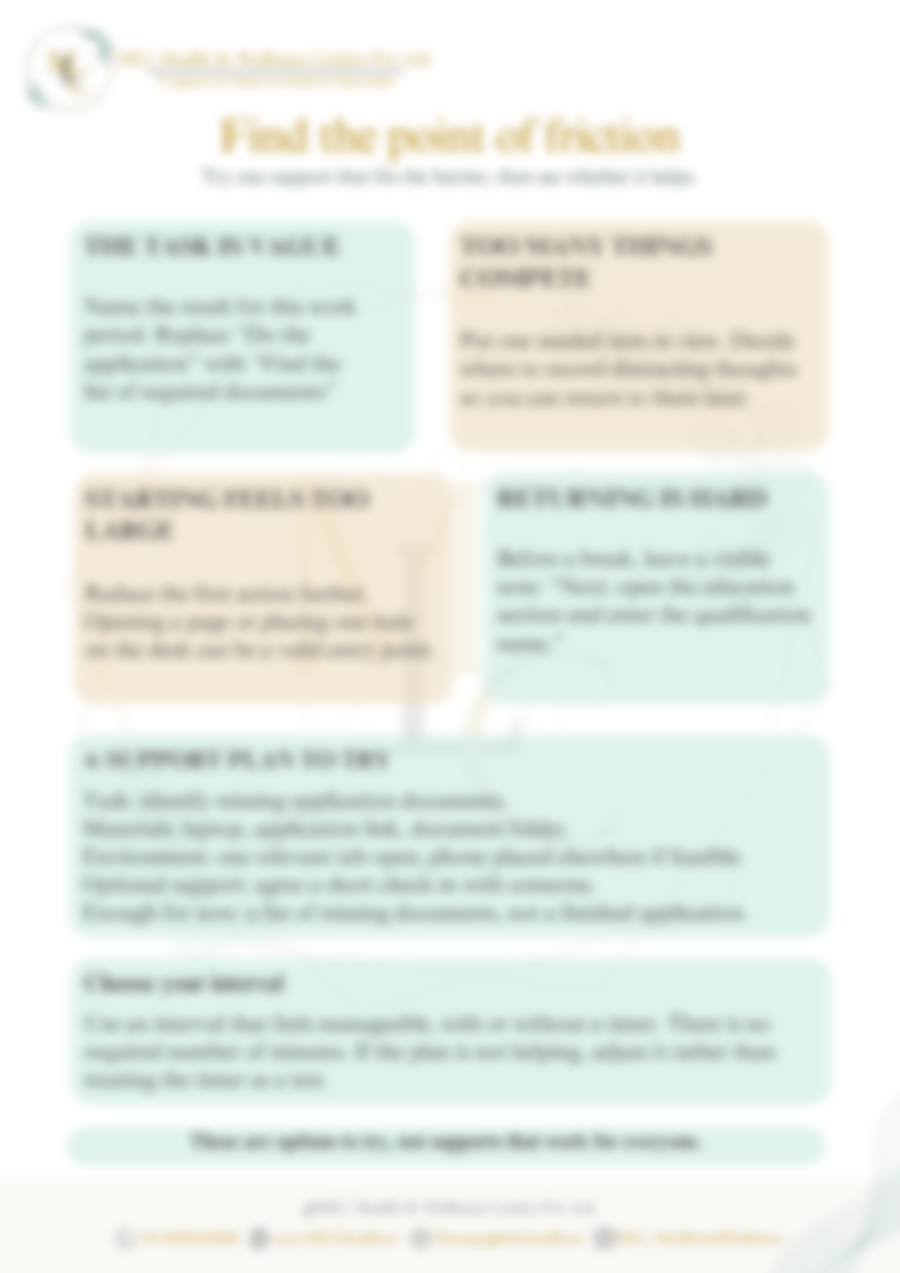
The second page, Find the point of friction, covers four barriers: the task is vague, too many things compete, starting feels too large, and returning is hard.
- One support to try for each barrier.
- A support plan to try for the application example, with a task, materials, environment, an optional support and what counts as enough for now.
- A short note on choosing an interval, with or without a timer. No number of minutes is given.
- The closing line “These are options to try, not supports that work for everyone.”
Page 3: Build your task launch board
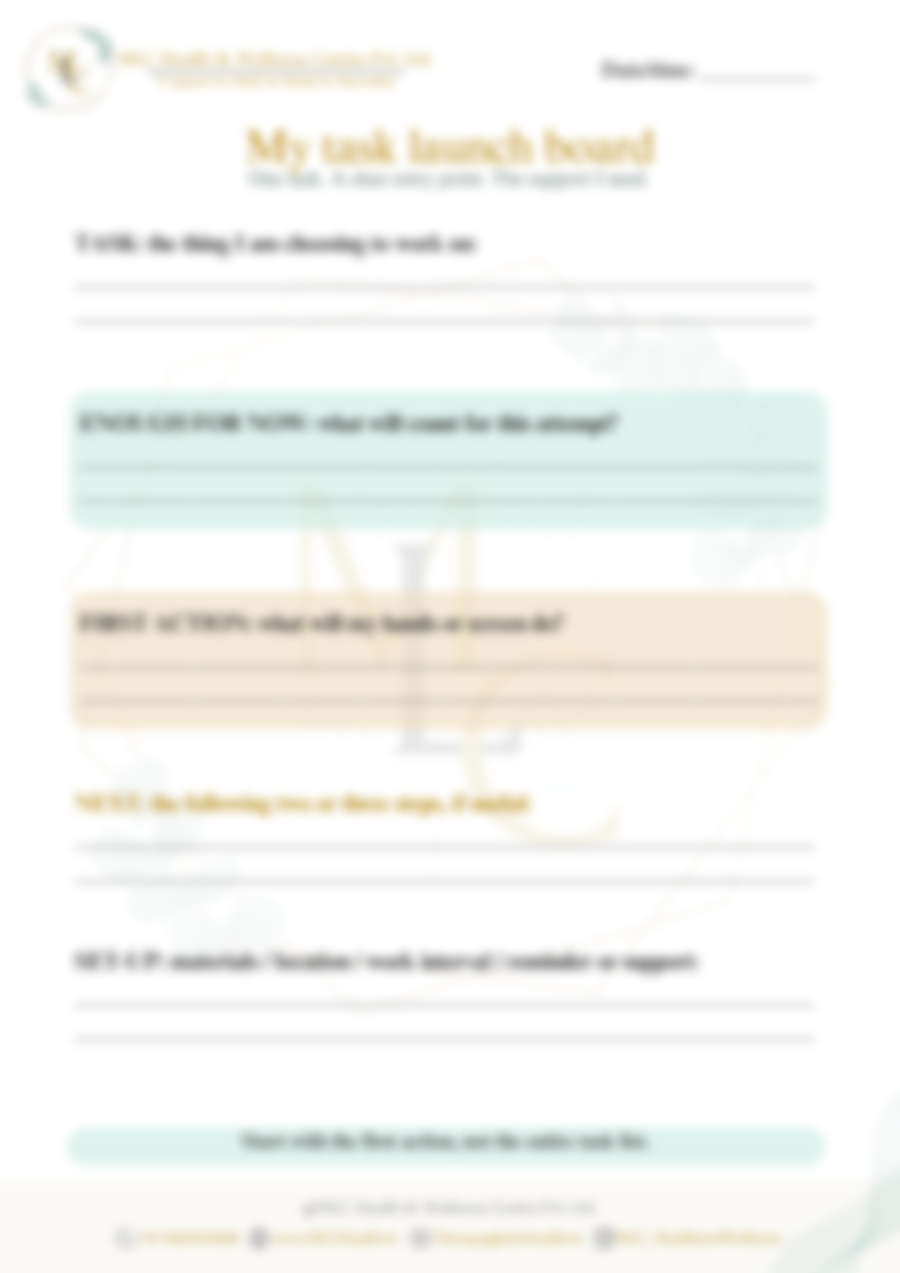
The third page, My task launch board, has the line “One task. A clear entry point. The support I need.”, a date and time field, and five writing areas:
- Task: the thing I am choosing to work on.
- Enough for now: what will count for this attempt.
- First action: what will my hands or screen do.
- Next: the following two or three steps, if useful.
- Set-up: materials, location, work interval, reminder or support.
Page 4: Prepare a restart and review
The fourth page, Leave a way back in, has a restart note, an “After trying” column and a line for planning a return.
- My restart note, with “I stopped at” and “The next visible action”.
- A note that you can stop because the task is complete, because the interval ended, or because the plan needs changing, and that not finishing is information about the task and context, not a score of your effort.
- An “After trying” column. The prompt “What made starting easier?” is printed twice in this column, followed by “One support or step to change”.
- A line for when or where you might return, or how you will decide.
- A literature-context line naming Safren and colleagues (2017), with the note that the workbook is not independently validated.
What it does not include
It is not a full ADHD planner, an appointment calendar, a habit tracker, or a time-management app. It has no daily, weekly or monthly layout, no reminders, no time tracking, and no scoring. The PDF has no printed “What got in the way?” field. That question is suggested on this web page as optional guidance only, and it is not part of the printed worksheet.
How to break down a task for ADHD planning
A broad task describes a whole piece of work. An observable action describes something you could start doing in the next few minutes. “Visible” here means concrete enough to describe, such as what your hands or screen will do. It does not have to be something another person could see.
| Broad task | A smaller, visible starting action |
|---|---|
| “Do the application.” | “Open the application link.” |
| “Work on the assignment.” | “Open the document and type the three required headings.” |
| “Sort out the paperwork.” | “Place the documents in one location and identify the first form.” |
| “Prepare for the meeting.” | “Open the agenda and write down one question.” |
The first action should fit the actual barrier. Opening a document is not automatically useful if you first need missing information, accessibility support, or a clearer instruction. In that case the first action may be to ask the question or request the support.
Start with a single task. A good test is whether you could say, in one sentence, what you would do first.
What does “enough for now” mean?
“Enough for now” is the result you are aiming for in the current attempt. It separates beginning a task from completing the whole of it. Examples include:
- Identify the required documents.
- Create headings for a draft.
- Read the instructions and note unanswered questions.
- Complete one section.
A smaller target does not change an external deadline or remove a required standard. It is a planning choice within the larger responsibility.
You do not always need to make a task smaller. Sometimes the more relevant adjustment is support, clarification, rest, or a change of environment. The page 1 line applies here: adjust the task or the support.
How to match support to the point of friction
Page 2 names four common points of friction and offers one support to try for each. These are options to test, and the PDF is clear that they are not universal fixes.
| Point of friction | Support to consider |
|---|---|
| The task is vague | Define a concrete result for this attempt. |
| Too many things compete | Put the relevant material in view and decide where to record other demands. |
| Starting feels too large | Reduce the entry action or clarify what information is missing. |
| Returning is hard | Leave a specific restart note before a break. |
Environmental adjustments may include having materials ready, reducing unnecessary tabs, changing notification settings where that is possible, or choosing a workable location. Not everyone can control their surroundings, so pick what is feasible for you.
A brief check-in with another person may be an optional support. It will not be available to everyone, and it is not presented as a treatment on its own. Some people describe working alongside another person as “body doubling”. This resource does not contain a body-doubling protocol and makes no claim about whether it works.
If one support does not help, try another or adjust the plan. If the difficulty is choosing between several possible responses, Problem-Solving is an MLC companion for comparing options. If worry about getting it right is the main barrier, Worry Management may help.
A worked example matching the PDF
Worked example based on the resource. It draws together the staircase on page 1 and the support plan on page 2. The PDF does not include a separate completed launch board, and this is an illustration, not a real person’s account or a promise that others will respond similarly. It does not guarantee any particular improvement, completion time, or emotional response.
Task
Start a course application.
Enough for now
Open it and identify the required documents.
First action
Open the application link.
Next visible step
Write the names of the missing documents.
Materials
Laptop, application link, and document folder.
Environment
One relevant tab open; phone placed elsewhere if feasible.
Optional support
Agree a short check-in with someone.
Restart cue
“Next: open the education section and enter the qualification name.”
How to use “My task launch board”
Use short, concrete entries rather than elaborate planning. You can complete the board aloud with a practitioner, or use only the prompts that are most relevant.
- Choose one task and write it in your own words.
- Define what counts as enough for this attempt.
- Describe what your hands, your screen, or another relevant action will do first.
- Record the next two or three steps, only if that is useful.
- Prepare the set-up: materials, location, an interval, a reminder, or support.
The plan should make starting easier to identify. If completing the plan becomes another large task, simplify it.
You do not need a fully detailed plan before you begin. Start with the first action, not the entire task list, as the foot of the page says. Add the date and time if you want a record of the attempt.
If the larger goal still needs defining, the SMART Goals worksheet is an MLC companion. If low motivation or a very low mood is making it hard to begin anything, Behavioural Activation may be a better fit.
Choosing a work interval without a rigid timer rule
The PDF suggests an interval that feels manageable, with or without a timer. It gives no number of minutes, and it does not require a 25-minute Pomodoro cycle or any other fixed schedule. Things you might weigh up:
- The task itself.
- Your current capacity.
- The time you actually have.
- How you respond to timers. Some people find them helpful, and some find them stressful.
- A natural point to stop or review.
- What you need for breaks and for restarting.
There is no single ideal interval for ADHD, and using a timer is not required for the plan to work. As page 2 puts it, if the plan is not helping, adjust it rather than treating the timer as a test.
A chosen interval is a planning aid. It is not a test of attention span or effort. The worksheet does not measure time blindness and does not train time perception.
Restarting after a break or interruption
Before stopping, leave information that makes the next entry point easier to identify. Page 4 gives the restart note three parts:
- I stopped at: the exact point you reached.
- The next visible action: the next concrete thing to do.
- When or where I might return: a feasible arrangement, or a way to decide.
Example: “I stopped after listing the missing documents. Next, open the education section and enter the qualification name.” Keep the note where you will return to it.
Returning may still be difficult. The note is a support to try, not a guarantee. You may stop because the task is complete, because the interval has ended, or because the plan needs changing. Not finishing is information about the task and context, not a score of your effort.
When you review the attempt, the printed prompts ask what made starting easier and what one support or step you would change. As optional guidance on this web page only, you may also ask what got in the way. That question is not a printed field in the current PDF.
If harsh self-judgement shows up when you restart, Negative Self-Talk is an MLC companion for noticing it.
Guidance for therapists and ADHD-focused skills practice
For practitioners looking for ADHD intervention worksheets, this workbook can support collaborative practice of selected planning and organisation skills within a broader formulation. A way of using it in session:
- Choose a real task with the client.
- Explore what is making entry difficult.
- Identify a manageable outcome for this attempt.
- Translate a broad instruction into an observable first action.
- Prepare external cues or environmental support.
- Consider rehearsing the first action in the session.
- Plan a restart cue.
- Review the fit of the strategy rather than compliance.
Consider sleep, anxiety, low mood, pain, learning demands, unclear instructions, sensory needs, and practical barriers where relevant. The worksheet cannot show how much each one contributes, so avoid reading a diagnosis into it.
In Indian and other contexts, relevant tasks may include examination preparation, university assignments, applications, work documentation, caregiving, or shared living arrangements. Do not assume access to a quiet room, a laptop, flexible work hours, or another person’s help. These are possibilities, not stereotypes.
This is a practice aid for selected ADHD-relevant skills, not a complete ADHD intervention or an independently validated treatment.
Frequently asked questions
Created by MLC and supporting references
Created by MLC Health & Wellness Centre Pvt. Ltd. The explanations, examples, design, and practice prompts were developed by MLC, informed by established psychological literature. Supporting references are provided below.
These sources support the broader literature on cognitive behavioural skills for adult ADHD. They do not identify external authors as creators of the MLC resource, imply endorsement, or establish that this specific four-page workbook has been independently tested or validated. The PDF itself lists the 2017 workbook. The 2010 trial is added here as broader context and is not printed in the PDF.
- Safren, S. A., Sprich, S. E., Perlman, C. A., & Otto, M. W. (2017). Mastering your adult ADHD: A cognitive-behavioral treatment program, client workbook (2nd ed.). Oxford University Press. https://academic.oup.com/book/1239 Relevance: an established adult ADHD workbook addressing skills including organisation, planning, distractibility, and managing overwhelming tasks. MLC’s resource is original and does not reproduce or deliver the complete programme.
- Safren, S. A., Sprich, S., Mimiaga, M. J., Surman, C., Knouse, L., Groves, M., & Otto, M. W. (2010). Cognitive behavioral therapy vs relaxation with educational support for medication-treated adults with ADHD and persistent symptoms: A randomized controlled trial. JAMA, 304(8), 875–880. https://doi.org/10.1001/jama.2010.1192 Relevance: a trial of a multi-session clinician-delivered CBT programme for adults with persistent ADHD symptoms while receiving medication. It did not test this MLC worksheet or establish the effectiveness of a task-planning sheet alone, and its findings should not be generalised to unmedicated adults, children, or every individual strategy.
Platform disclaimer: this is a reflection and planning tool. It is not a diagnostic instrument or a substitute for therapy. If you are in distress, call Tele-MANAS at 14416.
More worksheets from MLC
3-Minute Mindful Breathing
A brief pause to notice, return, and reconnect
4–7–8 Breathing
A breathing practice with a longer exhale
5–4–3–2–1 Grounding
Notice your surroundings through your senses
Assertive Communication Worksheet
Clear words, a specific request, and room for a response
Browse all therapist tools