
Inside the worksheet
Unlocks after purchase
Unlocks after purchase
Unlocks after purchase
What is a problem-solving worksheet?
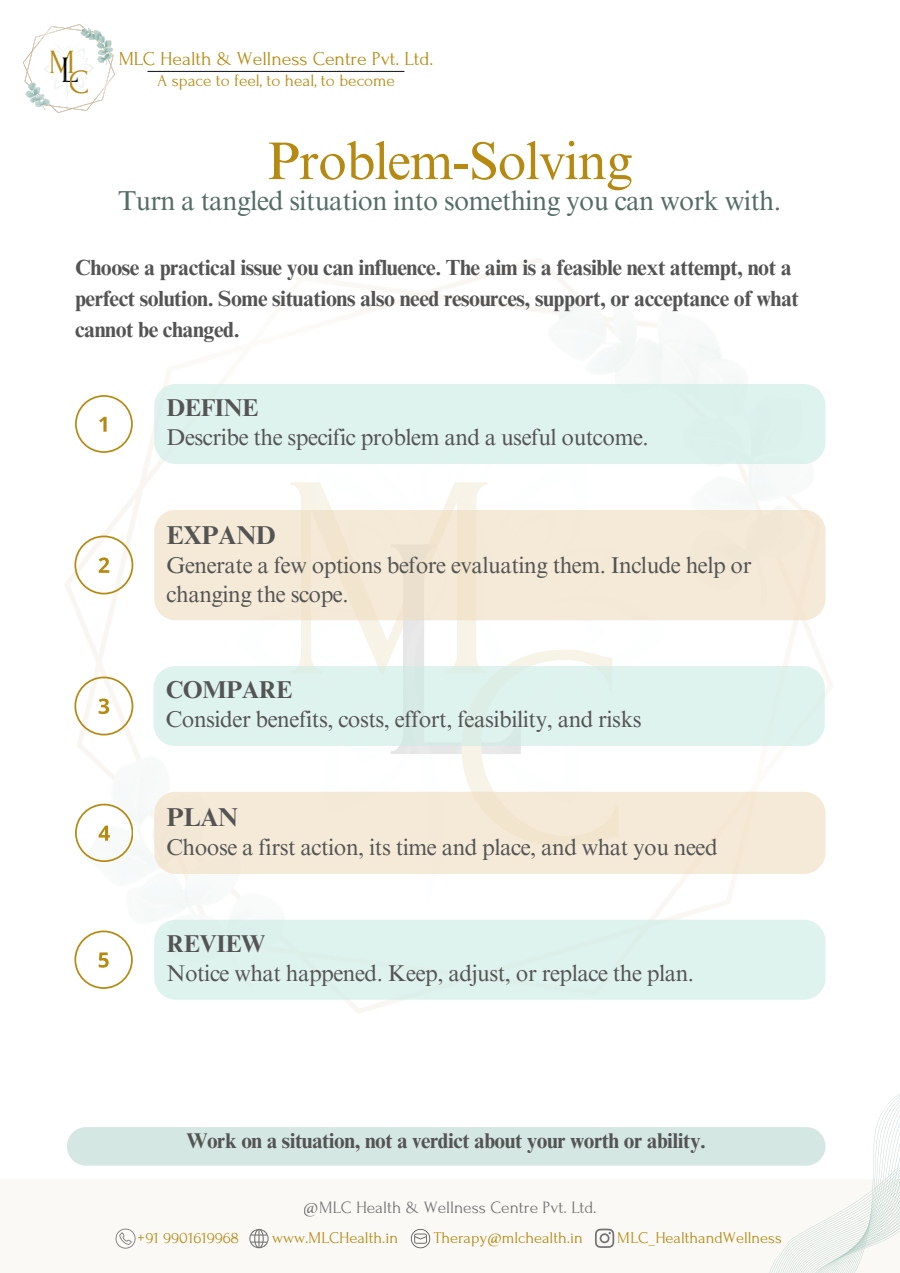
A problem-solving worksheet provides a structure for defining a practical difficulty, considering possible responses, choosing an action, and reviewing what happens.
This MLC resource organises the process into five steps: Define, Expand, Compare, Plan, and Review. It helps you organise your thinking and action. It does not determine the correct answer, and it cannot guarantee that every problem can be resolved.
The aim is a workable next attempt with the resources available, not a perfect solution.
- Define: describe the specific problem and a useful outcome.
- Expand: generate options before evaluating them.
- Compare: consider benefits, costs, effort, feasibility, and risks.
- Plan: choose a first action, a time, a place, and any necessary support.
- Review: notice what happened, then keep, adjust, or replace the plan.
What kinds of problems does this resource address?
It suits specific, practical situations in which at least one aspect is within your influence. Examples include:
- Two deadlines competing for limited time.
- Difficulty arranging practical support.
- An unclear task that needs clarification.
- A plan that repeatedly meets the same obstacle.
- Too many possible responses and difficulty choosing one.
- A manageable everyday difficulty involving time, responsibilities, or resources.
“Within your influence” does not mean entirely within your control. You may be able to ask, prepare, gather information, or seek support without being able to decide the final outcome. That is still a useful place to start.
These are possible contexts of use, not established treatment indications.
What if the situation cannot simply be solved?
Some situations involve loss, uncertainty, structural barriers, ongoing illness, another person’s choices, or circumstances that individual planning cannot change. Page 1 of the PDF says so directly: some situations also need resources, support, or acceptance of what cannot be changed.
The exercise can sometimes help you find a practical part within a larger difficulty. It should not reduce the whole experience to a task list. For example:
| The larger situation | A practical part someone might address |
|---|---|
| An uncertain organisational decision that someone cannot resolve alone. | Finding out when information will be available, or discussing temporary arrangements. |
Emotional support, rest, advocacy, resources, or acceptance may also be needed alongside any plan.
A difficulty that persists does not prove poor problem-solving or insufficient effort. Many problems stay hard because of the circumstances, not because of the person.
Who is this resource for, and when might you use it?
It is written for adults and older adolescents who find structured writing or discussion helpful, and for therapists and counsellors using it collaboratively with clients. The age range is a practical suggestion, not a validated one. Useful starting points may include:
- Feeling stuck between options.
- Repeatedly thinking about a difficulty without choosing an action.
- Trying the same response despite recurring barriers.
- Wanting to make a plan more realistic.
- Reviewing an attempt that did not go as expected.
Begin with one manageable problem. You do not need a diagnosis to use it, and the worksheet cannot establish a diagnosis or determine treatment needs.
You can discuss the prompts aloud, write short phrases, or have someone help you record your own ideas.
Allow approximately 20 to 30 minutes for initial reflection and planning. The action and review happen later, as appropriate. This is a practical estimate, not a research-established duration.
What is included in the four-page PDF?
The PDF has four A4 pages: a guide, a worked example, and two practice pages. It is designed to be printed and written on. It has no scores, no confidence ratings, no fillable form fields, and no extra pages.
Page 1: Understand the process
The first page, titled Problem-Solving, has the subtitle “Turn a tangled situation into something you can work with.”
- The five steps, Define, Expand, Compare, Plan and Review, each with a one-line description.
- A note to choose a practical issue you can influence, with the aim of a feasible next attempt rather than a perfect solution.
- A reminder that some situations also need resources, support, or acceptance of what cannot be changed.
- The closing line “Work on a situation, not a verdict about your worth or ability.”
Page 2: See a completed example
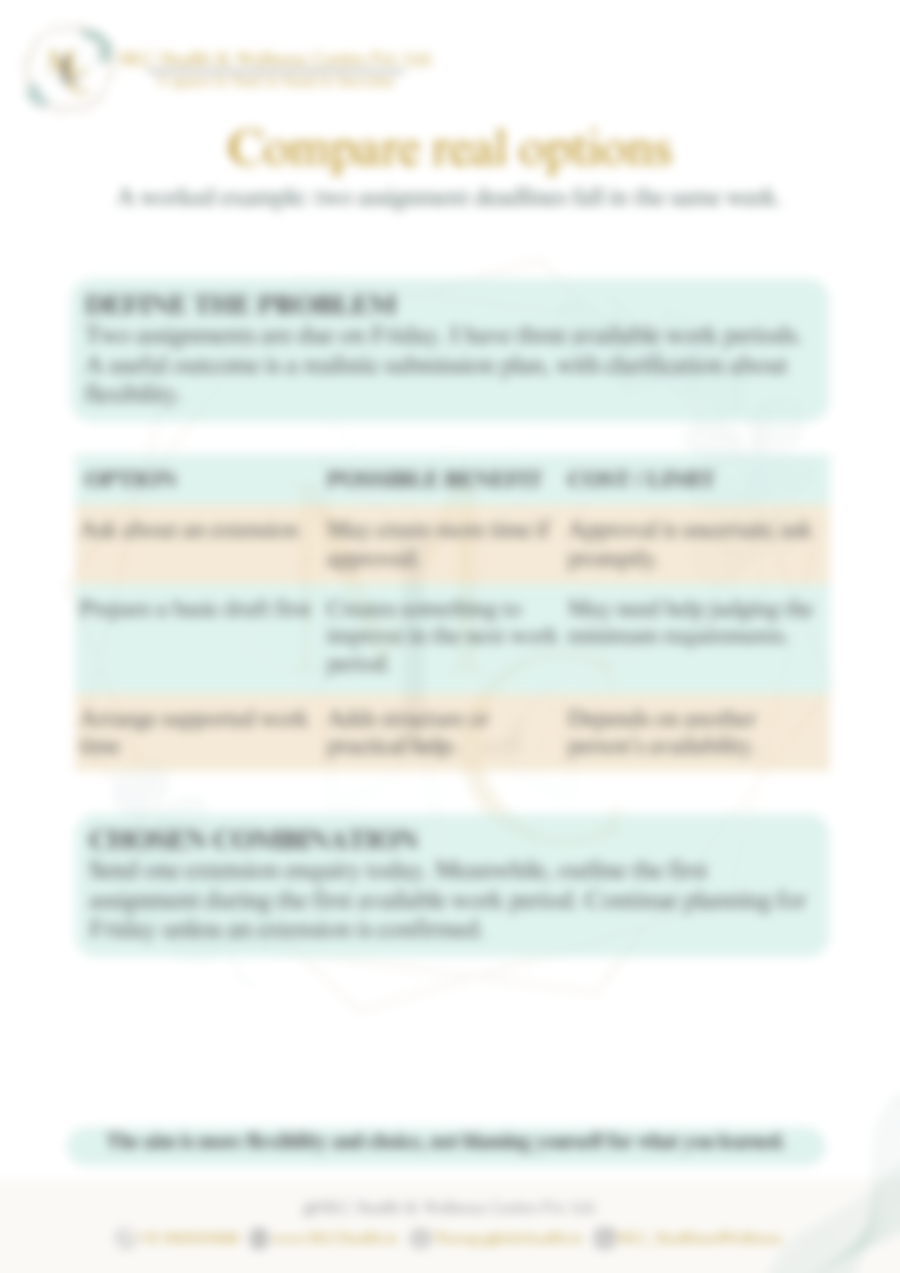
The second page, Compare real options, is a worked example about two assignment deadlines in the same week.
- The problem and a useful outcome.
- Three possible options, each with a possible benefit and a cost or limit.
- A chosen combination of actions.
- The line “The aim is more flexibility and choice, not blaming yourself for what you learned.”
Page 3: Compare your own options
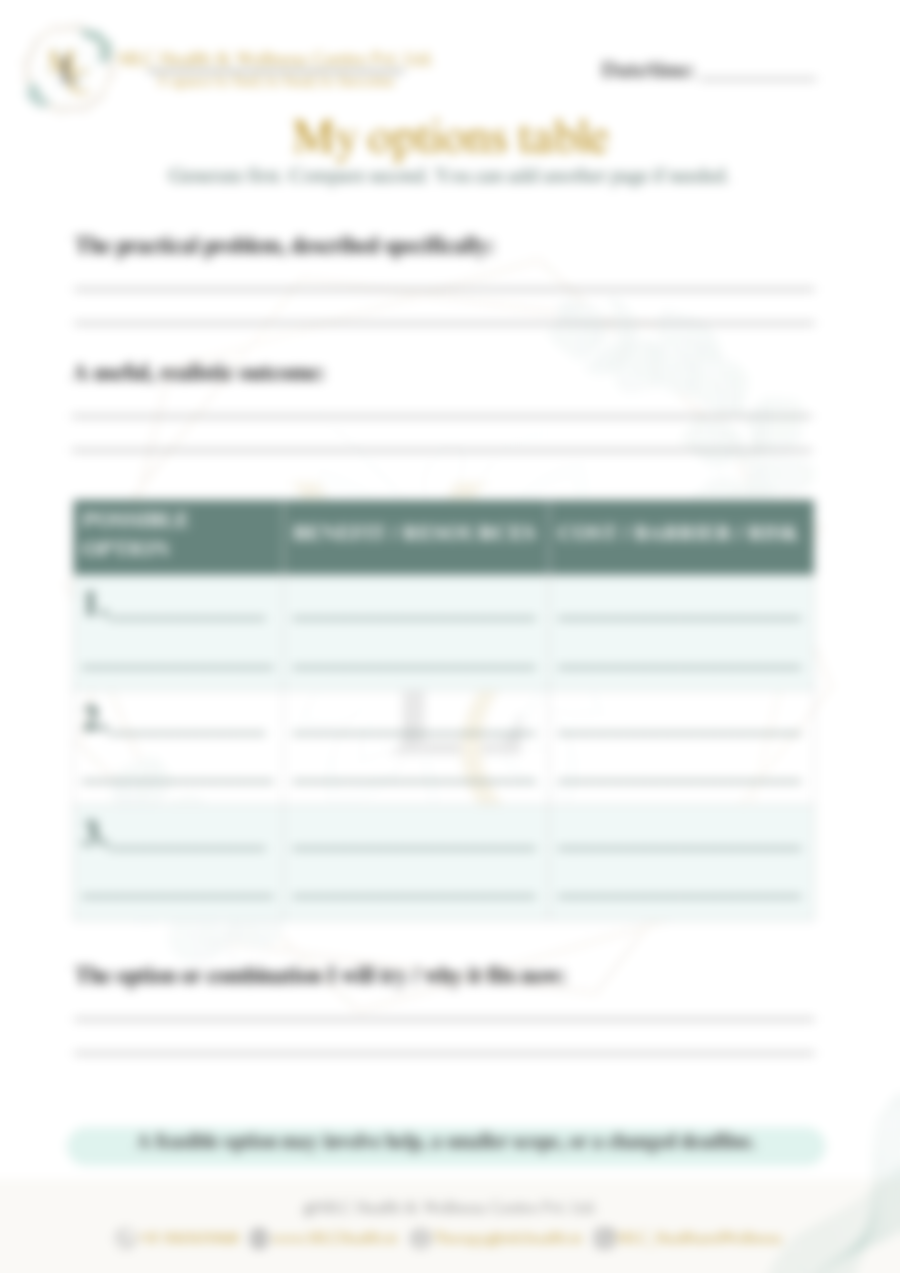
The third page, My options table, has the line “Generate first. Compare second. You can add another page if needed.”, a date and time field, and these areas:
- The practical problem, described specifically.
- A useful, realistic outcome.
- A table with three option rows and three columns: possible option, benefit or resources, and cost, barrier or risk.
- The option or combination I will try, and why it fits now.
Page 4: Plan and review
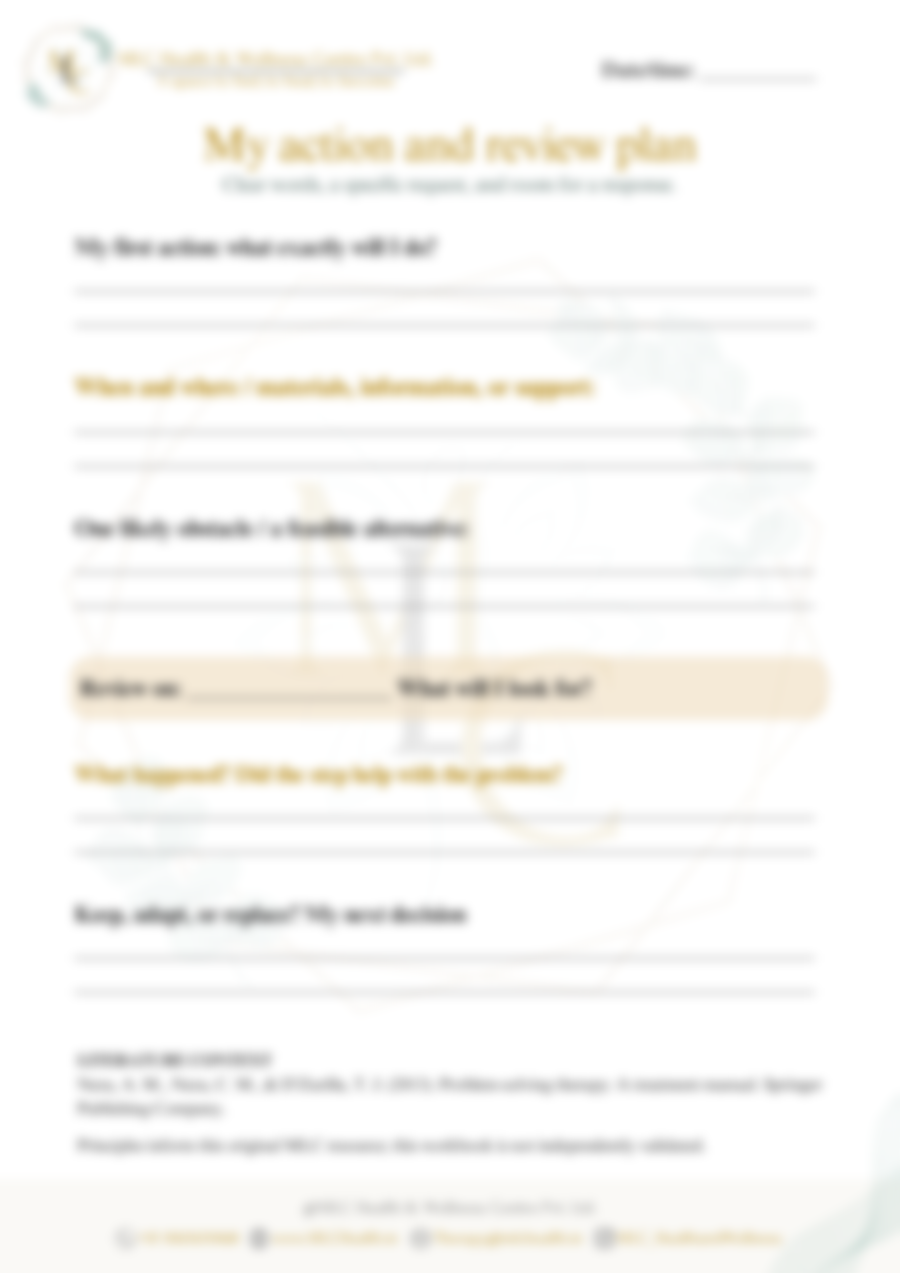
The fourth page, My action and review plan, has a date and time field and six writing areas:
- My first action: what exactly will I do?
- When and where, and the materials, information, or support needed.
- One likely obstacle and a feasible alternative.
- A review date, and what I will look for.
- What happened, and did the step help with the problem?
- Keep, adapt, or replace: my next decision.
What it does not include
The three option rows are writing spaces, not a requirement to invent exactly three solutions. You can use fewer, or add another page of your own. The PDF has no scoring system, no daily planner and no automated decision tool. Page 4 also carries a literature-context line naming Nezu, Nezu and D’Zurilla, with a note that the workbook is not independently validated. Its subtitle line belongs to a different MLC resource and is not part of this worksheet’s explanation.
Step one: define a specific problem and a useful outcome
Define the problem as specifically as you can. A broad judgement is hard to plan around, while a specific description gives you something to work with. Some prompts that can help:
- What is happening?
- What part needs attention?
- What constraints matter?
- What would count as a useful improvement?
- What information is missing?
| Broad judgement | Specific problem |
|---|---|
| “I cannot manage anything.” | “Two assignments are due on Friday, and I have three available work periods.” |
A useful outcome describes what you hope to achieve in realistic terms. For example: “A submission plan that fits my available time, with clarification about whether either deadline is flexible.”
You do not need a perfect definition before you move on. A first attempt is enough, and you can refine it as you learn more.
Step two: expand the options before judging them
The purpose of this step is to consider more than the first or most familiar response. The PDF says to generate a few options before evaluating them, and to include help or changing the scope. Possible options may include:
- Asking for clarification.
- Seeking practical help.
- Changing the order of tasks.
- Reducing the scope where appropriate.
- Requesting a different deadline.
- Combining two approaches.
- Gathering necessary information before deciding.
Keep brainstorming separate from evaluation at first. An option can be considered without becoming a commitment.
Not every option will be safe, available, or equally useful, and that is what the next step is for.
If you can identify only one option, you can talk it over with a practitioner or another appropriate source of support rather than forcing a longer list.
Step three: compare benefits, resources, costs, and risks
Page 3 gives each option a row and three columns:
| Column | What to write |
|---|---|
| Possible option | What would this response involve? |
| Benefit / resources | What might it help with, and what support or resources are available or needed? |
| Cost / barrier / risk | What effort, limitations, consequences, or uncertainty should be considered? |
Benefits are possibilities, not guarantees. Consider time, energy, money, accessibility, responsibilities, permissions, and other people’s availability.
There is no scoring. The option with the most written benefits does not automatically win. The aim is to choose something workable in the current circumstances, and a combination of options is welcome. Then write which option or combination you will try, and why it fits now.
A completed example matching the PDF
Worked example from the resource. It follows page 2 of the PDF. It is an illustration, not a real person’s account or a promise that others will respond similarly.
The problem: “Two assignments are due on Friday. I have three available work periods.”
A useful outcome: “A realistic submission plan, with clarification about flexibility.”
| Option | Possible benefit | Cost or limit |
|---|---|---|
| Ask about an extension | May create more time if approved. | Approval is uncertain; ask promptly. |
| Prepare a basic draft first | Creates something to improve during the next work period. | May need help judging the minimum requirements. |
| Arrange supported work time | Adds structure or practical help. | Depends on another person’s availability. |
Chosen combination: “Send one extension enquiry today. Meanwhile, outline the first assignment during the first available work period. Continue planning for Friday unless an extension is confirmed.”
The plan combines options and does not assume the request will be approved. A basic draft is a starting point for further work. It is not an instruction to ignore academic requirements.
Step four: choose a first action and make it concrete
A first action is something you can actually do. “Get organised” is vague. “Open the assignment instructions and list the required sections” is specific. Page 4 asks you to work through these prompts:
- Write the first action: what exactly will I do?
- Say when and where you will do it.
- List the materials or information you need.
- Note any practical support that would help.
- Name one likely obstacle and a feasible alternative.
- Set a review date and what you will look for.
A small step should still serve the outcome you chose. It does not need to solve the whole problem. Writing a plan does not ensure it will be completed, and you can change it as you learn more.
Planning for one obstacle without planning for everything
The workbook asks for one likely obstacle, not an exhaustive forecast of every difficulty. For example:
- Planned action: work on an outline after dinner.
- Likely obstacle: the home environment may be noisy.
- Alternative: use another available space, or complete a shorter preparation step and schedule the writing period elsewhere.
The alternative needs to fit your actual resources. Do not assume access to private space, money, flexible hours, or another person’s help.
Helpful contingency planning prepares for one realistic problem. Repeatedly elaborating hypothetical problems is different, and it can become another form of worry. If that happens, Worry Management is an MLC companion. You can revise the plan whenever new information arrives.
Step five: review what happened
On the review date, look back at what you planned and what happened. Questions that may help:
- Did I take the planned step?
- What happened?
- Did it help with the practical problem?
- What was easier or harder than expected?
- Did a constraint change?
- What information did I gain?
- Should I keep, adapt, or replace the plan?
If the action did not happen, explore what made it difficult rather than reading it as failure. An unsuccessful attempt still gives information, and a successful step does not mean the whole problem is resolved.
The workbook has no numerical success score. It frames the review as learning, in line with the page 1 line about working on a situation, not a verdict about your worth or ability.
If the next step is to set a larger target, the SMART Goals worksheet is an MLC companion. If starting a task is the main difficulty, see ADHD Task Planning, which focuses on making a first action visible and is not specific to any one diagnosis.
Guidance for therapists, adaptations, and limits
For therapists and counsellors, some practical suggestions:
- Start with a problem the client agrees is relevant.
- Validate the emotional experience before moving into planning.
- Separate practical difficulties from self-critical conclusions.
- Check which aspects are actually within the client’s influence.
- Explore options collaboratively rather than supplying the “correct” answer.
- Consider access, resources, capacity, and responsibilities.
- Help make the first step observable.
- Review learning rather than compliance.
- Recognise when support, advocacy, or another intervention is more appropriate.
In Indian and other contexts, examples may include examination demands, workplace hierarchy, caregiving, financial constraints, shared housing, and family responsibilities. These are possibilities, not stereotypes. Systemic barriers are not individual planning failures.
If the difficulty is how to ask for something, Assertive Communication is a separate MLC resource for preparing a message. This worksheet is not a communication tool.
Do not use the workbook alone to decide medical, legal, financial, or immediate safety matters that need appropriate expertise.
This is an educational planning resource. It is not a diagnostic assessment, a complete course of problem-solving therapy, or a replacement for individual assessment and support.
Frequently asked questions
Created by MLC and supporting references
Created by MLC Health & Wellness Centre Pvt. Ltd. The explanations, examples, design, and practice prompts were developed by MLC, informed by established psychological literature. Supporting references are provided below.
The references below support the broader problem-solving principles informing this resource. They do not identify external authors as creators of the MLC workbook, imply endorsement, or establish that this specific four-page resource has been independently tested or validated. The PDF itself names Nezu, Nezu and D’Zurilla. The meta-analysis is added here as broader context and is not printed in the PDF.
- Nezu, A. M., Nezu, C. M., & D’Zurilla, T. J. (2013). Problem-solving therapy: A treatment manual. Springer Publishing Company. https://www.springerpub.com/problem-solving-therapy-9780826109408.html Relevance: an established clinical manual describing problem-solving therapy and structured approaches to practical difficulties. It supports the broader principles rather than validating MLC’s exact five headings, examples, or worksheets.
- Malouff, J. M., Thorsteinsson, E. B., & Schutte, N. S. (2007). The efficacy of problem solving therapy in reducing mental and physical health problems: A meta-analysis. Clinical Psychology Review, 27(1), 46–57. https://doi.org/10.1016/j.cpr.2005.12.005 Relevance: a peer-reviewed synthesis of research on problem-solving therapy. It does not test this MLC workbook or establish that completing a brief planning sheet reproduces the outcomes of the interventions studied.
Platform disclaimer: this is a reflection and planning tool. It is not a diagnostic instrument or a substitute for therapy. If you are in distress, call Tele-MANAS at 14416.