
Inside the worksheet
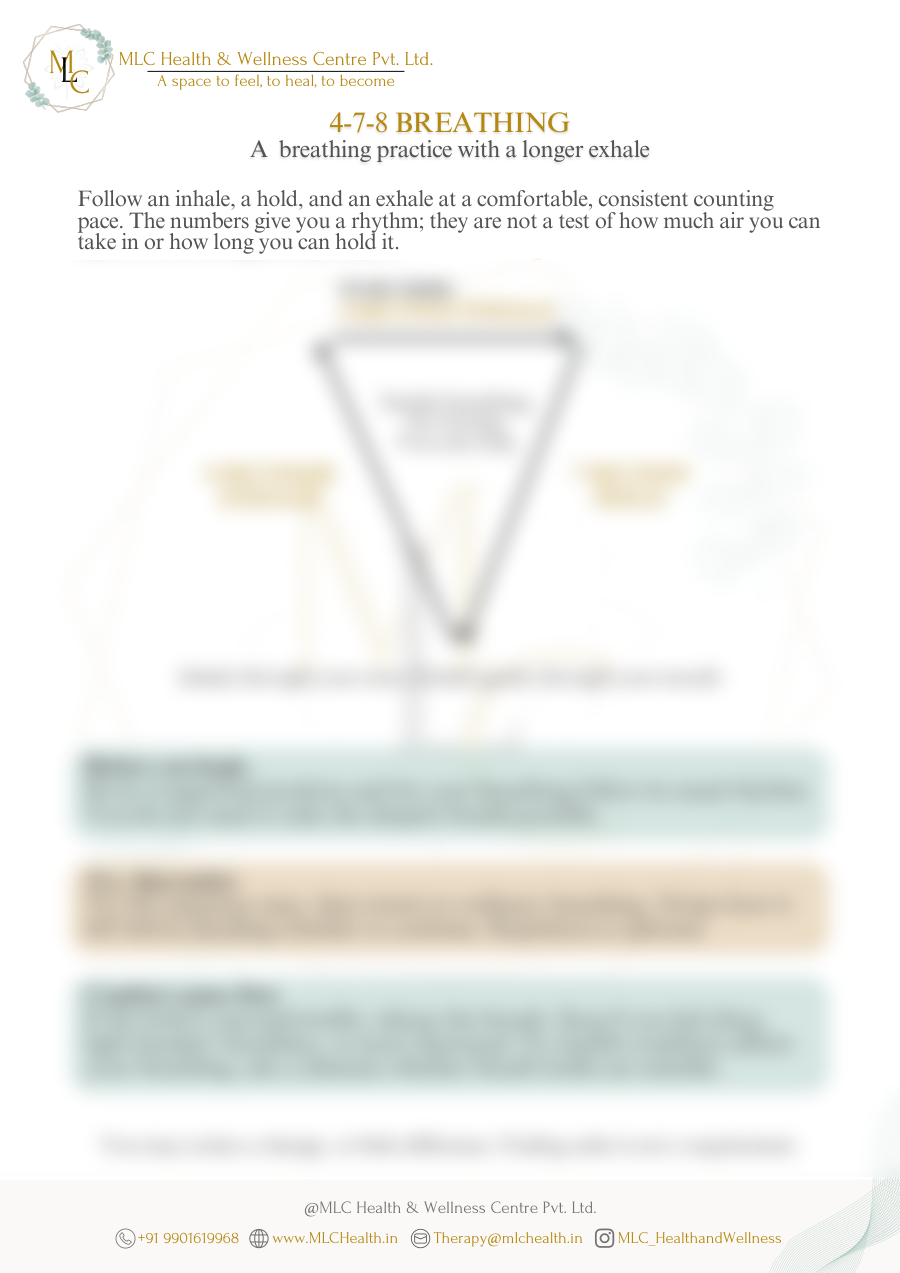

Unlocks after purchase
What is 4–7–8 breathing?
4–7–8 breathing is a deliberately paced sequence with three stages: breathing in for four counts, holding for seven counts, and breathing out for eight counts.
The name describes the relative lengths of the stages. The exhale is longer than the inhale, and the sequence includes a pause after breathing in.
In MLC’s resource, a triangular diagram shows the order. Follow the top arrow for the inhale, the right-hand arrow for the hold, and the left-hand arrow for the exhale.
The numbers provide structure. They are not a test of how much air you can take in or how long you can tolerate a hold.
What is this resource intended to help you practise?
These are the resource’s functions. They are not promised improvements in emotional regulation, attention, or health.
Following a simple sequence
The diagram gives you a clear order to follow without having to remember several unrelated instructions.
Noticing your experience
The resource asks you to observe whether the breathing feels comfortable, awkward, effortful, or mixed.
Making an informed choice
The reflection page helps you decide whether to use the practice again, seek guidance, or choose another tool.
What is included in the PDF?
Page 1: Practice guide
The first page contains:
- A brief explanation.
- A triangle showing the inhale, hold, and exhale.
- A reminder to breathe gently, avoid forcing, and stop if needed.
- Preparation guidance.
- Instructions to try the sequence once and return to ordinary breathing.
- Specific comfort guidance.
Page 2: Optional reflection
The second page includes:
- Date/time.
- Cycles tried.
- What was happening before the practice.
- What was noticed before starting.
- One overall comfort choice: comfortable, uncomfortable, or unsure/mixed.
- Anything noticed while breathing.
- Observations after returning to normal breathing.
- Whether to use the practice again, adapt it, or choose another tool.
- One chosen next step.
What it does not include
There are no separate phase-rating tables, numerical symptom scales, or daily trackers. The PDF is printable, with writing spaces and tick boxes, and has no embedded form fields.
When might you choose to use it?
Ordinary moments where a short, structured practice might fit:
- During a pause between demanding tasks.
- Before responding to a message that brought up a strong reaction.
- While exploring coping options with a therapist.
- At a quiet moment when learning the sequence.
A breathing practice does not resolve the situation that prompted it. You may still need rest, support, problem-solving, or a conversation.
It is an option, not a required response to distress, and not everyone will want a practice that includes a breath hold.
How to use the practice page
- Sit in a supported position.
- Allow your breathing to follow its usual rhythm before beginning.
- Breathe in gently through the nose for four counts.
- Hold for seven counts, only while this is comfortable.
- Breathe out gently through the mouth for eight counts.
- Return to ordinary breathing.
- Notice how the sequence felt before deciding whether to continue.
Use a consistent counting pace. You do not need to take a maximal breath, brace your body, or force out every last bit of air.
The PDF suggests trying the sequence once. That is an introductory instruction, not a scientifically established minimum effective dose, and repeating it is optional.
Understanding the count and the hold
The sequence is defined by its 4–7–8 pattern, but comfort takes priority over completing the numbers.
If the hold becomes uncomfortable, release the breath rather than waiting until the count is finished.
There is no need to rush the counting to get through a difficult hold, repeatedly restart, or compensate by taking a larger breath.
If you prefer breathing without holds, you can choose a different practice. Removing the hold changes the sequence; it does not represent failure.
The seven-count hold is part of this pattern, not a requirement for achieving any particular benefit.
What might you notice?
You might notice any of these. They are possible observations, not promised effects.
- The rhythm of counting.
- The unfamiliarity of the hold.
- A change in subjective tension.
- Distraction.
- Little difference.
It helps to separate description from interpretation:
A description of experience
“The hold felt effortful.”
A subjective response
“I felt a little more settled.”
A physiological claim the worksheet cannot establish
“My nervous system has reset.”
No checking required
The exercise does not require pulse checking, oxygen monitoring, or searching for evidence that it worked.
Comfort and choosing an alternative
The PDF asks you to stop if you feel dizzy, light-headed, breathless, or more distressed, and to return to ordinary breathing. Please do not push through these experiences.
If a health condition affects your breathing, the PDF recommends asking a clinician whether breath holds are suitable.
If focusing on your breathing is uncomfortable, you may choose an activity that directs your attention elsewhere, such as looking around the room or noticing an object.
An uncomfortable experience does not mean the practice is releasing emotions or working especially well. It is a sign to adjust or stop.
How to complete the reflection worksheet
Short phrases are enough, and you can leave any field blank.
The worksheet is a personal reflection, not a diagnostic assessment or validated outcome measure.
Date/time and cycles tried
Record what actually happened. The number of cycles is not a performance target.
What was happening before I started the practice?
Describe the situation, such as finishing a task or preparing for a conversation.
Before starting, I noticed
Record thoughts, emotions, or sensations present beforehand.
How did the practice feel?
Choose comfortable, uncomfortable, or unsure/mixed. This concerns the overall experience of practising.
Anything I noticed while breathing
Describe details such as effort, ease, distraction, or the experience of the hold.
After returning to normal breathing, I noticed
Record the experience after the deliberate sequence has ended.
Would I use this again, adapt it, or choose another tool?
Consider suitability. An adaptation might concern position or receiving guidance; it does not need to involve stronger or longer breathing.
One next step I choose
Identify a manageable action relevant to the situation.
A completed example
This is an illustrative example, not a real client account or an expected result.
- Date/time: Monday, 5:00 p.m.
- Cycles tried: 1.
- What was happening before I started the practice? “I had finished work but was still thinking about an unfinished task.”
- Before starting, I noticed: “I felt restless and kept planning what to do next.”
- How did the practice feel? “Unsure/mixed.”
- Anything I noticed while breathing: “The counting was straightforward, but the hold felt less comfortable, so I released the breath early.”
- After returning to normal breathing, I noticed: “I was still thinking about the task. I was more certain that I preferred not to hold my breath.”
- Would I use this again, adapt it, or choose another tool? “I would choose a practice without holds and discuss the options with my therapist.”
- One next step I choose: “I will write down the unfinished task so I can return to it tomorrow.”
This example records a useful decision without requiring a calming effect or perfect completion.
Common questions and misunderstandings
Do I have to complete every count?
No. Release the breath if the hold is uncomfortable.
Do I need a very deep inhale?
No. The PDF explicitly says that the deepest possible breath is unnecessary.
How many times must I repeat it?
The PDF suggests trying the sequence once and makes repetition optional. There is no compulsory target.
What if I lose count?
Return to ordinary breathing. You can decide whether to try again; restarting is not required.
What if I feel no different?
That is a valid observation. The worksheet does not require improvement.
Is this a proven way to fall asleep quickly?
The reference supplied for this page does not establish that claim, so no particular sleep outcome is promised.
Guidance for therapists
Ways to introduce this resource in a session:
Completing the count is not a measure of engagement or therapeutic progress.
Introduce the exercise collaboratively
Explain the sequence and ask whether the person wants to try a practice containing a hold.
Demonstrate gently
Avoid modelling exaggerated inhalation, bracing, or forceful exhalation.
Agree that stopping is allowed
The person can release the breath before the count ends.
Use the PDF’s endpoint
Return to ordinary breathing and check the experience before considering repetition.
Ask neutral questions
“How did that feel?” allows more useful feedback than “Do you feel calmer now?”
Use the reflection selectively
The person may write, discuss observations, or leave fields blank.
Connect the practice to the broader task
Any pause can be followed by problem-solving, communication, rest, or another chosen action.
About this resource
Created by MLC Health & Wellness Centre Pvt. Ltd. The explanations, examples, design, and practice prompts were developed by MLC, informed by established psychological literature. Supporting references are provided below.
The supporting reference does not imply that its authors created, reviewed, endorsed, or validated this MLC resource.
What does the evidence support?
Vierra, Boonla, and Prasertsri (2022) examined 43 healthy adults aged 19–25, grouped according to sleep deprivation status. Both groups completed three sets of six 4–7–8 cycles, with ordinary-breathing breaks. The study reported immediate changes in cardiovascular measures, including reduced heart rate and systolic blood pressure.
The comparison was between sleep-deprived and non-sleep-deprived participants; there was no separate group that omitted the breathing exercise. This limits causal conclusions. The study did not establish treatment effects for insomnia or anxiety disorders, nor did it validate this MLC worksheet or its single-cycle introduction.
This resource presents a practice to explore, informed by a relevant physiological study. It should not be advertised as a clinically validated treatment.
Frequently asked questions
Supporting reference
This reference supports the background discussion. It does not imply that its authors created, reviewed, endorsed, or validated this MLC resource.
- Vierra, J., Boonla, O., & Prasertsri, P. (2022). Effects of sleep deprivation and 4–7–8 breathing control on heart rate variability, blood pressure, blood glucose, and endothelial function in healthy young adults. Physiological Reports, 10(13), e15389. https://doi.org/10.14814/phy2.15389 Relevance: Direct research on the 4–7–8 breathing pattern and immediate physiological measurements. It does not validate MLC’s resource or establish broad clinical benefits.
Platform disclaimer: this is a reflection and planning tool. It is not a diagnostic instrument or a substitute for therapy. If you are in distress, call Tele-MANAS at 14416.
More worksheets from MLC
3-Minute Mindful Breathing
A brief pause to notice, return, and reconnect
5–4–3–2–1 Grounding
Notice your surroundings through your senses
ADHD Task Planning Worksheet
Make the next action visible
Assertive Communication Worksheet
Clear words, a specific request, and room for a response
Browse all therapist tools