
Inside the worksheet
Unlocks after purchase
What is 5–4–3–2–1 grounding?
This exercise gives you a sequence for noticing sensory information in the present moment:
- Five things you can see.
- Four points of contact or textures you can feel.
- Three sounds you can hear.
- Up to two scents you can smell.
- One taste already present, if any.
The numbers give the practice a memorable structure. They are not a requirement to produce fifteen distinct observations.
You can describe what you notice silently, aloud, or afterwards on the worksheet.
Grounding here means directing attention towards immediate experience. It does not mean forcing yourself to feel calm or proving that everything is okay.
What is this resource intended to help you practise?
These are the exercise’s intended functions. One use is not claimed to produce lasting improvements in attention or emotional regulation.
Noticing concrete details
Instead of only thinking “there is a chair,” you might notice its curved armrest, smooth surface, or the contact beneath your legs.
Directing attention deliberately
The sequence gives you something specific to explore when your attention feels absorbed in thoughts or emotions.
Choosing what comes next
The final prompt invites a practical action, such as continuing a task, taking a break, or seeking support.
What is included in the PDF?
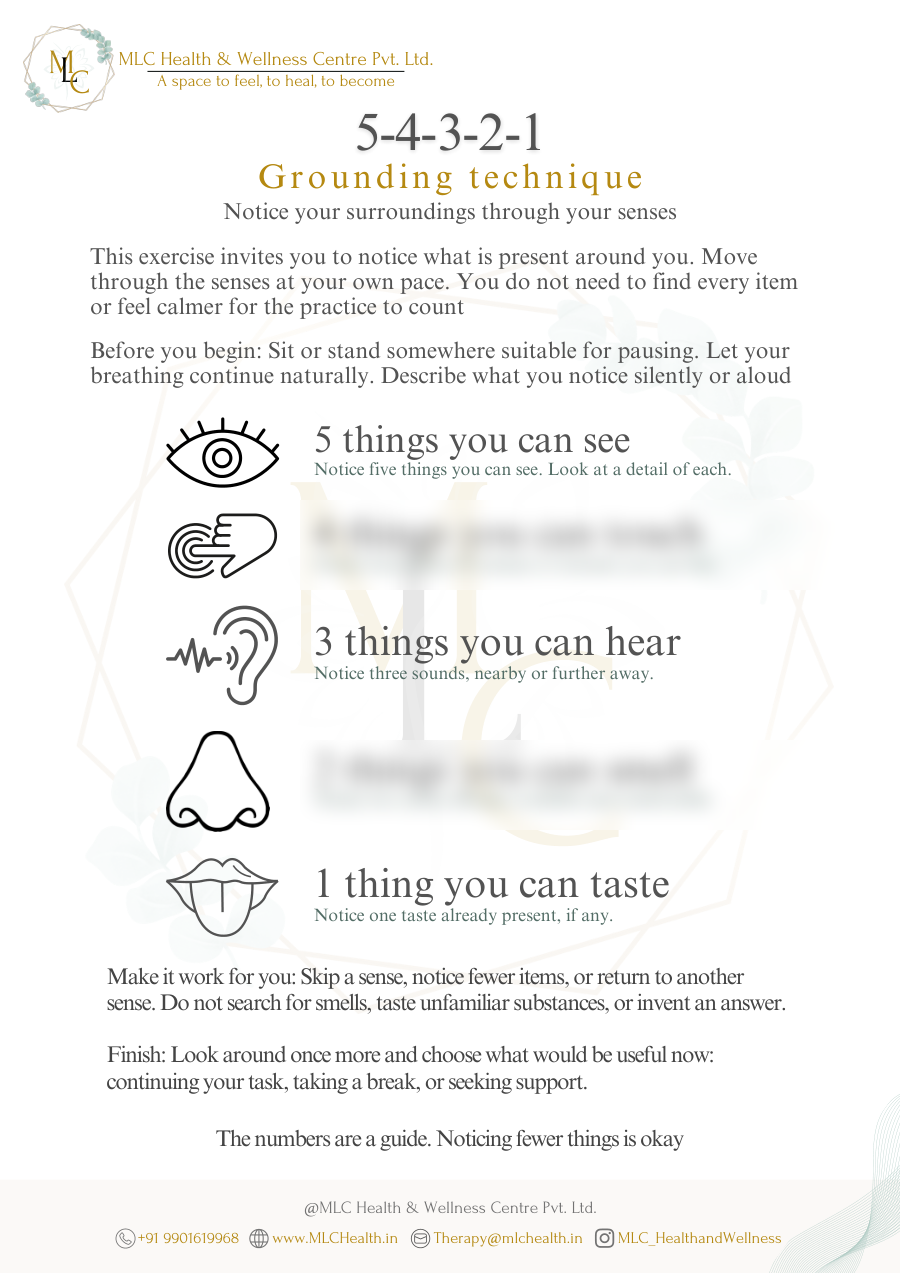
Page 1: Illustrated guide
The guide includes:
- A short explanation.
- Preparation instructions.
- Five sensory stages with corresponding icons.
- Permission to skip senses or notice fewer items.
- Guidance not to search for smells, taste unfamiliar substances, or invent answers.
- A closing invitation to choose a next step.
Page 2: Practice worksheet
The worksheet contains:
- Date/time.
- “Before starting, I noticed.”
- Five spaces for things seen.
- Four spaces for things felt.
- Three spaces for sounds heard.
- Two spaces for scents, if any.
- One space for a taste, if any.
- “After the practice, I noticed.”
- “One next step I choose.”
What it does not include
There is no symptom-rating scale, comfort checklist, trigger field, or daily tracker. The PDF is printable, with writing spaces only, and has no embedded form fields.
When might you choose to use it?
Concrete moments where a sensory pause might fit:
- Between demanding tasks, when you want a deliberate pause.
- After becoming absorbed in a stream of worrying thoughts.
- Before returning attention to a conversation or activity.
- During a therapy session, when you and your therapist agree to explore sensory grounding.
- At an ordinary moment, to become familiar with the instructions.
The practice does not solve the underlying situation. A deadline may still require planning, and a difficult interaction may still require communication or boundaries.
It is an optional way to pause and orient before deciding what would help.
How to begin
Choose somewhere suitable for pausing, either seated or standing.
Let your breathing continue naturally. The PDF does not ask for a deep breath, a breath hold, or a counted breathing pattern.
Look around if that is comfortable. Describe what is actually available rather than trying to find impressive or meaningful objects.
Use a few ordinary words: “blue folder,” “cool tabletop,” or “traffic outside.”
You can use the guide without writing. The reflection page can be completed afterwards, partly completed, or left unused.
As a practical planning estimate, a brief exploration might take about 3–5 minutes, with optional writing afterwards. The PDF does not prescribe a duration and research has not established one, so use less or more time as you choose.
Moving through the five senses
The examples below are illustrations, not sensations you should expect to find.
- See: notice five things and a detail of each, such as colour, shape, position, or light. For example, the curved handle of a mug or a shadow on the wall.
- Feel: notice four points of contact or textures. Existing contact counts: a sleeve against your arm, your feet inside your shoes, or the chair beneath you. You do not need to touch four separate objects.
- Hear: notice three sounds, nearby or further away. You do not need to identify the source with certainty; “a low hum” is a sufficient description.
- Smell: notice up to two scents already available and comfortable. Do not search for stronger smells or bring substances close to your face to complete the exercise.
- Taste: notice a taste already present, if any. There is no requirement to eat or drink anything.
Finish by looking around once more and choosing what would be useful now: continuing your task, taking a break, or seeking support.
What if a sense is unavailable or uncomfortable?
The PDF allows you to skip a sense, notice fewer items, or return to another sense. If you cannot access a particular sense, use the information available to you. The sequence should adapt to the person.
These are practical adaptations the resource permits; they have not each been separately tested.
- If no scent is apparent, leave the scent spaces blank.
- If a sound is unpleasant, choose a different available sound or move to another sense.
- If tactile attention is uncomfortable, focus on visual details instead.
- If the numbered sequence feels demanding, notice one or two details and stop.
What might you notice, and what counts as useful?
You might notice details you had overlooked, become more aware of the room, remain distracted, feel somewhat more settled, or experience little change. These are examples, not promised outcomes.
You do not need to suppress thoughts or emotions. If your attention wanders, return to an available sensory detail; there is no need to restart.
Feeling calmer is not the only possible result. A useful observation might be identifying a preferred sense, deciding the exercise does not suit you, or recognising that you need a break.
You do not need to continue until distress disappears, and completing the sequence is not proof that the practice worked.
How to use the worksheet
A few words are enough, and blank spaces are permitted.
The worksheet is a personal record, not a diagnostic assessment, symptom scale, or validated treatment-outcome measure.
Date/time
Record the context if it is useful.
Before starting, I noticed
Describe thoughts, emotions, sensations, or attention before beginning. There is no required kind of answer.
The sensory spaces
Use short descriptions in the five seen, four felt, three heard, two scent and one taste spaces. You do not need to fill them all.
After the practice, I noticed
Describe what is present afterwards. Improvement and comparison scores are not required.
One next step I choose
Identify an action suited to the situation, such as continuing, slowing down, taking a break, or asking for help.
A completed example
This is an illustrative example, not a real client account or an expected result.
- Date/time: Tuesday, 4:15 p.m.
- Before starting, I noticed: “I was thinking about several unfinished tasks and finding it difficult to choose where to begin.”
- Five things I could see: 1. A blue notebook. 2. A curved mug handle. 3. Light on the wall. 4. The edge of the desk. 5. A green leaf by the window.
- Four things I could feel: 1. My feet inside my shoes. 2. The chair beneath my legs. 3. My sleeve against my arm. 4. The smooth desk under my hand.
- Three things I could hear: 1. A fan. 2. Traffic outside. 3. A door closing.
- Two scents I noticed, if any: 1. Soap on my hands. 2. Left blank.
- One taste I noticed, if any: “Nothing clear.”
- After the practice, I noticed: “The tasks were still on my mind. I could also notice the room and the support of the chair.”
- One next step I choose: “I will choose one task and write down its first step.”
The blank scent entry and unclear taste are intentional. The example does not need to fulfil every number.
Common difficulties and practical responses
If the practice becomes more distressing or disorienting, stop and choose an alternative or seek support. Increased distress is not a sign that it is working.
“I cannot find enough items.”
Use fewer. Do not invent an observation.
“I keep thinking about the problem.”
You can notice that and return to one detail. The exercise does not require thoughts to disappear.
“Counting makes it feel like a test.”
Focus on one or two accessible observations, or stop.
“One of the sensations is unpleasant.”
Move to another sense or choose a different activity. Do not force attention to remain on it.
“Writing interrupts the practice.”
Notice first and write afterwards, or skip the writing.
“I feel no calmer.”
Record that if it is useful. Repetition is not required.
Guidance for therapists
Ways to introduce this resource in a session:
The worksheet can support discussion, but it should not be used as a measure of compliance or treatment success.
Agree on the purpose
Introduce the exercise as an opportunity to notice the present surroundings, not a test of whether someone can calm down.
Check accessibility and preferences
Ask about senses or stimuli the person would prefer not to use.
Offer choices
The person can describe silently, aloud, or in writing and can skip stages.
Keep prompts concrete
“What colour is that object?” may be easier to answer than repeatedly asking whether the person feels grounded.
Avoid performance pressure
Do not insist on completing every number.
Debrief neutrally
Ask “What did you notice?” or “Would you change anything?” rather than “Did that calm you down?”
Choose the next step collaboratively
The person may continue an activity, take a break, or identify another need.
About this resource
Created by MLC Health & Wellness Centre Pvt. Ltd. The explanations, examples, design, and practice prompts were developed by MLC, informed by established psychological literature. Supporting references are provided below.
The supporting reference concerns the broader grounding approach. It does not imply that the cited author created, reviewed, endorsed, or validated this MLC resource.
What is the evidence basis?
Grounding is discussed in established clinical literature as a coping approach. Najavits’s Seeking Safety includes a dedicated chapter on grounding within a broader treatment manual.
This provides a relevant clinical foundation for discussing grounding. It does not, by itself, establish the effectiveness of this exact 5–4–3–2–1 sequence, prove a specific brain mechanism, or validate MLC’s worksheet.
This resource is informed by established grounding literature. Evidence for a complete treatment programme is not evidence that this brief exercise produces the same outcomes, and the absence of direct validation does not mean the practice cannot be helpful.
Frequently asked questions
Supporting reference
This reference concerns the broader grounding approach. It does not imply that the cited author created, reviewed, endorsed, or validated this MLC resource.
- Najavits, L. M. (2002). Seeking safety: A treatment manual for PTSD and substance abuse. Guilford Press. https://www.guilford.com/books/Seeking-Safety/Lisa-Najavits/9781572306394/contents Relevance: An established clinical manual containing a grounding chapter. It supports the broader clinical background, not validation of this exact numbered exercise.
Platform disclaimer: this is a reflection and planning tool. It is not a diagnostic instrument or a substitute for therapy. If you are in distress, call Tele-MANAS at 14416.