
Inside the worksheet
Unlocks after purchase
Unlocks after purchase
Unlocks after purchase
What is worry management?
Worry management involves noticing what a worry is asking of you and choosing a response that fits the situation, whether that means practical action, planning, or leaving some uncertainty unresolved.
This resource does not ask you to eliminate every worry, to feel positive, or to guarantee a favourable outcome. Its purpose is narrower and more realistic: to support a useful decision about what deserves your attention next.
If you would like to see how thoughts, feelings and actions connect first, The CBT Model is a companion MLC guide.
How is worry different from practical planning?
The difference lies in the purpose of the activity and what it produces. Practical planning identifies a problem, considers relevant information, and develops a feasible next step. Worry can involve repeatedly imagining what might go wrong without producing new information or a workable decision.
| Kind of thinking | Example |
|---|---|
| Planning | “The application closes on Friday. I will request the missing document today.” |
| Repeated worry | “What if something is still wrong? What if I am rejected? What if I have missed something?” |
This does not mean that all future-focused thinking is unhelpful, or that you should never review a decision. One worry can contain both a practical issue and an uncertain prediction, which is why the resource begins by separating them.
When might this resource be useful?
It can help when a worry keeps returning and you are not sure what, if anything, to do about it. Situations where people often find it useful include:
- Waiting for an application or examination result.
- Thinking repeatedly about whether a task was completed correctly.
- Preparing for an uncertain work or study situation.
- Revisiting the same unanswered question.
- Struggling to decide whether another check would be useful.
- Finding it difficult to return to an activity after making a plan.
Begin with one manageable concern rather than your biggest one. The list above describes possible contexts of use, not established treatment indications.
The worksheet should not be used to tell anyone to disregard a genuine danger, a required safety check, a medical recommendation, or a significant practical decision.
Who is it for?
It is written for adults and older adolescents who find reflective writing or discussion useful, and for therapists and counsellors working collaboratively with clients. The age range is a practical suggestion, not a validated one.
You do not need a diagnosis to use it, and it cannot determine whether you have generalised anxiety disorder, OCD, health anxiety, or any other condition. The prompts can be discussed aloud or completed in short phrases, with support where useful.
Allow approximately 15 to 20 minutes for the guide and an initial response plan, with an optional review later. This is a practical estimate, not a research-established duration.
Persistent worry that substantially affects everyday functioning may need individual assessment and treatment beyond this resource.
What is included in the four-page PDF?
The PDF has four A4 pages: a guide, a worked example, and two practice pages. It is designed to be printed and written on. It has no scores, no anxiety ratings, no fillable form fields, no scheduled worry-time exercise, and no multi-day tracking diary.
Page 1: Understand the choices
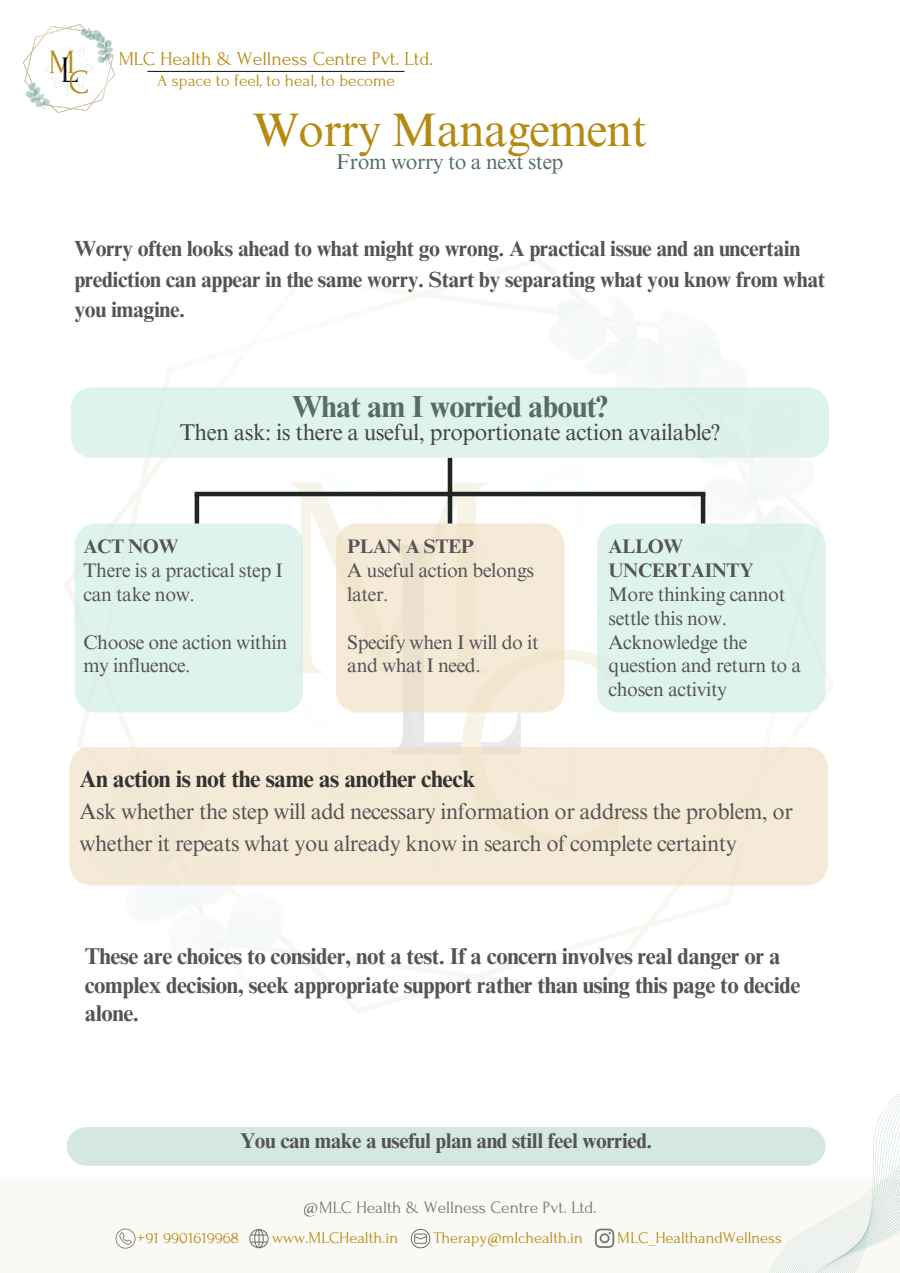
The first page, titled Worry Management, has the subtitle “From worry to a next step.”
- An explanation that worry looks ahead to what might go wrong, that a practical issue and an uncertain prediction can appear in the same worry, and that it helps to separate what you know from what you imagine.
- A three-option decision map starting from “What am I worried about?”: Act now, Plan a step, and Allow uncertainty.
- A note that an action is not the same as another check, with a question about whether a step adds necessary information or repeats what you already know in search of complete certainty.
- A reminder that these are choices to consider, not a test, and that real danger or a complex decision calls for appropriate support.
- The closing line “You can make a useful plan and still feel worried.”
Page 2: See a worked example
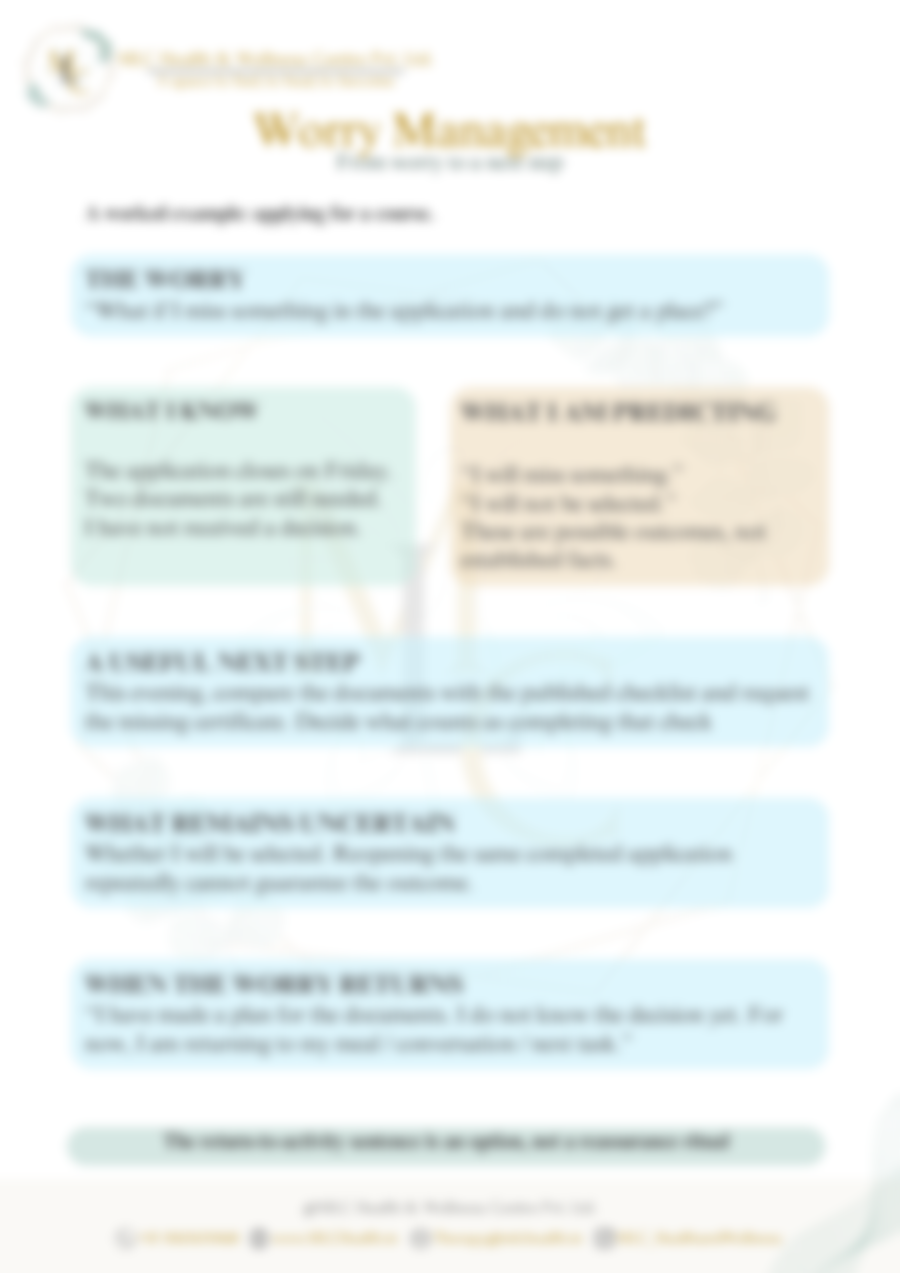
The second page follows a worked example about applying for a course.
- The worry, what I know, and what I am predicting, with a note that these are possible outcomes, not established facts.
- A useful next step, and what remains uncertain.
- A possible response when the worry returns, with a note that the return-to-activity sentence is an option, not a reassurance ritual.
Page 3: Build a personal response map
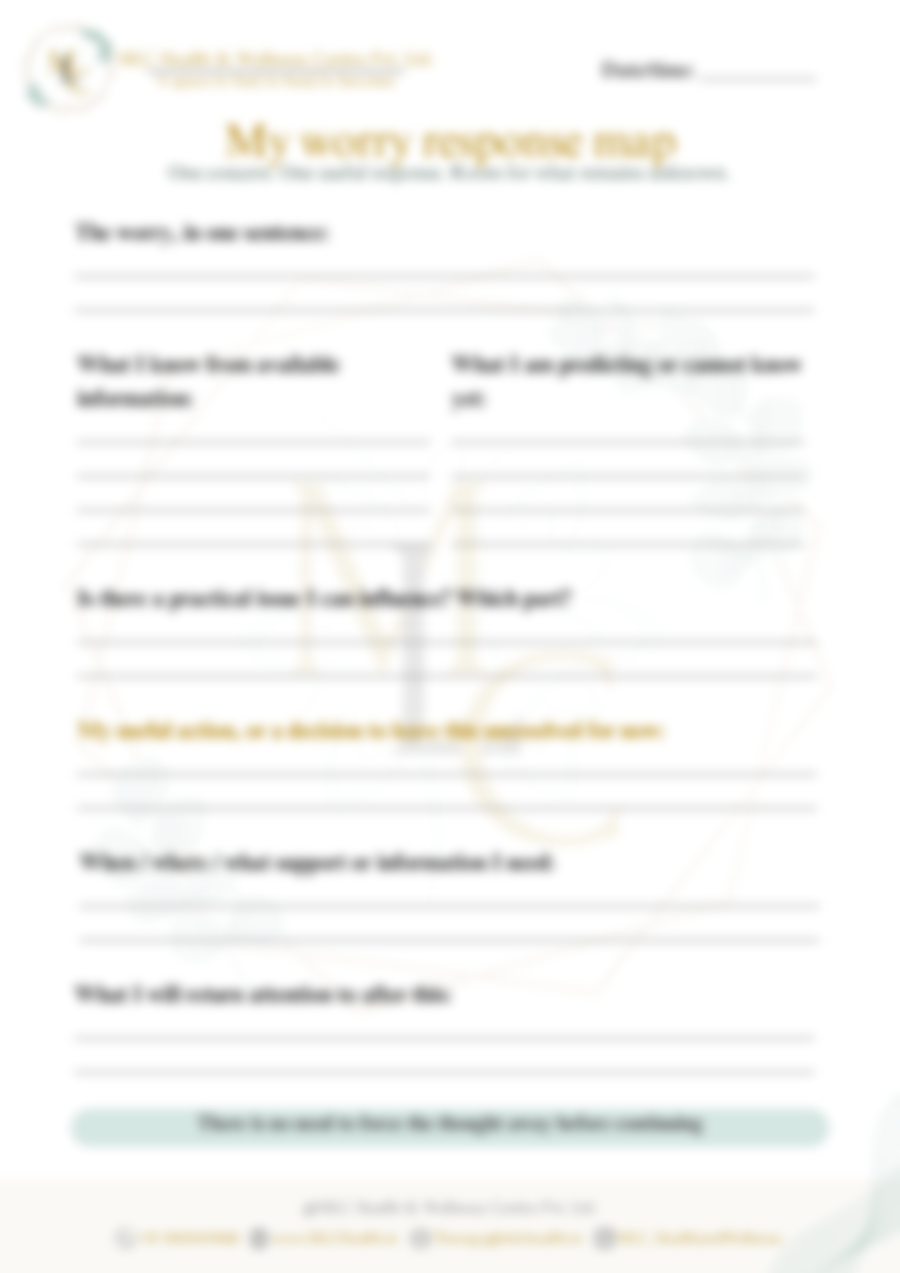
The third page, titled My worry response map, has the line “One concern. One useful response. Room for what remains unknown.”, a date and time field, and seven writing areas. The prompts for what I know and what I am predicting sit side by side.
- The worry, in one sentence.
- What I know from available information.
- What I am predicting or cannot know yet.
- Is there a practical issue I can influence, and which part.
- My useful action, or a decision to leave this unresolved for now.
- When, where, and what support or information I need.
- What I will return attention to after this.
Page 4: Respond when worry returns
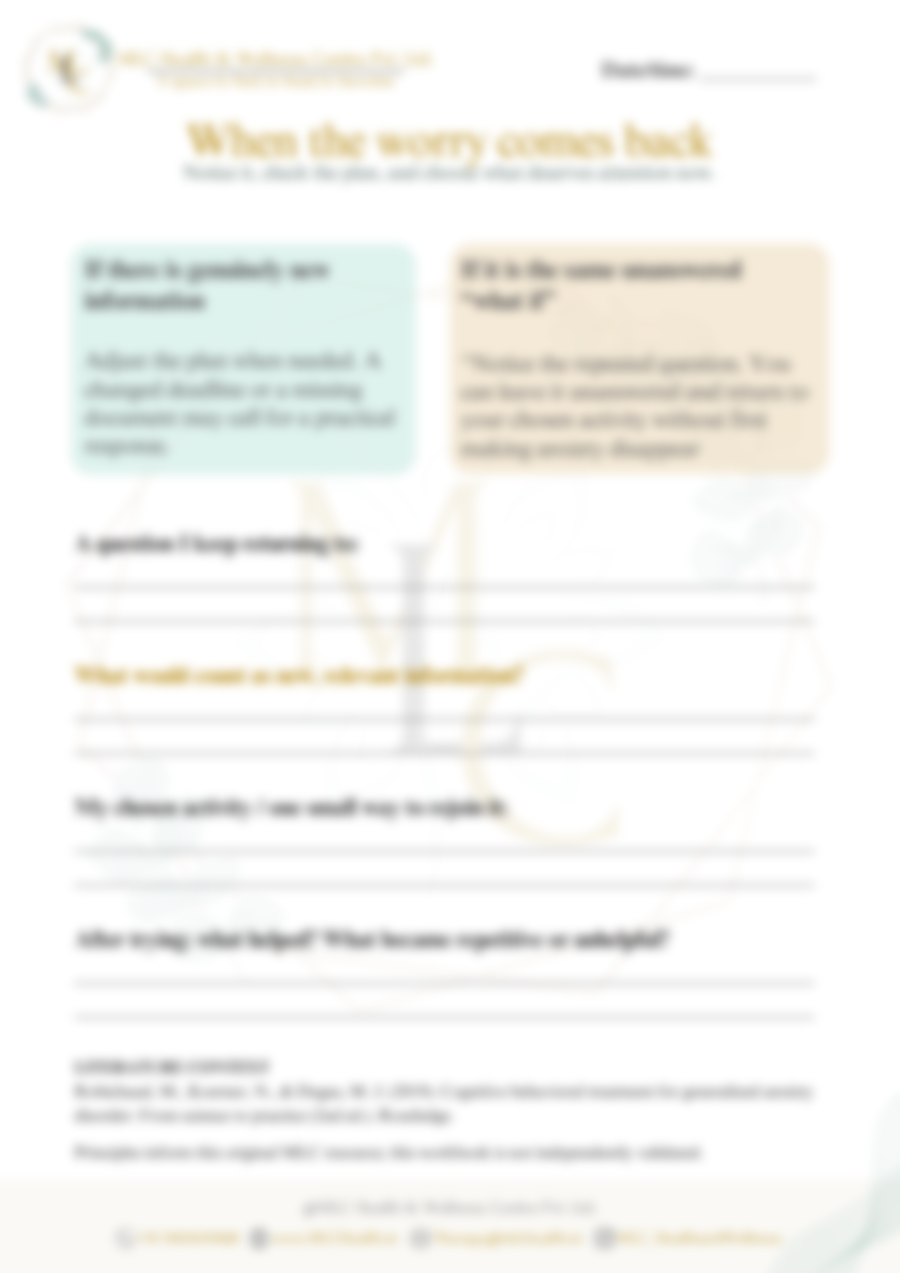
The fourth page, titled When the worry comes back, has the line “Notice it, check the plan, and choose what deserves attention now.”, a date and time field, and two boxes that distinguish genuinely new information from the same unanswered “what if”. It has four reflection areas:
- A question I keep returning to.
- What would count as new, relevant information.
- My chosen activity, and one small way to rejoin it.
- After trying: what helped, and what became repetitive or unhelpful.
What it does not include
There is no daily worry log, no worry-time schedule, no anxiety rating scale, and no exposure hierarchy. Page 4 also carries a short literature-context line naming Robichaud, Koerner and Dugas, with a note that the workbook has not been independently validated. The questions and examples on this web page go beyond the PDF, and none of them is printed in it.
Start by separating what you know from what you predict
Here, “known” means information reasonably available in this situation. It does not mean absolute certainty. Everything else is a prediction or an unresolved question.
| Available information | Prediction or unresolved question |
|---|---|
| “The deadline is Friday.” | “I will miss something important.” |
| “Two documents are still needed.” | “The application will be rejected.” |
| “I have not received a decision.” | “No reply means something has gone wrong.” |
Predictions may concern real possibilities. Calling something a prediction does not prove it is false. The aim is to tell apart information from an outcome that has not been established.
You do not need to gather exhaustive evidence or keep checking before you move on from this step. A few lines from what you already have is enough.
Option one: when should you act now?
Choose this option when a useful, proportionate practical action is available now. Examples:
- Request a missing document.
- Clarify a deadline.
- Send a necessary message.
- Gather information needed for a decision.
- Address an immediate practical problem.
Say what the action involves and what would count as completing it, so that it has an end point.
“The question is not ‘Can I make myself completely certain?’ It is ‘Is there a useful practical step available with the information I have?’”
Rising anxiety does not always mean that urgent action is needed. Act when there is a step worth taking, not simply to relieve a feeling.
Option two: how do you plan a step?
Some useful actions cannot, or need not, happen immediately. A plan makes the action concrete by stating:
- What to do.
- When and where.
- What information, materials, or support is needed.
- How you will remember the step, if that is useful.
Example: “The office is closed now. I will call tomorrow during opening hours to ask which document is required.”
A plan does not have to be rehearsed in your mind again and again to remain valid. Once it is made, it can wait. The PDF asks you to plan an action. It does not ask you to schedule a session of worrying.
Option three: what does it mean to allow uncertainty?
Sometimes no further useful action is available, or the remaining question cannot be settled now. Allowing uncertainty means acknowledging what is unresolved while choosing how to continue. It does not mean approving of a feared outcome or pretending that it cannot happen. Examples:
- “I have submitted the application. I do not know the decision yet.”
- “I have completed the agreed check. I cannot guarantee that nothing unexpected will happen.”
- “I can return to this conversation while the question remains unanswered.”
Returning attention to an activity does not require the thought to disappear first. This is not about suppressing thoughts, distracting yourself until anxiety vanishes, or forcing acceptance on command.
If it helps to bring attention back to the present, the 5-4-3-2-1 Grounding exercise is an MLC companion, and Circles of Control can help you sort what is yours to act on.
A worked example from the resource
Worked example from the resource. It follows page 2 of the PDF. It combines practical preparation with an unresolved outcome, and it is an illustrative example, not a real client’s account or a promise that others will respond similarly.
The worry
“What if I miss something in the application and do not get a place?”
What I know
“The application closes on Friday. Two documents are still needed. I have not received a decision.”
What I am predicting
“I will miss something.” “I will not be selected.”
A useful next step
“This evening, compare the documents with the published checklist and request the missing certificate. Decide what counts as completing that check.”
What remains uncertain
“Whether I will be selected.”
When the worry returns
“I have made a plan for the documents. I do not know the decision yet. For now, I am returning to my meal, conversation, or next task.”
What to keep in mind
The return-to-activity sentence is optional. It is not something you must repeat until you feel reassured. Reopening the same completed application repeatedly cannot guarantee the outcome.
How to use “My worry response map”
Work on one worry at a time, and take as long as you need.
- Write one worry in a sentence. Use your own words.
- Record the available information. Include only what you reasonably know now.
- Note your predictions and the questions that cannot yet be answered.
- Name any practical part that is within your influence, and which part it is.
- Choose an action, a plan, or a decision to leave something unresolved for now.
- Specify the practical arrangements: when, where, and what support or information you need.
- Choose what to return your attention to afterwards.
You can combine options: act on one part of the worry and leave another part uncertain. You can leave fields blank, pause, or complete the map with a practitioner.
Not every worry needs an action, and completing the sheet is not expected to reduce anxiety straight away. The page itself reminds you that there is no need to force the thought away before continuing.
What if the worry comes back?
Worries often return after a plan has been made. Page 4 helps you tell two situations apart.
The aim is not to decide perfectly whether every thought is new. Use the distinction as a practical guide rather than another checking task.
If you would like a structured way to look at one thought at a time, the Thought Journal is an MLC companion.
If there is genuinely new information
Consider whether the plan needs adjusting. Examples include a changed deadline, a response from the organisation, or newly identified required information. A practical response may be called for.
If it is the same unanswered “what if”
Notice that the question has returned. Its recurrence does not automatically mean that a new check or more analysis is needed. You can leave it unanswered and return to your chosen activity without first making anxiety disappear.
The four reflection prompts
Page 4 asks for:
- The question you keep returning to.
- What would count as new, relevant information.
- A chosen activity and one small way to rejoin it.
- What helped, and what became repetitive or unhelpful.
Practical action, repeated checking, and guidance for therapists
The same behaviour can serve different purposes. Checking a published checklist may give you necessary information, while reopening the same completed application again and again may be an attempt to obtain a feeling of certainty. Not all checking is unhelpful. Required safety procedures, professional standards, and real changes in circumstances should be respected.
For therapists and counsellors, some practical suggestions:
- Explore the purpose and context of the worry.
- Validate real uncertainty and practical constraints.
- Help distinguish a manageable action from reassurance seeking.
- Avoid providing repeated certainty about feared outcomes.
- Check whether the worksheet itself is becoming repetitive.
- Adapt language, pace, and writing demands.
- Review how returning to an activity felt, without measuring success only by anxiety reduction.
In Indian and other contexts, concerns may involve examinations, employment, finances, caregiving, or family expectations. These are possibilities, not stereotypes.
If checking feels compulsive, or the worry is persistent and disabling, individual assessment is recommended rather than treating this workbook as a complete intervention.
This is an educational practice resource, not a diagnostic assessment or a substitute for individual treatment.
Frequently asked questions
Created by MLC and supporting references
Created by MLC Health & Wellness Centre Pvt. Ltd. The explanations, examples, design, and practice prompts were developed by MLC, informed by established psychological literature. Supporting references are provided below.
The references below support the broader cognitive behavioural principles informing the resource. They do not identify external authors as creators of the MLC workbook, imply endorsement, or establish that this specific four-page resource has been independently tested or validated. The PDF itself names Robichaud, Koerner and Dugas. The trial by Dugas and colleagues is added here as broader context and is not printed in the PDF.
- Robichaud, M., Koerner, N., & Dugas, M. J. (2019). Cognitive behavioral treatment for generalized anxiety disorder: From science to practice (2nd ed.). Routledge. https://www.routledge.com/Cognitive-Behavioral-Treatment-for-Generalized-Anxiety-Disorder-From-Science/Robichaud-Koerner-Dugas/p/book/9781138888074/ Relevance: an established clinical reference addressing worry, uncertainty, and cognitive behavioural treatment. It supports the broader conceptual context. It does not validate MLC’s three-option decision map or exact worksheet wording.
- Dugas, M. J., Brillon, P., Savard, P., Turcotte, J., Gaudet, A., Ladouceur, R., Leblanc, R., & Gervais, N. J. (2010). A randomized clinical trial of cognitive-behavioral therapy and applied relaxation for adults with generalized anxiety disorder. Behavior Therapy, 41(1), 46–58. https://doi.org/10.1016/j.beth.2008.12.004 Relevance: research on a complete clinician-delivered treatment programme. It did not test this MLC resource, and it does not show that completing a brief worksheet reproduces treatment outcomes.
Platform disclaimer: this is a reflection and planning tool. It is not a diagnostic instrument or a substitute for therapy. If you are in distress, call Tele-MANAS at 14416.