
Inside the worksheet

Unlocks after purchase
Overview
The CBT model is a simple way of exploring how a situation, thoughts, emotions, actions and bodily responses can connect. This MLC resource is a printable two-page PDF: a visual guide and a practice worksheet, for personal reflection and for therapists introducing the cognitive behavioural model.
A difficult moment can involve several things at once: what happened, what went through your mind, how you felt, what you did, and what you noticed in your body.
The CBT model offers a way to explore those connections. It does not require you to decide that your thoughts are wrong or that you caused your distress.
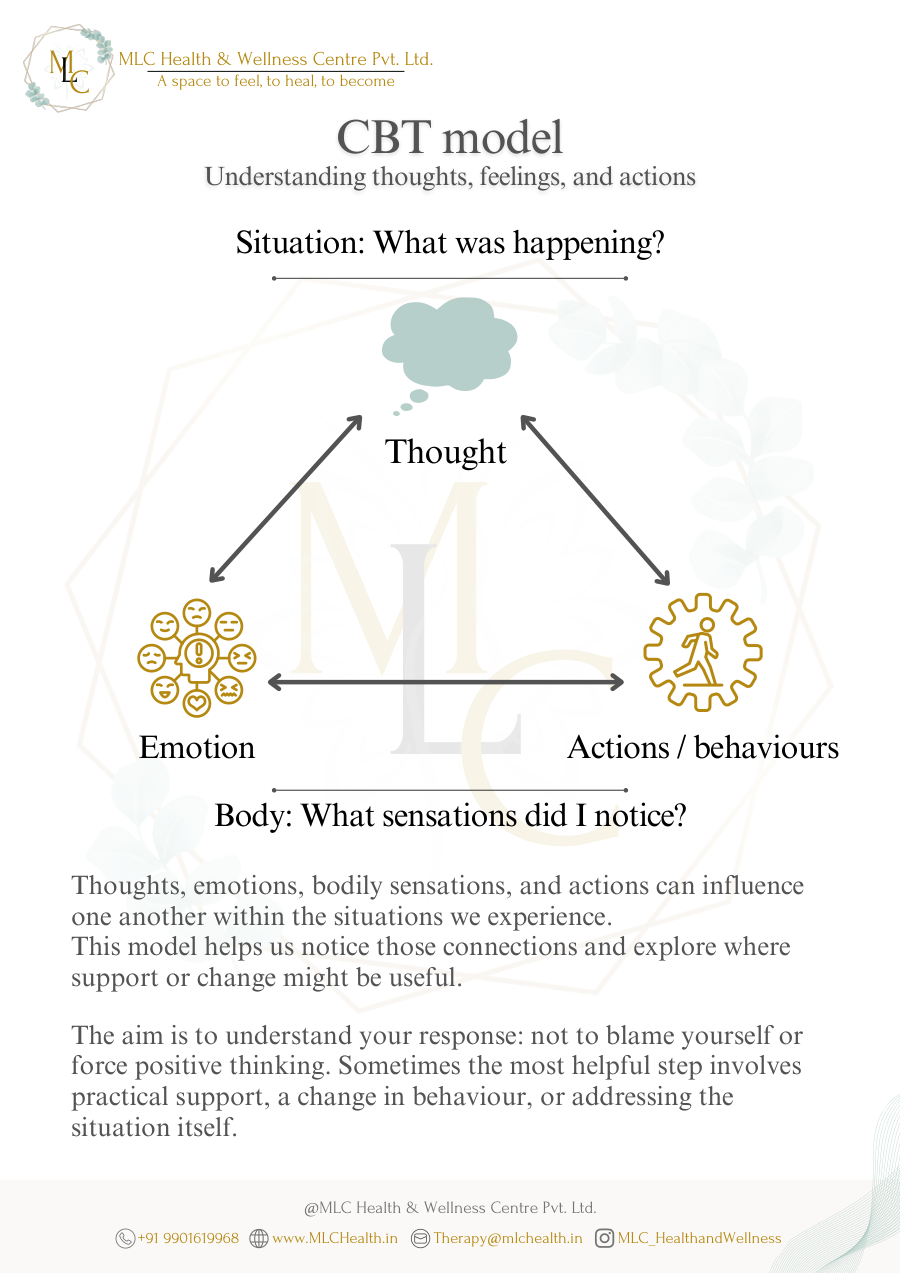
Page 1 introduces the relationships between thoughts, emotions, and behaviour, alongside prompts about the situation and bodily sensations. Page 2 provides space to explore one experience in more detail.
The purpose is understanding. Completing the worksheet does not require an immediate improvement in mood or a commitment to change.
For personal use
Choose a manageable example and become curious about your response. You can leave questions unanswered or return to them later.
For therapists
Use the model as a shared starting point for understanding a specific experience. The client’s words and circumstances should guide the exploration.
Inside the PDF
- A visual introduction to the CBT model.
- A practice worksheet with prompts for situation, thoughts, emotions, actions, and body.
- A personal 0–10 emotional intensity scale.
- Space to consider connections and one helpful response or source of support.
Quick start
If you only read one section, read this one. The introduction takes approximately 5 minutes and the practice worksheet approximately 10–15 minutes; these are suggested use times, not measured completion times.
- Choose one recent moment that feels manageable to explore.
- Describe what was happening.
- Record what went through your mind.
- Name any emotions you noticed. If useful, add an intensity rating.
- Describe what you did or avoided.
- Note bodily sensations if helpful.
- Explore how these parts might connect.
- Consider one helpful response or source of support.
The printed scale runs from 0, not noticeable, to 10, extremely strong. It is a personal description, not a test score. You can leave the intensity rating blank.
You can begin with whichever part you remember most clearly. You do not need to reconstruct a perfect sequence.
Understanding the model
The model has five parts. Each is explained below, followed by how they connect.
Situation
The event or circumstances you are exploring. Describe what happened separately from what you think it meant.
Thoughts
Words, images, or memories that went through your mind. A thought might be a prediction, interpretation, question, or judgement.
Emotions
Feelings such as sadness, worry, anger, embarrassment, or relief.
Actions and behaviours
What you did, stopped doing, avoided, or sought out.
Body
Sensations such as tension, warmth, heaviness, restlessness, or a racing heart.
How the parts connect
The arrows in the triangle show that thoughts, emotions, and behaviour can influence one another. The surrounding situation and bodily responses also matter.
A simplified map
This is a simplified map, not a rigid sequence that always starts with a conscious thought. For example, avoiding a conversation might bring immediate relief while leaving uncertainty unresolved. A supportive conversation might introduce new information. These are possibilities to explore, not conclusions to impose.
Using the worksheet
Use page 2 to explore one situation. Short answers are enough.
Date/time
Record when the experience occurred or when you completed the reflection. If these differ and it matters to you, note both.
Situation
The prompt asks what was happening, who was there, and where you were. Give enough detail to identify the moment without writing a full history.
Thoughts
Record what went through your mind. This may be words, an image, or a memory. If you are reconstructing it afterwards, note that it is your best recollection rather than a certainty.
Emotions and intensity
Choose words that describe how you felt. If useful, rate each emotion using the printed scale: 0 = not noticeable and 10 = extremely strong. The ratings are personal descriptions. Different people may use the scale differently, and there is no diagnostic cut-off.
Actions
Describe what you did or avoided doing. Include responses that helped, as well as responses you want to understand further.
Body
Record sensations if helpful. You can leave this section blank if inward attention is uncomfortable or unhelpful.
Connections
Explore possible links between the parts. You do not need to establish what caused what.
Next step
Consider one helpful response or source of support. This might involve practical assistance, communication, rest, a different action, further reflection, or a conversation with a therapist.
You do not need to change anything
You do not need to change any part of your experience. Start by noticing what feels useful to understand.
Therapist guide
Introduce the exercise collaboratively:
“Could we slow down one moment and look at the different parts together?”
Choose an experience that feels manageable. Begin with the part the client can identify rather than insisting on a fixed order.
Useful questions include:
- “What was happening just then?”
- “What went through your mind?”
- “What feeling word fits?”
- “What did you do next?”
- “What did you notice physically?”
- “What did that response help with?”
- “Were there any later consequences?”
- “What support was available or missing?”
Offer possibilities tentatively. Do not supply an automatic thought and record it as the client’s own.
Distinguish description from interpretation while recognising that the client may be responding to genuine danger, loss, discrimination, or mistreatment.
Treat a proposed connection as something to explore together. A completed map does not establish causation.
Close by asking what the client found useful and whether they want to explore anything further. Agree any between-session practice together.
Store completed worksheets according to the service’s consent and records practices.
These are suggested facilitation steps, not a standardised treatment protocol.
Worked examples
These examples are fictional. Their connections are illustrative rather than certain explanations. Intensity ratings are omitted here because they are personal and optional.
Example 1: An unanswered message
- Situation: A friend has not replied since yesterday.
- Thought: “Perhaps I have upset them.”
- Emotion: Worried.
- Action: Repeatedly checking my phone.
- Body: Tight stomach.
- Possible connection: Checking briefly reassures me, but I remain focused on the uncertainty.
- Possible next step: Return to another activity and decide whether a later follow-up would be useful.
Example 2: Cancelling plans
- Situation: I cancelled a social plan after a difficult week.
- Thought: “I do not have the energy to talk.”
- Emotions: Sad and relieved.
- Action: Stayed home.
- Body: Heavy and tired.
- Possible connection: Staying home allowed rest, but I also missed company.
- Possible next step: Consider a shorter, lower-pressure way to connect after resting.
Example 3: A hurtful comment
- Situation: Someone made a belittling comment during a meeting.
- Thought: “That was disrespectful.”
- Emotions: Angry and embarrassed.
- Action: Went quiet.
- Body: Warm face and tense shoulders.
- Possible connection: Silence helped me get through the moment, but I still want the behaviour addressed.
- Possible next step: Consider support, a boundary, or an appropriate reporting route.
A note on accurate thoughts
An accurate appraisal does not need to be replaced with a positive interpretation for the map to be useful.
When it feels difficult
“I cannot find a thought.”
Start with the situation, emotion, action, or bodily response. Do not invent a thought to complete the worksheet.
“I am writing the same thing in several places.”
Try separating what happened, what it meant to you, how you felt, what you did, and what you noticed physically. Some overlap is understandable.
“I feel blamed.”
Pause. The purpose is to understand your response within its circumstances, not to make you responsible for everything that happened.
“My thought is true.”
A thought can be accurate. The map can still help identify feelings, needs, and possible responses.
“I cannot tell which came first.”
You do not have to. Record the connections you notice without forcing a sequence.
“I cannot choose an intensity number.”
Leave it blank or describe the feeling in words. Precision is not required.
“I keep analysing.”
Keep the entry brief or take a break. Completing a perfect explanation is not the goal.
“Writing about it makes me more distressed.”
Stop or choose a less intense example. Consider exploring the experience with support rather than continuing alone.
Noticing patterns
If mapping feels useful, compare a few examples over time. There is no required daily schedule.
Ask:
- Do particular situations bring up similar meanings?
- Which responses help in the moment?
- Are there later costs or benefits?
- What circumstances or unmet needs recur?
- What support or change would be useful?
- Is completing the worksheet helping, or becoming a burden?
Do not assume repetition proves a single cause.
Progress might involve clearer understanding, more choice, improved communication, or identifying practical support. It does not have to mean lower emotion ratings.
Do not add the ratings into a total score or interpret them against clinical thresholds.
Adapting it
Adolescents
Use familiar language and examples they choose. Allow drawing or spoken answers.
Reading or writing difficulties
Complete fewer prompts, use brief phrases, or work through the map aloud.
Neurodivergent users
Ask which format helps. Offer concrete prompts, processing time, and alternatives to body-focused attention. Do not assume a particular experience from a diagnosis.
Language and culture
Invite the person’s own language and meanings. Do not assume an emotion word or behaviour carries the same meaning across contexts.
High distress
Choose a less intense example, shorten the exercise, or return later with support.
Real-world adversity
Include practical circumstances and available resources. Do not reduce financial pressures, discrimination, illness, or mistreatment to thinking errors.
A note on these suggestions
These are practical accessibility and facilitation suggestions, not evidence that this worksheet has been validated for each group.
Limits & ethics
This resource introduces a simplified model. It is not a diagnostic assessment, a complete clinical formulation, or a stand-alone treatment.
Not every emotion has an identifiable conscious thought. Bodily states, environment, relationships, and wider circumstances matter.
The worksheet should not be used to dismiss someone’s experience or persuade them that harmful treatment is acceptable.
People may decline, skip questions, or stop. A therapist should not require a client to agree with a proposed interpretation.
Completed worksheets can contain sensitive information. Consider where they will be stored and who may see them.
The exercise does not replace clinical assessment, safeguarding procedures, or urgent support when needed.
Background & evidence
The reference texts below provide established descriptions of the cognitive behavioural model and practical ways of exploring experience.
Judith S. Beck’s Cognitive Behavior Therapy: Basics and Beyond describes the cognitive model within individualised CBT (Beck, 2020).
Greenberger and Padesky’s Mind Over Mood teaches readers to distinguish and explore thoughts, moods, behaviours, physical reactions, and circumstances (Greenberger & Padesky, 2016).
These books provide conceptual and practical background. They do not establish that this particular MLC worksheet has been independently tested.
The triangle on page 1 introduces part of a broader model. The practice worksheet includes situation and body prompts to support a fuller exploration. It should not be interpreted as evidence that thoughts alone cause distress or that changing thoughts is always the appropriate first step.
The suggested timings, examples, and facilitation steps on this page are practical guidance, not validated specifications for this worksheet.
Using the PDF
The download contains two A4 pages.
- Page 1 provides the visual explanation and brief situation and body prompts.
- Page 2 provides the practice worksheet, including date/time, situation, thoughts, emotions and intensity, actions, body, connections, and next step.
Keep page 1 as a reference and print page 2 again when you want to explore another experience.
Write on a printed copy or annotate the PDF using a suitable app. This file does not contain interactive typing fields.
You can complete it privately or with a therapist. Keep completed copies somewhere appropriate for sensitive personal information.
Attribution
This PDF, including its diagram, layout and practice worksheet, was designed and produced by MLC Health & Wellness Centre Pvt. Ltd.
The cognitive behavioural framework is described in the reference texts below. This resource presents MLC’s explanation and practice prompts. The references do not imply that their authors created, reviewed, or endorsed this particular resource.
Frequently asked questions
References
- Beck, J. S. (2020). Cognitive behavior therapy: Basics and beyond (3rd ed.). The Guilford Press. https://www.guilford.com/books/Cognitive-Behavior-Therapy/Judith-Beck/9781462544196
- Greenberger, D., & Padesky, C. A. (2016). Mind over mood: Change how you feel by changing the way you think (2nd ed.). The Guilford Press. https://www.guilford.com/books/Mind-Over-Mood/Greenberger-Padesky/9781462520428
Platform disclaimer: this is a reflection and planning tool. It is not a diagnostic instrument or a substitute for therapy. If you are in distress, call Tele-MANAS at 14416.