
Inside the worksheet
Unlocks after purchase

Unlocks after purchase
Overview
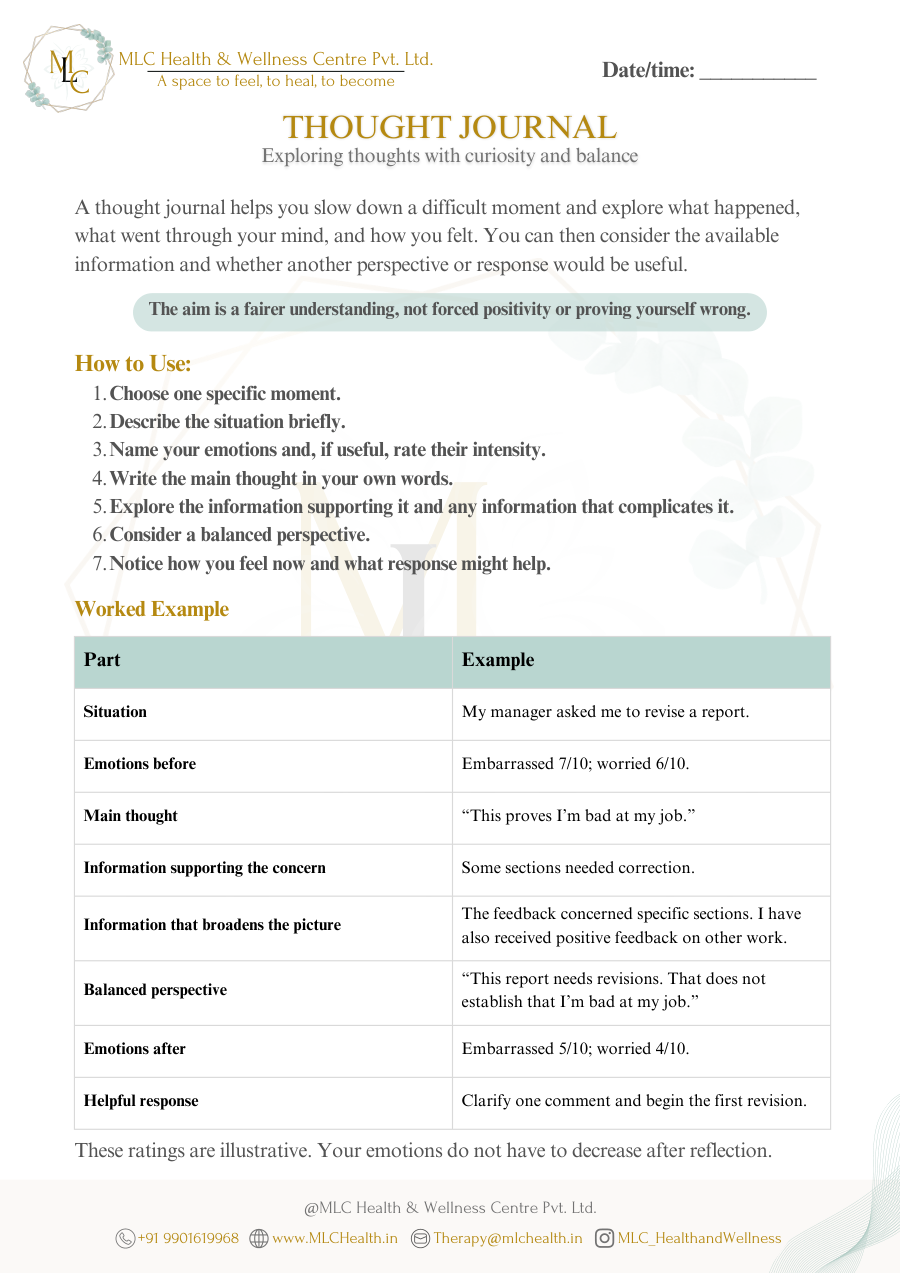
A thought journal is a structured way to explore a difficult thought: what happened, how you felt, what supports the concern, what broadens the picture, and what response might help. This MLC resource is a printable three-page PDF: a guide with a worked example, a detailed worksheet for one situation, and a compact table for multiple entries. It is for personal reflection and for therapists facilitating thought reflection.
A difficult thought can feel convincing before we have had time to examine it. A thought journal offers space to slow down, describe the moment, and consider the available information.
You can explore what supports your concern, what broadens the picture, and whether another perspective or response feels fair and believable.
The aim is not forced positivity or proving yourself wrong. Sometimes reflection confirms that a situation is difficult and that practical support, a boundary, or action is needed.
For personal use
Choose one manageable situation and one main thought. Brief answers are enough.
For therapists
Use the journal collaboratively. Let the person’s words, circumstances, and concerns guide the exploration.
Inside the PDF
- Page 1: instructions and a worked example.
- Page 2: a detailed worksheet for one situation.
- Page 3: a compact table for multiple entries.
- A personal 0–10 emotion scale on the detailed worksheet.
- Prompts for a balanced perspective and a helpful response.
Quick start
If you only read one section, read this one. Reading the guide takes approximately 5 minutes and completing one entry approximately 10–15 minutes; these are suggested use times, not measured completion times.
- Choose one specific moment.
- Describe the situation briefly.
- Name your emotions and, if useful, rate their intensity.
- Write the main thought in your own words.
- Explore information supporting it and information that broadens the picture.
- Consider a fair, believable perspective.
- Notice your emotions afterwards and what action or support might help.
Start with page 2 if you want more writing space. Use page 3 for shorter entries once the process feels familiar.
You do not need to complete an entry perfectly or feel better immediately afterwards.
Understanding the process
Situation and interpretation
“What happened” and “what it meant to me” are related but different. For example, “My manager requested revisions” describes an event; “I am bad at my job” expresses an interpretation.
Supporting information
Consider information that genuinely supports the concern. The exercise should not dismiss inconvenient facts.
Wider information
Look for relevant details, exceptions, uncertainty, and context. You do not need to invent reassurance or assume a positive explanation.
Balanced perspective
Bring the information together in a way you can believe. A balanced perspective may acknowledge a mistake, risk, unfairness, or unresolved uncertainty.
Helpful response
Understanding can lead to practical action, clarification, support, acceptance, or a boundary. A different thought is not the only possible outcome.
Using the journal
Use the detailed worksheet for one situation and one main thought.
Date/time
Record when the experience occurred or when you completed the entry.
Situation
Describe what was happening. Keep the description specific enough to identify the moment.
Emotions and intensity
Name the emotions that accompanied the experience. If useful, use the printed scale from 0, not noticeable, to 10, extremely strong. It is a personal rating, not a test score.
Main thought
Write the thought in your own words. Choose one to explore rather than trying to address every thought at once.
Supporting information
Record information supporting the thought or concern. Where possible, distinguish specific observations from assumptions.
Wider information
Consider information that does not fit the thought or suggests a more complete picture. Include relevant circumstances and what remains unknown.
Balanced perspective
Ask what feels fair and believable after considering both kinds of information. Avoid replacing one absolute conclusion with another. It can acknowledge that something is difficult, unfair, or uncertain, and it does not have to sound positive.
Emotions after
Notice how you feel now. If useful, use the same personal intensity scale again. Your emotions may decrease, remain unchanged, increase, or become clearer.
Helpful response
Choose an action or source of support if one is useful. You can also decide to pause or discuss the experience with a therapist.
Using the compact table
Each blank row on page 3 can hold a separate entry. Follow its columns in the same order: situation or worry, emotions before, main thought, information supporting the concern, information that broadens the picture, balanced perspective, emotions after, and helpful response. Use brief phrases and return to page 2 when you need more space.
Therapist guide
Introduce the journal collaboratively:
“Would it help to write down this thought and look at the information together?”
Start with a manageable situation and the client’s own wording.
Explore both supporting and wider information. Do not turn the exercise into an argument in which the therapist must disprove the thought.
Useful questions include:
- “What makes this thought convincing?”
- “What happened that supports the concern?”
- “What information complicates the conclusion?”
- “What remains uncertain?”
- “What would a fair account include?”
- “Does this perspective feel believable to you?”
- “What action or support would help?”
If the concern is realistic, explore coping, protection, problem-solving, or practical support.
Before closing, ask how the process felt. Agree any further practice together and store completed entries according to the service’s records and consent practices.
These are suggested facilitation steps, not a standardised treatment protocol.
Worked examples
These examples are fictional. The first follows the example included in the PDF. Emotion ratings are illustrative, not expected outcomes.
Example 1: Feedback at work
- Situation: My manager asked me to revise a report.
- Emotions before: Embarrassed 7/10; worried 6/10.
- Main thought: “This proves I am bad at my job.”
- Supporting information: Some sections needed correction.
- Wider information: The feedback concerned specific sections. I have also received positive feedback on other work.
- Balanced perspective: “This report needs revisions. That does not establish that I am bad at my job.”
- Emotions after: Embarrassed 5/10; worried 4/10.
- Helpful response: Clarify one comment and begin the first revision.
Example 2: An unanswered message
- Situation: A friend has not replied since yesterday.
- Emotions before: Worried and disappointed.
- Main thought: “They are deliberately ignoring me.”
- Supporting information: There has been no reply.
- Wider information: I do not know why. A delayed reply alone does not establish their intention.
- Balanced perspective: “I would like a reply, and the uncertainty is uncomfortable. I do not yet know what the delay means.”
- Emotions after: Still worried, with more recognition of uncertainty.
- Helpful response: Return to another activity and decide whether a later follow-up would be appropriate.
Example 3: A genuine difficulty
- Situation: A colleague has repeatedly made belittling comments.
- Emotions before: Angry and hurt.
- Main thought: “This behaviour is disrespectful, and I need support.”
- Supporting information: I can identify specific comments and when they occurred.
- Wider information: The broader context and available workplace support may affect how I respond. They do not erase the comments.
- Balanced perspective: “My concern is supported by what happened. I can consider a response that protects my wellbeing.”
- Emotions after: Still angry and hurt.
- Helpful response: Consider documentation, a boundary, or an appropriate support route.
A note on harmful behaviour
The journal does not require a positive reinterpretation of harmful behaviour.
When it feels difficult
“I have too many thoughts.”
Choose one that feels central. Other thoughts can wait.
“I cannot find wider information.”
Record what remains uncertain. Do not invent evidence to make the entry work.
“The alternative perspective sounds fake.”
Make it more modest and specific. “I do not know yet” may be more believable than reassurance.
“My original thought seems accurate.”
A balanced perspective can acknowledge that. Explore what support or response is needed.
“My emotions have not decreased.”
That does not mean the exercise failed. Consider whether anything became clearer.
“I keep rewriting until I feel certain.”
You do not need a perfect conclusion. Pause if journalling becomes repetitive reassurance-seeking and discuss the pattern with your therapist.
“Writing makes me more distressed.”
Stop, choose a less intense example, or explore the experience with support.
Reviewing entries
If useful, look back over a few entries rather than monitoring every thought.
Ask:
- Which situations bring up similar interpretations?
- What information do I tend to overlook?
- Which balanced perspectives felt believable?
- What actions or support helped?
- Did journalling improve understanding, or become another demand?
Progress may mean a more specific description, greater flexibility, more tolerance of uncertainty, or a practical next step.
Lower emotion ratings are not the only indication of usefulness. Do not add ratings into a diagnostic score.
Adapting it
Adolescents
Use familiar examples they choose. Keep entries brief and avoid making the sheet feel like a test.
Writing difficulties
Use short phrases, spoken reflection, or supported writing. The detailed worksheet offers more space than the compact table.
Language and culture
Invite the person’s own language and meanings. Explore context before treating an interpretation as inaccurate.
Neurodivergent users
Ask what format helps. Offer concrete prompts, processing time, and the option to complete fewer sections.
Perfectionism
Agree that an unfinished or “good enough” entry is acceptable. Avoid making a balanced perspective another standard to meet.
High distress
Use a manageable example or return later with support.
A note on these suggestions
These are practical facilitation suggestions, not evidence that this specific resource has been validated for each group.
Limits & ethics
This resource supports reflection. It is not a diagnostic instrument, a complete clinical assessment, or a stand-alone treatment.
Thoughts can be accurate, partly accurate, uncertain, or overly broad. The worksheet should not be used to dismiss concerns or reports of harm.
Emotions are not errors to eliminate. A balanced perspective can coexist with sadness, anger, fear, or uncertainty.
Users may leave sections blank, disagree with suggestions, or stop.
Completed journals may contain sensitive information. Consider where they will be stored and who may see them.
The resource does not replace clinical assessment, safeguarding procedures, or urgent support when needed.
Background & evidence
The Thought Journal was created by MLC and is informed by established CBT methods for identifying thoughts, examining information, and considering alternative or balanced perspectives.
Judith S. Beck’s Cognitive Behavior Therapy: Basics and Beyond discusses identifying, evaluating, and responding to automatic thoughts (Beck, 2020).
Greenberger and Padesky’s Mind Over Mood describes practical work with thought records, evidence, balanced thinking, and action plans (Greenberger & Padesky, 2016).
These references support the underlying approach. They do not establish that this particular MLC journal has been independently tested or that completing an entry will produce a specific emotional outcome.
The timings, examples, and facilitation suggestions on this page are practical guidance.
Using the PDF
The download contains three pages:
- Page 1: introduction, instructions, and a worked example.
- Page 2: a detailed journal worksheet.
- Page 3: a compact table for multiple entries.
Print page 2 again when you want to explore another situation in detail. Use page 3 for shorter entries; its rows are not assigned to particular weekdays.
Page 3 is arranged sideways. Rotate the view in your PDF reader to read it comfortably. When printing, use print preview to check the orientation and avoid cropping.
It is a printable PDF. Write on a printed copy or annotate the PDF using a suitable app. The file does not contain interactive typing fields.
Keep completed entries somewhere appropriate for sensitive personal information.
About this resource
Created by MLC Health & Wellness Centre Pvt. Ltd.
The explanations, examples, design, and practice prompts were developed by MLC, informed by established psychological literature. Supporting references are provided below.
Frequently asked questions
References
- Beck, J. S. (2020). Cognitive behavior therapy: Basics and beyond (3rd ed.). The Guilford Press. https://www.guilford.com/books/Cognitive-Behavior-Therapy/Judith-Beck/9781462544196
- Greenberger, D., & Padesky, C. A. (2016). Mind over mood: Change how you feel by changing the way you think (2nd ed.). The Guilford Press. https://www.guilford.com/books/Mind-Over-Mood/Greenberger-Padesky/9781462520428
Platform disclaimer: this is a reflection and planning tool. It is not a diagnostic instrument or a substitute for therapy. If you are in distress, call Tele-MANAS at 14416.