
Inside the worksheet
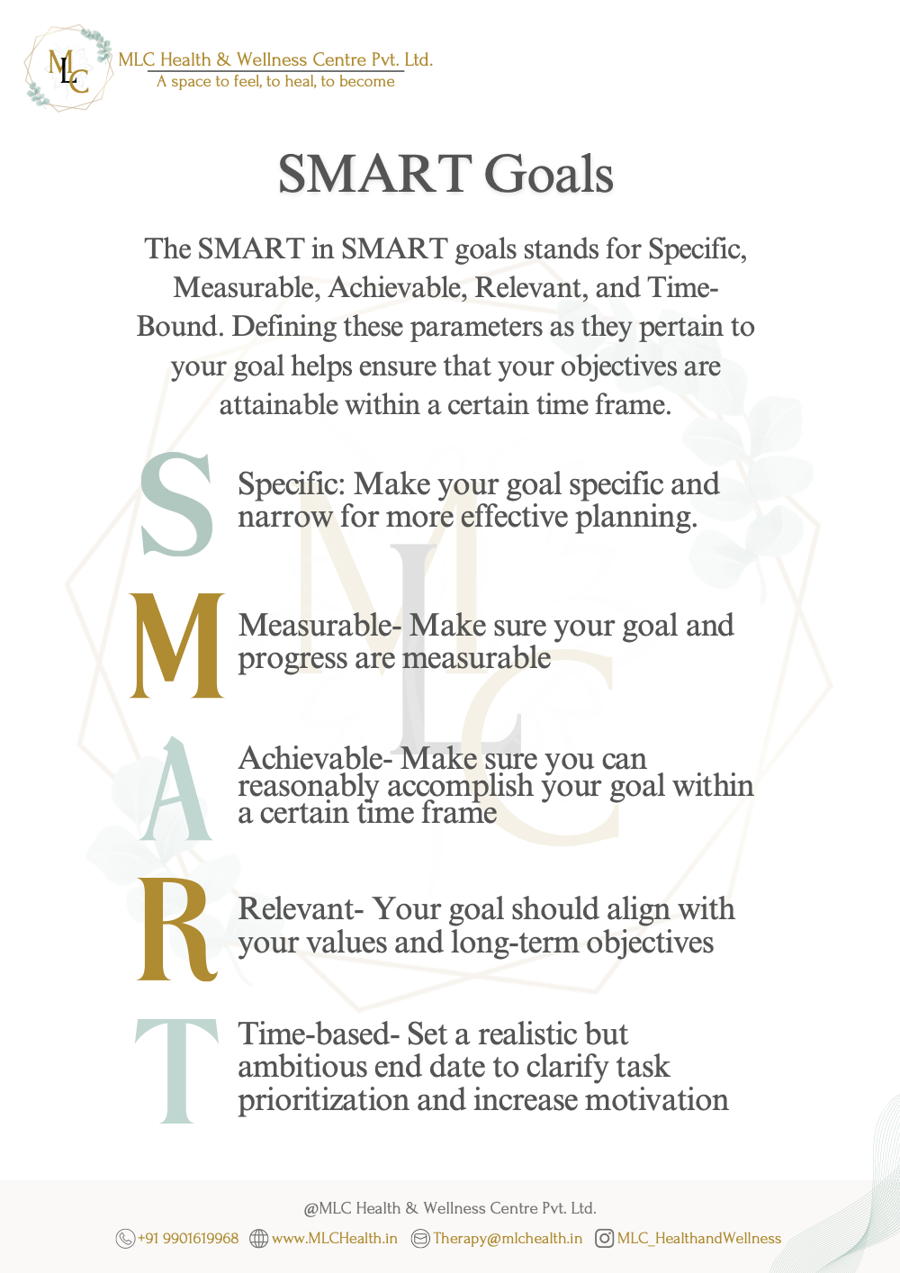

Unlocks after purchase
Overview
SMART is a simple checklist for turning a wish into a plan. A goal is SMART when you can answer five questions about it: is it Specific, Measurable, Achievable, Relevant and Time-bound? Instead of "I want to feel better", you end up with something like "I will walk for 15 minutes after dinner on four days a week for the next three weeks, and rate my mood before and after."
This page explains the whole method, so you can use it with or without the worksheet: what each letter means, how to fill in every line, how a therapist can run it in a session, worked examples, what to do when a goal stalls, and when SMART goals are the wrong tool. The MLC worksheet is a two-page printable that puts the method on paper: page 1 explains the five parts, page 2 is a fill-in sheet with space for each part, a practice task and a note for therapists.
For therapists
Use SMART goals to turn a broad treatment aim ("reduce anxiety", "re-engage with life") into a behavioural target the client has agreed to and can check each week. The format gives you a shared reference for review: you can see whether the goal was attempted, whether the plan or the goal needs changing, and whether the target still matters to the client. It works best when the client writes the words and you guide the questions.
For clients
Big goals can feel vague and heavy, and it is hard to know where to start. This worksheet breaks one goal into five short questions, so you know exactly what you will do, how you will notice progress, and when you will check in. You do not need to get it perfect the first time. The aim is a goal that is clear and small enough to start this week.
What is in the PDF
- Page 1: the five SMART components explained in plain language.
- Page 2: a fill-in sheet with two writing lines for each component.
- A short practice task: break down several goals this way until the method feels natural.
- A note for therapists on using the sheet across sessions.
Quick start: write a SMART goal in 10 minutes
If you only read one section, read this one.
- Pick ONE goal. Choose something that matters to you and feels doable in the next few weeks.
- Say it roughly first, even if it is vague ("I want to be less stressed").
- Turn it into an action: what will you actually do? Make it something a camera could film.
- Add a measure: how often, for how long, or what rating from 0 to 10 will you track?
- Check it is realistic: on a 0-10 scale, how sure are you that you can do it? If it is below 7, make it smaller.
- Ask why it matters to you, in one sentence.
- Set dates: when you start, and when you will review it (usually 1 to 4 weeks away).
- Read your five answers as one sentence. If they do not fit together, adjust until they do.
The five components in depth
Each letter is a question you ask about your goal. For each one below you will find what it means, the questions to ask, a weak and a stronger version of the same goal, and a common mistake to avoid. Different sources use slightly different words for the same letters (for example Achievable or Attainable, Time-bound or Time-based). The idea is the same.
S: Specific. What exactly will I do?
A specific goal names one clear thing you will do or change, in concrete terms that another person could picture. "Be healthier" could mean anything. "Walk" is something a camera could record.
- Ask: What exactly will I do? Where and when? With whom, if anyone?
- Test: could a friend watch you for a day and tell whether you did it?
- Weak: "Be less stressed." Stronger: "Practise a five-minute breathing exercise at my desk after lunch."
- Tip: describe an action you will do, not only something you will stop or feel. "Stop worrying" is hard to start on. "Write my worries down for ten minutes at 6 pm" is easy to start.
- Mistake: putting several goals into one sentence. Pick one.
M: Measurable. How will I know I am making progress?
Measurable means you can see progress on something concrete. Without it, it is easy to judge by mood on a given day, which changes constantly, and to conclude "it is not working" when it is.
- Ways to measure: a count (times per week), a duration (minutes), a yes/no tick box, a 0-10 rating (stress, mood, urge), or a clear outcome (an email sent, a call made).
- Ask: What number or tick will I look at? Where will I record it?
- Weak: "Sleep better." Stronger: "In bed by 11 pm on five nights a week, ticked on a sleep log."
- Tip: measure what you do (actions you control) as well as how you feel (which fluctuates).
- Mistake: choosing a measure so complicated that you stop recording it. One tick box is enough.
A: Achievable. Can I realistically do this?
Achievable means realistic for your time, energy, money, skills and the rest of your life right now, not on your best day. A goal that is a little challenging can motivate you. A goal that is out of reach usually leads to giving up.
- Ask: Have I done something like this before? What could get in the way? What would make it half as hard?
- A practical rule of thumb: rate your confidence from 0 to 10 that you will do it. If the rating is below 7, shrink the goal (fewer days, shorter time) until it reaches 7 or higher. This is a common clinical convention, not a research cut-off.
- Weak: "Exercise every day for an hour." Stronger: "Walk for 15 minutes, three days a week, after dinner."
- Tip: plan for the obstacle in advance ("if it rains, I will walk the stairs at home").
- Mistake: setting the goal for your best day instead of your average day.
R: Relevant. Why does this matter to me?
Relevant means the goal fits your values and the bigger picture of your life. It is where motivation comes from. A goal that matters to you is far easier to keep going with than one you took on because you felt you should.
- Ask: Why does this matter to me? Which part of my life gets better? Is this my goal, or someone else's expectation?
- Weak: "Join a gym because everyone says I should." Stronger: "Walk after dinner because I want more energy to play with my children."
- For therapists: if the client cannot say why the goal matters, explore that before refining anything else.
- Mistake: goals chosen to please others, such as family, a partner, or even the therapist.
T: Time-bound. By when, and when will I review?
Time-bound means the goal has a start, an end and a review date. A date turns "someday" into a plan and gives you a natural moment to check how it is going and decide what to change.
- Ask: When do I start? When will I check progress? When is the end point?
- Typical windows: one to four weeks for a first behavioural goal. Bigger outcomes should be broken into smaller milestones, each with its own date.
- Always set a review date, even for ongoing habits. Review is where you decide to keep, adjust or retire the goal.
- Mistake: a deadline so far away it creates no urgency, or so close that it almost guarantees failure.
Filling in the worksheet, line by line
Page 2 of the worksheet has five prompts, each with two lines for writing. One clear sentence per line is better than a paragraph.
- Before you write, decide on one rough goal. You can jot it on scrap paper first.
- Specific ("What is the clear outcome you want?"): write the action or outcome in plain words.
- Measurable ("How can you measure your progress?"): write how often, how long, or which rating you will track.
- Achievable ("Make it as realistic as possible"): write why it is doable, and what you will do about the likely obstacle.
- Relevant ("Does it align with values and long-term objectives?"): write the reason it matters to you.
- Time-based ("Set a realistic time-frame"): write the start date, review date and end date.
- Join the five answers into one sentence using the template below, and read it aloud. Adjust anything that sounds forced.
- For the practice task at the bottom of the sheet, repeat this for two or three different goals over the coming weeks until the method feels natural.
Template: "I will [specific action], [how often / how much], from [start date] until [end date]. I will track it by [measure]. This matters to me because [reason]. I will review it on [date]."
Therapist guide: running it in session
A first goal usually takes 15 to 20 minutes. Later reviews take five to ten. Keep the stance collaborative: you ask the questions, the client chooses the words.
Before the session
- Decide which treatment aim you want to translate into a goal, using your formulation or treatment plan.
- Print the worksheet or have it open on a tablet. Give the client the pen.
- Sit side by side if the room allows, so the page is shared and not an exam.
In the session, step by step
- Orient (1-2 min): explain that you will turn one goal into a clear plan together, and that the plan can change.
- Choose the goal (3-5 min): ask what they would like to be different by the end of the month. Pick one, in the client's words.
- Make it specific (3 min): ask what they would actually do, and what you would see if you were filming.
- Make it measurable (2 min): agree one simple measure and where it will be recorded.
- Test achievability (3 min): use a 0-10 confidence rating. If it is below 7, make the goal smaller. Ask what might get in the way and agree a plan for it.
- Check relevance (2 min): ask why this matters to them.
- Set dates (1 min): start date and a review date that falls in the next session or two.
- Read it back (1 min): the client reads the final sentence aloud and says whether it feels right.
Useful questions
- "What would you like to be different by the end of this month?"
- "If a camera were filming, what would we see you doing?"
- "What is the smallest version of this you are certain you could do?"
- "On a scale of 0 to 10, how confident are you that you will do this?"
- "What might get in the way, and what could we do about it now?"
- "Whose goal is this?"
After the session
- Record the agreed goal sentence and review date in your notes, with the client's consent and per your records policy.
- Give the client a copy (printed or photographed) to keep where they will see it.
- Open the next session by asking how the goal went before moving to new material.
Worked examples
Each example starts with a vague goal and shows the five answers. These are illustrations to adapt, not scripts to copy.
1. Anxiety before work
Vague goal: "I want to feel less anxious."
- Specific: Practise a five-minute breathing exercise when I notice my chest tightening before work.
- Measurable: Tick a tracker each time I use it; aim for five days a week. Rate my anxiety 0-10 before and after.
- Achievable: Five minutes fits my morning routine and I already have a quiet spot. Confidence: 8 out of 10.
- Relevant: Feeling calmer at work matters to me and supports my aim of leading team meetings.
- Time-based: Start Monday, review with my therapist in four weeks.
2. Low mood and withdrawal
Vague goal: "I want to stop feeling so low." Feelings cannot be scheduled directly, so the goal targets an action that often supports mood.
- Specific: Take a 15-minute walk outside after dinner.
- Measurable: Mark the days on the calendar and rate mood 0-10 before and after. Aim for four days a week.
- Achievable: 15 minutes is short. Shoes by the door; on rainy days I will walk the stairs at home. Confidence: 8 out of 10.
- Relevant: I want more energy to feel like myself and spend time with my family.
- Time-based: Three weeks, starting this Thursday, review at our next session.
3. Sleep
Vague goal: "I want to sleep better."
- Specific: Charge my phone outside the bedroom and start winding down at 10:30 pm.
- Measurable: Lights out by 11:30 pm on five nights a week, ticked on a sleep log.
- Achievable: I currently go to bed around 1 am, so I will move bedtime 30 minutes earlier each week instead of all at once.
- Relevant: Poor sleep is hurting my concentration at college.
- Time-based: Four weeks, with a quick check every Sunday.
4. A teenager and exams
Vague goal: "Do better in exams." Written by the teenager, in their own words, with the therapist.
- Specific: Study maths for 30 minutes at my desk after school.
- Measurable: Use a timer and tick the day. Aim for four days a week.
- Achievable: Tuesday is tuition day, so I will skip that day. I will keep my phone in another room.
- Relevant: I want to get into the course I have chosen.
- Time-based: Two weeks, then we review before deciding whether to add another subject.
5. A couple wanting to communicate better
Vague goal: "We should talk more." Each partner completes the sheet separately, then they compare.
- Specific: A 20-minute check-in after dinner with phones away; each of us speaks for five minutes without interruption.
- Measurable: Number of check-ins held each week. Aim for four.
- Achievable: We start with three evenings and add one if it goes well.
- Relevant: We both want to feel heard and less tense at home.
- Time-based: Six weeks, with a review at our next two sessions.
When a goal is not working
A goal that stalls is information, not failure. Change the plan, not the person.
- "I did not do it at all." Ask without blame what got in the way. Shrink the goal to a version rated 9 out of 10 for confidence, attach it to something you already do each day, or remove the obstacle.
- "I did it for a week, then stopped." Look at what happened when it dropped. Was it the plan or a life event? Reduce the frequency rather than abandoning it, and add a reminder or support.
- "I met the target but nothing improved." The goal may not be relevant, or the action may not connect to what you want. Revisit why it matters and whether another action would serve that better.
- "It feels like pressure." Check whose goal it is. Soften the wording from "must" to "will try". Consider whether a fixed target is the right format right now.
- "I have too many goals." Keep to one or two active goals at a time.
- "One missed day means I failed." Define "good enough" in advance, for example four days out of seven counts as a success. Aim to never miss twice in a row.
- "I cannot think of a goal." Start from what is not working, or one small thing that would make tomorrow better. Ask what matters most to you.
- "My goal is about feelings, so I cannot measure it." Use a 0-10 daily rating, and pair it with an action you can count.
Tracking and reviewing progress
Tracking can be as simple as a tick on a calendar. What matters is that you can see it at a glance and that you look at it on the review date.
Ways to track
- A tick chart or calendar on the wall or fridge.
- A notes or habit app on your phone.
- A 0-10 daily rating for mood, stress or urge.
- A short note on what helped or got in the way.
Review questions
- What did I actually do compared with the plan?
- What helped? What got in the way?
- Does this goal still matter to me?
- What do I want to keep, change or stop?
Deciding what to do next
- Hit the target for two or three weeks in a row: keep going, then raise it a little or add a new goal.
- Hit about half: keep the goal and adjust the obstacles or timing.
- Rarely hit it: shrink the goal rather than pushing harder.
- No longer matters: retire it without guilt and choose another.
- These are practical rules of thumb, not fixed cut-offs.
- Acknowledge effort as well as results. Showing up counts.
Adapting it for different clients
- Adolescents (13+): use shorter windows of one to two weeks, let them choose the words and the tracker, and avoid goals set mainly by parents or school. Involve parents as appropriate to their age and your consent practices.
- Low mood or low energy: choose very small, behavioural goals. "Feel happier" cannot be scheduled, but a ten-minute walk can.
- Anxiety: favour goals that move towards things that matter, not only goals that avoid discomfort. Plan any gradual exposure inside treatment, not as an unsupervised target.
- Perfectionism: spend extra time on Achievable and agree in advance what "good enough" looks like.
- Attention or organisation difficulties: use visual trackers, external reminders and smaller steps. Say the goal aloud and keep the sheet where it will be seen.
- Couples and families: write a shared goal. Have each person fill in the sheet alone, then compare and agree one version.
- Language and literacy: the worksheet is in English. The client can answer aloud in any language while the therapist writes, or the goal can be drawn or recorded.
Limits & ethics
SMART goals suit clear behaviours and outcomes. They are a planning tool, not a treatment. They do not diagnose anything and they do not replace a clinical assessment or therapy.
- Client ownership: the goal should be the client's. A goal set by a therapist, parent or partner usually loses motivation.
- Less suited to some work: when the main task is processing grief, trauma or identity, rigid targets can add pressure. Missed targets are information to explore, not failures.
- Risk and safety: a SMART goal is not a safety plan. If someone is at risk of harming themselves, follow your risk assessment and safety planning process.
- Not every goal needs all five: Doran himself described the format as a writing aid, and noted that not every objective will meet every criterion.
- Context matters: consider family, cultural and financial circumstances when judging what is realistic.
- Privacy: a completed worksheet contains personal information. Store and share it according to consent and your records policy.
- If you are in distress, contact a mental health professional or call Tele-MANAS on 14416.
Where SMART goals come from
The SMART acronym comes from a 1981 article by George T. Doran in Management Review, written for managers setting objectives. His original words were Specific, Measurable, Assignable, Realistic and Time-related. Later versions replaced some of those words, and the version used on this worksheet (Specific, Measurable, Achievable, Relevant, Time-based) is one of the common adaptations.
Separately, decades of goal-setting research, summarised by Locke and Latham (2002), found that specific, challenging goals tend to lead to better performance than vague "do your best" goals, especially when the person is committed to the goal and gets feedback on progress. That research comes mostly from work and performance settings. In therapy, SMART goals are best seen as a practical way to apply those ideas, and not as a clinical treatment that has been tested on its own.
Using the PDF
- Two A4 pages. Print them, or fill them in on a tablet with any PDF markup app.
- Print page 2 again for each new goal. Keep page 1 as a reference.
- Keep completed copies somewhere you will see them: a fridge, a desk, or the client file (with consent).
- Download links work after payment. You can download the PDF again from the confirmation page, or from your dashboard Resources page if you buy while logged in.
Attribution
The SMART acronym originates with George T. Doran (1981). No organisation owns the SMART framework. This guide and the worksheet layout were prepared for MLC Health & Wellness Centre.
Frequently asked questions
References
- Doran, G. T. (1981). There's a S.M.A.R.T. way to write management's goals and objectives. Management Review, 70(11), 35-36.
- Locke, E. A., & Latham, G. P. (2002). Building a practically useful theory of goal setting and task motivation: A 35-year odyssey. American Psychologist, 57(9), 705-717.
Platform disclaimer: this is a reflection and planning tool. It is not a diagnostic instrument or a substitute for therapy. If you are in distress, call Tele-MANAS at 14416.