
Inside the worksheet

Unlocks after purchase
Overview
Behavioural activation is an approach that explores how activity patterns relate to low mood and plans small, manageable actions that support engagement with life. This MLC resource is a printable two-page PDF: a guide with activity ideas, and a Sunday–Saturday weekly planner with review questions, for personal use and for therapists supporting collaborative activity planning.
When mood or energy is low, everyday activities can become harder. We may withdraw from routines, relationships, or interests that matter to us.
This resource offers a way to choose manageable activities and notice what happens when we try them. It combines activity ideas with a weekly planner and review questions.
The aim is not to fill every hour or complete a perfect schedule. A small action may support care, connection, or personal meaning even when it does not immediately improve mood.
For personal use
Choose a few activities that fit your circumstances. Leave other spaces blank.
For therapists
Use the planner collaboratively to explore activity patterns, barriers, available support, and realistic next steps.
Inside the PDF
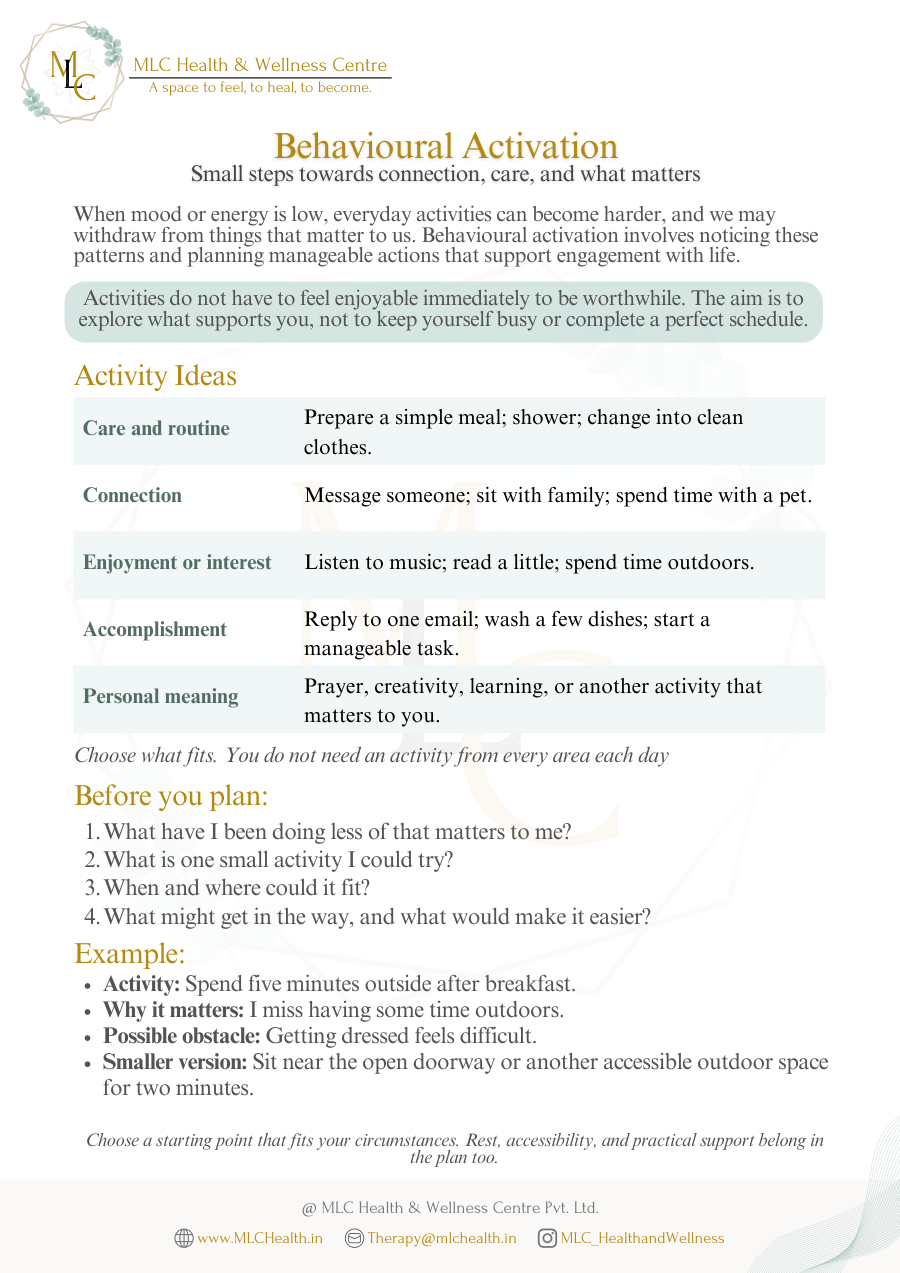
- Page 1: explanation, activity ideas, preparation questions, and an example.
- Page 2: a Sunday–Saturday planner with morning, afternoon, and evening spaces.
- Separate spaces for what you planned and what happened.
- Three questions for reviewing the week.
Quick start
If you only read one section, read this one. Initial reading and planning takes approximately 10–15 minutes, brief notes can be added during the week, and a weekly review takes approximately 5–10 minutes. These are suggested use times, not measured completion times.
- Read the activity ideas on page 1.
- Choose one small activity that matters to you.
- Decide when and where it could fit.
- Consider what might get in the way and a smaller version if needed.
- Write it in a suitable “Plan” space on page 2.
- Afterwards, briefly record what happened.
- Use the “Looking Back” questions to decide what to keep or adjust.
You do not need to fill every box or choose an activity from every area each day.
Understanding behavioural activation
Behavioural activation involves exploring how activities, avoidance, and circumstances relate to emotional difficulties, then planning useful changes.
The planner introduces one part of this work: choosing manageable actions and reviewing their effects. A full therapeutic approach also involves individual assessment and understanding patterns over time.
Activities can serve different purposes:
- Care and routine: supporting everyday needs.
- Connection: making room for relationships or companionship.
- Enjoyment or interest: returning to activities that offer interest or enjoyment, even if the response is muted at first.
- Accomplishment: taking a manageable step on a task that matters.
- Personal meaning: engaging with something important to you, such as creativity, prayer, learning, or another chosen value.
These areas overlap. They are ideas to explore, not a daily checklist.
Rest can be part of a useful plan. Consider what an activity does for you in context rather than treating all inactivity as avoidance.
Using the planner
Date/time and Week Beginning
Record when you are planning and identify the week you are using.
Choose a starting point
Use the four preparation questions on page 1. Start with an activity that is specific and manageable in your current circumstances.
Plan
Write a brief description in the relevant day and time period. For example: “After breakfast, spend two minutes outside.” The morning, afternoon, and evening columns are flexible. You can note a more specific time within a cell if useful.
What happened
Record what you actually did and any important context. Examples include:
- “Sat outside for two minutes.”
- “Called instead of visiting.”
- “Too tired today; need a smaller step.”
- “Needed transport that was unavailable.”
A changed or unfinished activity
A changed or unfinished activity is still useful information.
Looking Back
The three printed questions invite you to consider what felt worthwhile, what affected participation, and what to adjust next week. You can reflect on them, discuss them with your therapist, or write answers on a separate sheet. The PDF does not provide separate response boxes for this review.
Therapist guide
Introduce the planner collaboratively:
“Could we look at a small activity that matters to you and what would make it possible?”
Explore current patterns and circumstances before scheduling activities. Consider energy, health, finances, accessibility, relationships, responsibilities, and practical support.
Useful questions include:
- “What have you been doing less of?”
- “What do you miss, or want more room for?”
- “What is the smallest useful version?”
- “What might get in the way?”
- “What support would make it easier?”
- “What happened when you tried?”
- “Was it worthwhile in any way, even without a mood change?”
Avoid interpreting an incomplete plan as unwillingness or lack of effort.
Review what the activity did in context. Rest, practical help, or changing environmental barriers may be more useful than adding tasks.
Agree further practice together. These are suggested facilitation steps, not a complete behavioural activation treatment protocol.
Worked examples
These examples are fictional. They illustrate planning and review, not expected outcomes.
Example 1: Time outdoors
- Why it matters: “I miss spending time outside.”
- Plan: Five minutes outside after breakfast.
- Possible obstacle: Getting dressed feels difficult.
- Smaller version: Two minutes in a safe, accessible outdoor space.
- What happened: “I spent two minutes near the doorway. My mood felt similar, but I appreciated the change of surroundings.”
- Next adjustment: Keep the smaller version for now.
Example 2: Reconnecting
- Why it matters: “I miss a friend, but meeting feels like too much.”
- Plan: Send a short message on Tuesday afternoon.
- What happened: “I sent the message. We have not arranged anything yet.”
- Review: The action created an opportunity for connection; a reply was outside my control.
- Next adjustment: Consider a brief call if both of us want one.
Example 3: An unfinished task
- Why it matters: “Unopened post is becoming stressful.”
- Plan: Open one envelope on Thursday morning.
- What happened: “I did not start. I was worried about what it might contain.”
- Review: The barrier involved worry, not simply remembering the task.
- Next adjustment: Consider opening it with a trusted person or discussing the concern with my therapist.
When it feels difficult
“Everything feels too much.”
Make the activity smaller, reduce how many you plan, or consider what support is needed.
“I did it but felt no better.”
Notice other effects: care, connection, information, interest, or a practical benefit. Immediate mood improvement is not required.
“I filled every box and became overwhelmed.”
Leave more space. The planner is not a requirement to stay busy.
“I keep postponing.”
Explore what happens before postponement. The activity may be too large, poorly timed, inaccessible, or linked to a concern that needs attention.
“I need rest.”
Include rest where it supports your needs. Do not use the planner to push through illness, pain, or exhaustion.
“The activity is no longer relevant.”
Change or remove it. The plan should serve your circumstances.
“I feel guilty about unfinished activities.”
Use the record to understand barriers and adjust the plan. Completion is not a measure of your worth.
Reviewing the week
Use the three questions printed under “Looking Back”:
- Which activities felt worthwhile, supportive, or connecting, even if my mood did not change?
- What made activities easier or harder?
- What would I keep, make smaller, change, or ask for help with next week?
Look for patterns without turning the week into a pass-or-fail score.
You might decide to repeat an activity, reduce its size, change its timing, seek support, or stop something that was unhelpful.
The planner contains no mood-rating scale or clinical scoring system. You do not need to calculate a completion percentage.
Adapting it
Low energy
Use fewer activities and smaller steps. Consider essential care and practical support.
Physical health or disability
Choose accessible activities and respect relevant health advice and physical limits. Adapt movement-based examples rather than treating them as requirements.
Adolescents
Use activities they choose and avoid making the planner a behaviour-compliance chart.
Neurodivergent users
Offer concrete wording, reminders, flexible timing, and fewer active plans where useful.
Shift work or irregular routines
Use the time-period columns flexibly and note the timing that fits your day.
Language or writing difficulties
Use brief words, symbols, or supported spoken planning.
Cultural and personal meaning
Let the person define what matters. Prayer, family time, creativity, or community activities are possibilities, not assumptions.
A note on these adaptations
These are practical adaptations, not evidence that this particular planner has been validated for each group.
Limits & ethics
This resource is a planning and reflection aid. It is not a diagnostic assessment or a complete treatment programme.
Low mood and reduced activity can occur alongside illness, disability, grief, burnout, unsafe circumstances, or practical deprivation. A planner does not resolve every cause.
Do not use it to pressure someone into activities, dismiss their need for rest, or judge their motivation.
Choose safe, accessible activities that fit the person’s circumstances.
Users can leave spaces blank, change plans, or stop.
Completed planners may contain personal information. Consider where they will be stored and who may see them.
The resource does not replace clinical assessment, safeguarding procedures, or urgent support when needed.
Background & evidence
This MLC resource is informed by behavioural activation, an established psychological approach that includes examining activity patterns, planning meaningful actions, and reviewing what happens.
Martell, Dimidjian, and Herman-Dunn’s clinical guide describes behavioural activation assessment, activity scheduling, work with avoidance, and progress monitoring (Martell, Dimidjian, & Herman-Dunn, 2022).
Uphoff and colleagues’ Cochrane review examined behavioural activation therapy for depression in adults (Uphoff et al., 2020). Its findings concern therapeutic interventions, not this individual planner. The review also identified uncertainty and limitations in the evidence.
The literature supports the underlying approach. It does not establish that this particular MLC worksheet has been independently tested or that any selected activity will improve mood.
The activity groupings, suggested timings, examples, and facilitation steps on this page are practical guidance.
Using the PDF
The PDF contains two A4 pages.
- Page 1: explanation, activity ideas, preparation questions, and a small-step example.
- Page 2: weekly planner and review questions.
Keep page 1 as a reference and print page 2 again for another week.
It is a printable PDF. Write on a printed copy or annotate the PDF using a suitable app. The file does not contain interactive typing fields.
Use a few words in each cell. If you want longer review notes, use a separate sheet.
Keep completed plans somewhere appropriate for personal information.
About this resource
Created by MLC Health & Wellness Centre Pvt. Ltd. The explanations, examples, design, and practice prompts were developed by MLC, informed by established psychological literature. Supporting references are provided below.
Frequently asked questions
References
- Martell, C. R., Dimidjian, S., & Herman-Dunn, R. (2022). Behavioral activation for depression: A clinician’s guide (2nd ed.). The Guilford Press. https://www.guilford.com/books/Behavioral-Activation-for-Depression/Martell-Dimidjian-Herman-Dunn/9781462548385
- Uphoff, E., Ekers, D., Robertson, L., Dawson, S., Sanger, E., South, E., Samaan, Z., Richards, D., Meader, N., & Churchill, R. (2020). Behavioural activation therapy for depression in adults. Cochrane Database of Systematic Reviews, 2020(7), Article CD013305. https://doi.org/10.1002/14651858.CD013305.pub2
Platform disclaimer: this is a reflection and planning tool. It is not a diagnostic instrument or a substitute for therapy. If you are in distress, call Tele-MANAS at 14416.