
Inside the worksheet
Unlocks after purchase
What is this negative self-talk worksheet?
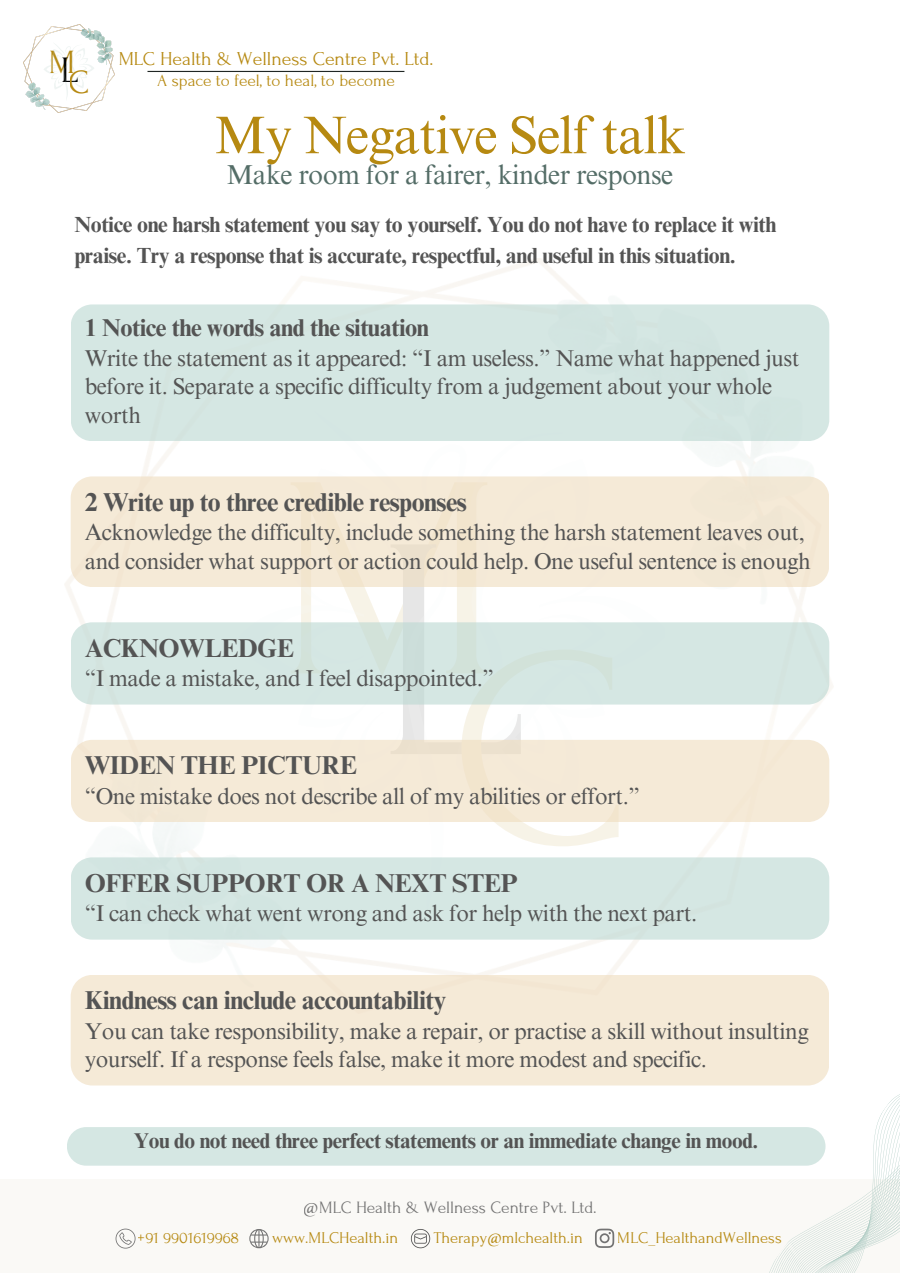
This negative self-talk worksheet is a two-page reflection resource, created by MLC, for responding to harsh self-judgements in a more specific, fair and supportive way. It asks you to choose one situation, rather than to evaluate your whole personality.
The key distinction is between an event and a verdict. “I forgot an important task” describes an event. “I am useless” turns that event into a sweeping judgement about the person. The exercise does not ask you to deny that a mistake happened. It asks whether a response can leave room for the facts, your feelings, your responsibility, and help.
If you would like to see how thoughts, feelings and actions connect before you start, The CBT Model is a companion MLC guide.
What it does not ask of you
The worksheet does not require positive affirmations, three completed answers, or an immediate improvement in mood.
When might you use it?
You might use it when you notice self-attacking language and have enough space to reflect. Common moments include:
- After receiving feedback.
- After missing a deadline.
- After making a mistake at work.
- When you are struggling with an exam.
- When you are comparing yourself with someone else.
- When you feel you have disappointed a person.
Starting with a recent, manageable situation may be easier than beginning with your most painful experience. There is no expectation to complete the worksheet every day or on a schedule.
A difficult feeling does not automatically mean your interpretation is wrong. Begin by understanding what happened and what you need.
Who is it for?
The worksheet is written for adults and older adolescents who find short reflective writing useful, and for therapists and counsellors who want a shared starting point for talking about self-criticism. For adolescents, the language and the amount of support are best adapted to the individual. The age range is a practical suggestion, not a validated one.
You do not need a diagnosis to use it. Equally, the worksheet does not establish a diagnosis or decide what treatment someone needs.
Reading, writing, concentration, language and emotional readiness all affect how usable it is. A practitioner can read the prompts aloud or help record the person’s own words. It is not designed for young children and it will not suit everyone.
What does the exercise help you practise?
The exercise helps you practise a small set of skills. These are skills the worksheet invites you to try, not outcomes this PDF has been shown to produce:
- Noticing the exact words of a harsh self-judgement.
- Linking the statement to a specific situation.
- Recognising how it affected your feelings or the urge to act.
- Separating a difficulty from a global judgement of personal worth.
- Developing a response that feels credible.
- Choosing a practical action or form of support when that is appropriate.
You may still feel upset after writing. The exercise is not a test of whether you can make yourself feel better.
If it is hard to put a name to what you felt, the Feelings Wheel & Emotional Check-In can help you find words first.
What is included in the two-page PDF?
The PDF has two A4 pages: a guide with examples, then a practice page with writing lines. It is designed to be printed and written on. It does not include a score, a rating scale, an evidence table or a progress tracker, and it has no fillable form fields.
Page 1: Guide and examples
The first page introduces the exercise and shows what a response can look like.
- An opening instruction to notice one harsh statement you say to yourself, without replacing it with praise.
- Step 1, Notice the words and the situation: write the statement as it appeared, name what happened just before it, and separate a specific difficulty from a judgement about your whole worth.
- Step 2, Write up to three credible responses. One useful sentence is enough.
- Three response directions, each with an example: Acknowledge (“I made a mistake, and I feel disappointed.”), Widen the picture (“One mistake does not describe all of my abilities or effort.”), and Offer support or a next step (“I can check what went wrong and ask for help with the next part.”).
- A note that kindness can include accountability, and that a response which feels false can be made more modest and specific.
- A closing reminder that you do not need three perfect statements or an immediate change in mood.
Page 2: Personal practice
The second page has space to write about one situation. Its fields are:
- Date and time.
- The situation: what was happening.
- The harsh statement you noticed.
- The emotional impact: how it affected what you felt or wanted to do.
- A response that acknowledges the difficulty.
- A response that includes a fuller, fairer picture.
- A response that offers support or a next step.
- Which words feel most believable, and one action you choose.
Every response is optional
The page ends with a reminder that one credible response is enough and that other spaces can be left blank. None of the three response fields is mandatory, and this is not a multi-stage protocol with a required order or completion.
How to use the worksheet, step by step
Work through one situation at a time. Take as long as you need, and stop whenever you wish.
- Choose one situation and describe what happened in a sentence or two.
- Record the harsh statement as it appeared, without making it harsher and without correcting it straight away.
- Note what you felt and what you felt like doing. No rating or score is needed.
- Choose one or more of the three response directions: acknowledge the difficulty, include relevant information the harsh statement leaves out, or identify support or a manageable action.
- Read your response and check whether you can believe it. If it sounds exaggerated, make it more modest and specific.
- Choose an action if it would help. It might be a repair, asking for help, taking a pause, or finding information. A productivity task is not compulsory.
You may leave fields blank. One credible response is enough.
A completed example
The example below is an illustration written for this website. It is not a real client’s story, and it is not an additional completed page in the PDF.
Situation
“I sent a work email without the attachment.”
Harsh statement
“I am useless. I cannot do anything properly.”
Emotional impact
“I felt embarrassed and anxious. I wanted to avoid opening my inbox.”
Acknowledge the difficulty
“I missed the attachment, and I feel embarrassed about it.”
Widen the picture
“This was one mistake in one email. It does not describe everything I do or all of my abilities.”
Offer support or a next step
“I can send the attachment with a brief correction. I can also try a short check before future emails.”
Words that feel believable and the action chosen
“I missed an attachment, and I can correct it. I will send the follow-up email.”
After the next step
After sending the follow-up, the person might still feel embarrassed. The aim is not to remove the feeling. It is to respond to the situation fairly and to take a useful next step.
What makes a response credible?
A credible response fits the situation and does not ask you to believe something grand or untrue. It is specific, it acknowledges what is difficult, and it sounds like something you could say to yourself without wincing.
Harsh statement
“I always ruin everything.”
Forced praise
“I never make mistakes and I am amazing at everything.”
A more credible response
“This situation did not go as I hoped. I can identify what happened and decide what would help next.”
Optional prompts
These prompts are website guidance. They are not additional fields in the PDF.
- “What happened, specifically?”
- “What relevant information does this statement leave out?”
- “Can I describe the difficulty without insulting myself?”
- “What would be a respectful and honest response?”
- “What support or next step is available?”
A note on accuracy
This is not a claim that every difficult thought is inaccurate. Sometimes a thought holds something true and useful, and the aim is to respond to it fairly. If you would like a fuller structure for looking at a thought, the Thought Journal and Cognitive Reframing guides are MLC companions.
Can kindness include accountability?
Yes. A fair response can acknowledge a mistake, recognise another person’s experience, and support repair. Kindness towards yourself does not require excusing harmful behaviour or pretending that consequences do not matter.
Here is an original example: “I interrupted someone, and I want to take responsibility. I can apologise and practise letting them finish. Calling myself a terrible person does not tell me what to do differently.”
Notice that the response contains responsibility and a plan, but no insult. The insult adds pain without adding direction.
Responsibility also needs context. It would be unfair to assume you caused mistreatment, discrimination, abuse, or circumstances outside your control. This worksheet is not meant to turn someone else’s harmful behaviour into your personal failure.
Guidance for therapists and counsellors
The worksheet works best as a collaborative discussion aid. These suggestions keep it that way:
- Ask permission to explore the statement.
- Understand the situation, and the function or meaning of the self-criticism, before proposing alternatives.
- Use the client’s own language, and avoid supplying an answer they feel pressured to accept.
- Validate distress without automatically endorsing the global self-judgement.
- Ask which response, if any, feels believable.
- If every alternative feels false, simplify it. “I am struggling with this today” may be more acceptable than praise.
- Discuss practical constraints, relational dynamics, and the support that is available.
- Offer between-session use collaboratively, not as a test of compliance.
- Review afterwards whether the exercise was useful, frustrating, or emotionally activating.
The three response directions are MLC’s own way of organising this exercise. They are not a named or validated three-step treatment, and their wording is not attributed to an external author.
Adapting the exercise to your context
A person might speak their answer instead of writing it, write in the language they think in, use a short phrase, or complete just one field with support. This is guidance for using the English PDF flexibly. It is not a claim that translated versions exist.
Self-criticism often sits inside a context. Pressures that may be relevant for some people, and not for others, include:
- Examination pressure.
- Comparisons with relatives or peers.
- Workplace hierarchy.
- Caregiving responsibilities.
- Family expectations.
A fairer response can respect relationships and responsibilities while also recognising limits and personal needs. It does not have to claim that other people’s opinions never matter.
When to pause or seek additional support
Writing about self-criticism can sometimes feel difficult. You can pause at any point, look at something in your surroundings, choose a less intense situation, or come back to it with a trusted practitioner. If you would like a short way to settle first, 5-4-3-2-1 Grounding is one option.
If the exercise repeatedly increases your distress, or turns into a search for a perfect or certain answer, it may help to work on this in a different way with a therapist.
This worksheet is an educational reflection tool. It does not replace individual assessment, therapy, or support for persistent or severe distress.
Created by MLC
Created by MLC Health & Wellness Centre Pvt. Ltd. The explanations, examples, design, and practice prompts were developed by MLC, informed by established psychological literature. Supporting references are provided below.
Frequently asked questions
Supporting references and evidence context
The literature below supports the cognitive and self-compassion principles informing this resource. It does not establish that this specific MLC worksheet has been independently tested or validated.
- Beck, J. S. (2021). Cognitive behavior therapy: Basics and beyond (3rd ed.). Guilford Press. https://www.guilford.com/books/Cognitive-Behavior-Therapy/Judith-Beck/9781462544196 Relevance: a clinical reference for identifying, evaluating, and responding to thoughts in CBT. It does not contain this exact MLC exercise or its three response headings.
- Neff, K. D. (2003). Self-compassion: An alternative conceptualization of a healthy attitude toward oneself. Self and Identity, 2(2), 85–101. https://doi.org/10.1080/15298860309032 Relevance: a conceptual account of self-compassion, including self-kindness and balanced awareness of difficulty. It is not an efficacy trial of this worksheet, and MLC’s three response directions are a different grouping from its components.
- Neff, K., & Germer, C. (2018). The mindful self-compassion workbook: A proven way to accept yourself, build inner strength, and thrive. Guilford Press. https://www.guilford.com/books/The-Mindful-Self-Compassion-Workbook/Neff-Germer/9781462526789 Relevance: a practice-oriented book on responding to difficulty with self-compassion. “A proven way” is part of the book’s title and is not an efficacy claim for this worksheet, which is not the Mindful Self-Compassion programme.
Platform disclaimer: this is a reflection and planning tool. It is not a diagnostic instrument or a substitute for therapy. If you are in distress, call Tele-MANAS at 14416.