
Inside the worksheet
Unlocks after purchase

Unlocks after purchase
Overview
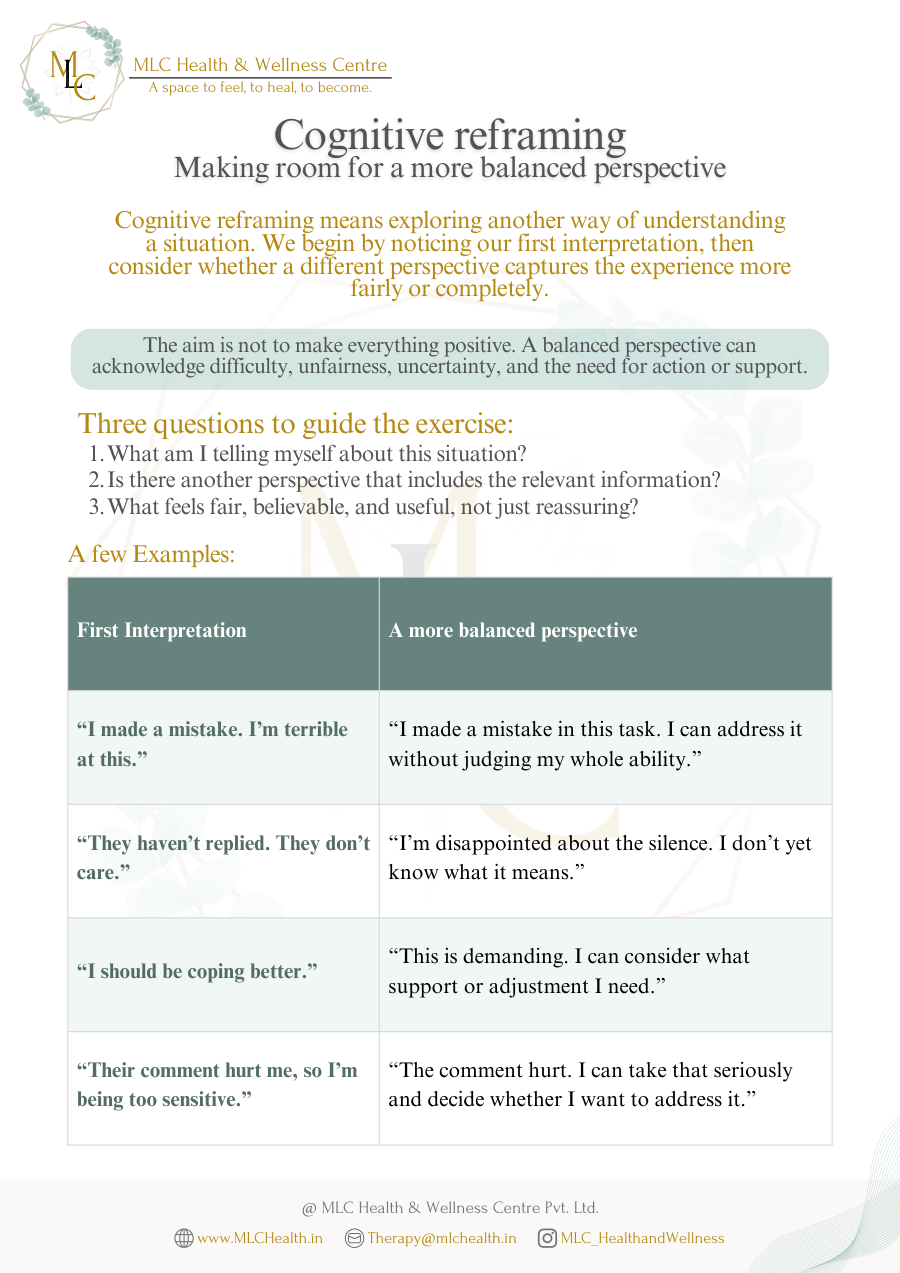
Cognitive reframing means exploring another way of understanding a situation: noticing your first interpretation, then considering whether a different perspective captures the experience more fairly or completely. This MLC resource is a printable three-page PDF: a guide with four examples, a detailed reflection worksheet, and a ten-entry table for shorter practice. It is for personal reflection and for therapists facilitating collaborative exploration of interpretations.
Our first interpretation of a situation can feel like the only possible explanation. Cognitive reframing invites us to pause and explore whether another perspective captures the experience more fairly or completely.
This does not mean making everything positive. A balanced perspective can acknowledge difficulty, unfairness, uncertainty, and the need for action or support.
The purpose is to make room for understanding and choice, not to force a change in thought or emotion.
For personal use
Choose a manageable situation and explore what you are telling yourself about it. You do not have to adopt an alternative perspective that does not fit.
For therapists
Use the resource collaboratively. Understand the person’s meaning and circumstances before suggesting another perspective.
Inside the PDF
- Page 1: explanation, three guiding questions, and four examples.
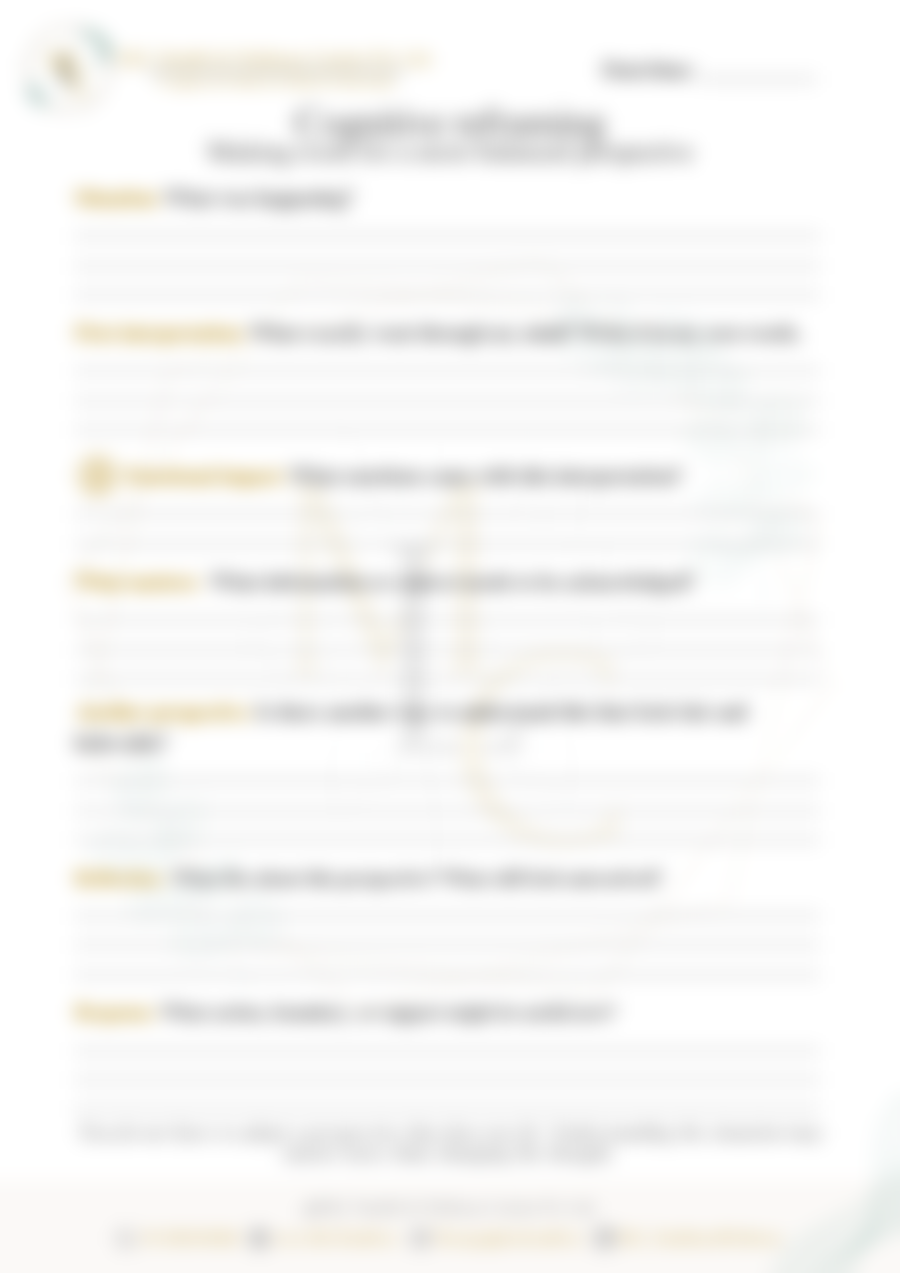
- Page 2: a detailed reflection worksheet.
- Page 3: a ten-entry table for shorter practice.
Quick start
If you only read one section, read this one. Reading the guide takes approximately 5 minutes, a detailed reflection approximately 10–15 minutes, and a brief table entry approximately 3–5 minutes once you are familiar with it. These are suggested use times, not measured completion times.
Use the three questions printed in the resource:
- What am I telling myself about this situation?
- Is there another perspective that includes the relevant information?
- What feels fair, believable, and useful, not just reassuring?
For a fuller reflection, use page 2 to explore the situation, emotional impact, relevant context, and possible response.
For shorter practice, use a row on page 3 to record a first interpretation and another perspective.
You do not need to complete all ten rows or work to a daily schedule.
Understanding reframing
First interpretation
This is what the situation initially means to you. It may contain accurate observations, assumptions, predictions, or broader judgements.
Relevant context
A useful reframe considers what happened and what matters. It does not discard information because it is uncomfortable.
Another perspective
A different perspective may be more specific, less absolute, or more accepting of uncertainty. It should remain consistent with the available information.
Believability
A statement that sounds reassuring but feels untrue may not help. A modest perspective such as “I do not know yet” may fit better than a confident positive prediction.
Response
Reflection may suggest practical action, a boundary, support, acceptance, or further information. Changing the interpretation is not always the main need.
Using the worksheets
Page 2 is a detailed reflection worksheet. Its prompts, in the printed order, are:
Date/time
Record when the experience happened or when you are reflecting.
Situation
Describe what was happening.
First interpretation
Write what went through your mind in your own words. Avoid immediately replacing it with what you think you should say.
Emotional impact
Name the emotions that came with the interpretation. The worksheet does not include a numerical rating scale.
What matters
Record information and context that need to be acknowledged. This can include real difficulties, needs, uncertainty, and relevant circumstances.
Another perspective
Explore another understanding that feels fair and believable. You may find that only part of your first interpretation needs adjusting.
Reflection
Notice what fits about the perspective and what remains unresolved. You do not have to reach certainty.
Response
Consider an action, boundary, or source of support that would be useful now.
Page 3: brief practice
Use one numbered row for a first interpretation and another perspective. The guiding questions are repeated above the table, and there is one Date/time space at the top of the page. Use page 2 when you need more context or writing space. The ten rows are available for flexible use, not a completion target, and they are not assigned to particular dates or days.
A closing reminder
You do not have to adopt a perspective that does not fit. Understanding the situation may matter more than changing the thought.
Therapist guide
Introduce the resource collaboratively:
“Could we explore whether there is another way of understanding this that still takes your experience seriously?”
Begin with the person’s own words. Ask what makes the interpretation convincing and what emotional meaning it carries.
Useful questions include:
- “Which parts are observations, and which parts are interpretations?”
- “What information must not be overlooked?”
- “Is the conclusion broader than the information supports?”
- “What remains uncertain?”
- “What would a fair account include?”
- “Does this perspective feel believable to you?”
- “Is action or support more important than changing the interpretation?”
Offer suggestions tentatively and accept disagreement.
Avoid using reframing to dismiss genuine danger, discrimination, loss, or mistreatment. A client may need validation, protection, practical help, or a boundary.
Close by checking how the exercise felt and what, if anything, the person wants to take from it.
These are suggested facilitation steps, not a standardised treatment protocol.
Worked examples
These fictional examples reflect the four comparisons included on page 1.
Example 1: A mistake
- First interpretation: “I made a mistake. I am terrible at this.”
- A more balanced perspective: “I made a mistake in this task. I can address it without judging my whole ability.”
- Possible response: Identify the correction or learning point.
Example 2: An unanswered message
- First interpretation: “They have not replied. They do not care.”
- A more balanced perspective: “I am disappointed about the silence. I do not yet know what it means.”
- Possible response: Allow uncertainty and decide whether a later follow-up would be appropriate.
Example 3: Coping expectations
- First interpretation: “I should be coping better.”
- A more balanced perspective: “This is demanding. I can consider what support or adjustment I need.”
- Possible response: Identify one demand that could be reduced or shared.
Example 4: A hurtful comment
- First interpretation: “Their comment hurt me, so I am being too sensitive.”
- A more balanced perspective: “The comment hurt. I can take that seriously and decide whether I want to address it.”
- Possible response: Consider a boundary, conversation, or support.
A note on the response suggestions
The response suggestions are additional website guidance. They are not separate printed fields on the examples page.
When it feels difficult
“The new perspective feels fake.”
Make it more modest, specific, or uncertain. Do not force yourself to adopt it.
“My first interpretation is accurate.”
Acknowledge that. The useful shift may concern self-blame, coping, or what to do next rather than the facts.
“I am trying to find a positive explanation.”
Return to the available information. Positive does not automatically mean balanced.
“I still feel upset.”
The emotion may remain understandable. Reframing does not require immediate relief.
“I keep generating alternatives.”
You do not need an exhaustive list. Pause when the exercise becomes repetitive rather than useful.
“Someone else’s reframe feels dismissive.”
You can disagree. A useful perspective should take your circumstances seriously.
“Nothing feels resolved.”
Use the reflection prompt to name what remains uncertain and what support might help.
Noticing progress
If useful, look back over a few entries.
Ask:
- Am I describing events more specifically?
- Am I separating what I know from what I assume?
- Can I allow uncertainty without inventing reassurance?
- Am I being fairer towards myself?
- Have I identified useful actions or support?
- Does this practice help, or feel like another demand?
Progress does not require eliminating difficult thoughts or emotions.
The resource has no scoring system. Completing all ten rows does not indicate recovery, and leaving rows blank does not indicate failure.
Adapting it
Adolescents
Use familiar examples they choose. Avoid presenting the exercise as correcting their attitude.
Reading or writing difficulties
Use short phrases, spoken reflection, or supported writing. Choose the detailed worksheet or brief table according to preference.
Language and culture
Explore the meaning of words and expectations within the person’s circumstances. Do not assume unfamiliar values or expressions are inaccurate thinking.
Neurodivergent users
Offer concrete questions, processing time, and clear distinctions between information and inference. Accept that an alternative interpretation may not fit.
Perfectionism
Emphasise that a perspective can be tentative and incomplete. There is no perfect reframe.
Real-world adversity
Take practical barriers, harm, discrimination, illness, and loss seriously. Consider action and support alongside interpretation.
A note on these adaptations
These are practical adaptations, not evidence that this specific resource has been validated for each group.
Limits & ethics
This is a reflection resource, not a diagnostic instrument, complete assessment, or stand-alone treatment.
Reframing should not be used to excuse harmful behaviour, minimise risk, or persuade someone to accept mistreatment.
Emotions are not errors. A different interpretation does not automatically remove an emotion or invalidate its meaning.
People may decline, disagree, leave sections blank, or stop.
Completed worksheets can contain sensitive information. Consider where they will be stored and who may see them.
The resource does not replace clinical assessment, safeguarding procedures, or urgent support when needed.
Background & evidence
This MLC resource is informed by established CBT methods for identifying interpretations, considering relevant information, and exploring alternative or balanced perspectives.
Judith S. Beck’s Cognitive Behavior Therapy: Basics and Beyond discusses identifying, evaluating, and responding to automatic thoughts within individualised CBT (Beck, 2020).
Greenberger and Padesky’s Mind Over Mood describes work with thoughts, evidence, alternative or balanced thinking, and action plans (Greenberger & Padesky, 2016).
These references support the underlying methods. They do not establish that this particular MLC resource has been independently tested or that completing it will produce a specific emotional outcome.
The suggested timings, examples, and facilitation steps on this page are practical guidance.
Using the PDF
The PDF contains three A4 pages.
Page 1
Read the explanation, three guiding questions, and four examples.
Page 2
Explore one situation in detail, including context, emotional impact, another perspective, and a response.
Page 3
Record shorter entries in the ten-row practice table.
Printing and writing
Print another copy of page 2 or page 3 when needed. You do not have to complete every row. It is a printable PDF: write on a printed copy or annotate the PDF using a suitable app. The file does not contain interactive typing fields. Store completed copies somewhere appropriate for personal information.
About this resource
Created by MLC Health & Wellness Centre Pvt. Ltd. The explanations, examples, design, and practice prompts were developed by MLC, informed by established psychological literature. Supporting references are provided below.
Frequently asked questions
References
- Beck, J. S. (2020). Cognitive behavior therapy: Basics and beyond (3rd ed.). The Guilford Press. https://www.guilford.com/books/Cognitive-Behavior-Therapy/Judith-Beck/9781462544196
- Greenberger, D., & Padesky, C. A. (2016). Mind over mood: Change how you feel by changing the way you think (2nd ed.). The Guilford Press. https://www.guilford.com/books/Mind-Over-Mood/Greenberger-Padesky/9781462520428
Platform disclaimer: this is a reflection and planning tool. It is not a diagnostic instrument or a substitute for therapy. If you are in distress, call Tele-MANAS at 14416.