
Inside the worksheet

Unlocks after purchase
Overview
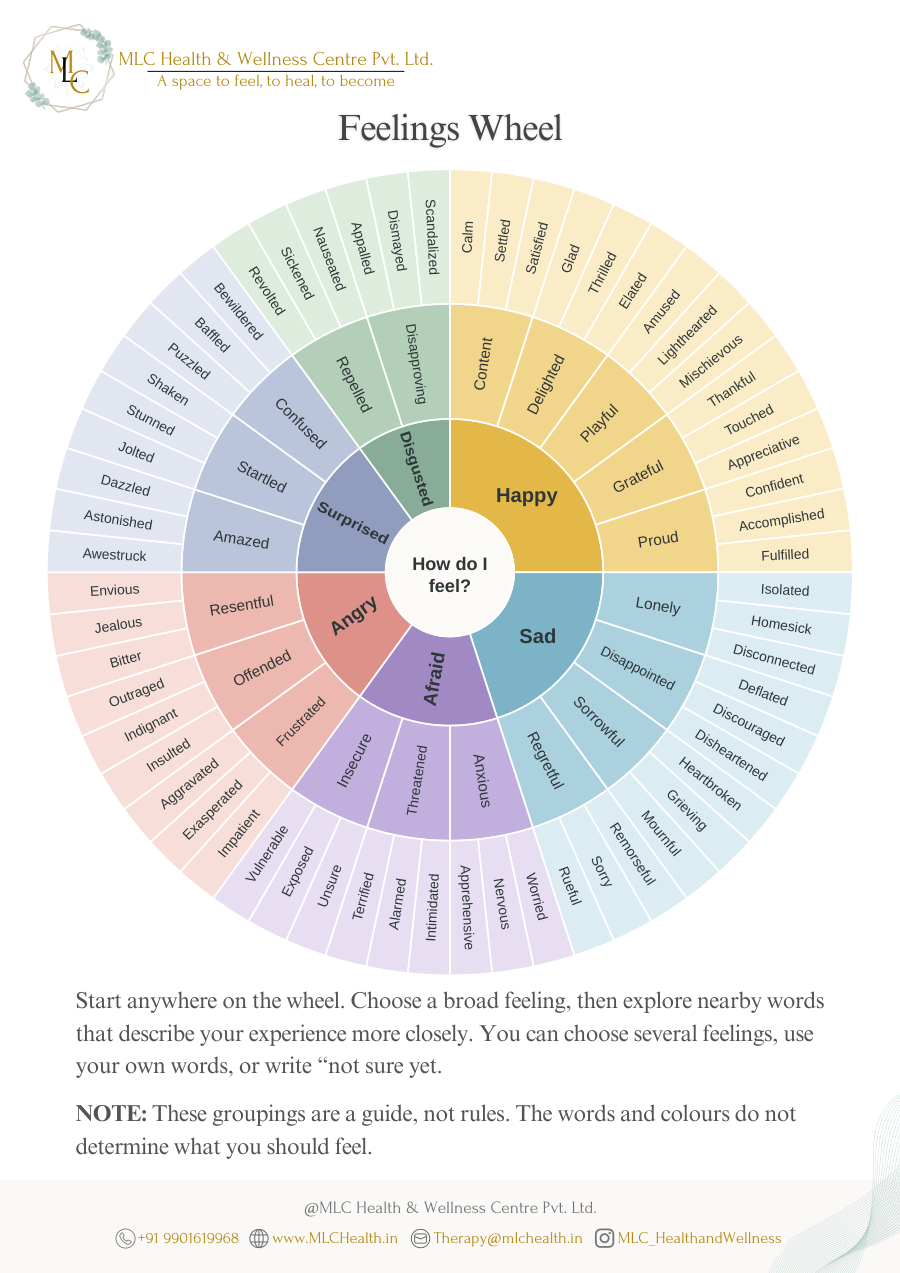
A feelings wheel is a diagram of feeling words, arranged so you can start with a broad word and explore more specific ones. This MLC resource is a printable two-page PDF: a feelings wheel plus a reusable Emotional Check-In worksheet, for personal reflection and for conversations in therapy.
Sometimes we know that something is happening emotionally but cannot find words for it. We may say “fine,” “bad,” or “stressed,” even when our experience is more complicated.
A feelings wheel offers a selection of words to explore. You can start with a broad label and move towards a more specific description, or begin with any word that catches your attention. There is no correct route.
The companion check-in page invites you to connect those words with a particular moment: what was happening, what you noticed, how you responded, and what might support you.
The aim is understanding. Feeling calmer afterwards is not a requirement.
For personal use
Use this resource to pause and become curious about your experience. You can choose several words, change your mind, or decide that none fits.
For therapists
Use the wheel as a shared vocabulary aid. Invite the client’s own meaning rather than treating the diagram as an answer key.
Inside the PDF
- Page 1: a feelings wheel with brief instructions and a note about interpreting the groupings.
- Page 2: a reusable emotional check-in worksheet.
- Space to choose up to three feeling words and optionally describe their intensity.
- Prompts exploring context, thoughts, bodily sensations, urges, actions, support, and a manageable response.
Quick start
If you only read one section, read this one. A brief check-in usually takes approximately 5–10 minutes; these are suggested use times, not measured completion times.
- Choose a present feeling or a recent moment that feels manageable to explore.
- Look for a broad word that roughly fits.
- Explore nearby words, or scan the rest of the wheel.
- Choose one to three words, or write your own.
- If useful, add a personal intensity rating beside each feeling.
- Ask: “What was happening, and what might support me now?”
- Write a brief response on the check-in sheet.
One optional way to describe intensity is a scale from 0, not noticeable, to 10, extremely strong. This is suggested guidance for the optional intensity field, not a diagnostic score or a scale printed on the worksheet.
“Not sure yet” is a valid answer. You do not need to complete every prompt.
If reflection becomes overwhelming, pause. You might look around the room, notice the support of your chair, or return to the activity later.
Understanding the wheel
The wheel arranges broad feeling labels towards the centre and additional words further out. These groupings offer a starting point for exploration.
The six central groups in this wheel are Happy, Sad, Afraid, Angry, Surprised, and Disgusted. They organise this particular diagram; they are not an exhaustive or universally agreed classification.
You may:
- Start in the centre and work outwards.
- Start with a specific word and explore what it means to you.
- Choose words from different sections.
- Experience several feelings together.
- Use a word that does not appear on the wheel.
The wheel does not show a measured progression of intensity. Moving outwards offers additional vocabulary, not necessarily a stronger feeling.
Colours help organise the diagram. They are not scores or indicators of emotional health. The size of a section does not indicate how important or common that feeling is.
Some words describe bodily sensations, interpretations, or interpersonal experiences alongside feelings. For example, “nauseated,” “disapproving,” and “threatened” describe different aspects of experience. Ask what the chosen word means to you rather than treating every entry as the same kind of emotional label.
The groupings are suggestions. You might feel calm without feeling happy, or confused without feeling surprised. Your description does not have to follow the diagram’s arrangement.
Using the worksheet
Complete one check-in for one moment. Short answers are enough, and you can leave questions unanswered.
Date and context
Record the date or time in the space provided. Indicate whether you are reflecting on now or an earlier moment.
What was happening?
Describe the situation briefly. You do not need to give a full history or explain everything that led up to it.
Which feeling words fit?
Choose up to three words. Add your own or write “unclear” if needed.
Optional intensity
If useful, add a number beside each feeling. One suggested scale is 0 = not noticeable and 10 = extremely strong. This is additional guidance for the optional intensity field, not a diagnostic score or a scale printed on the worksheet.
Thoughts or meanings
Write what went through your mind or what the situation meant to you. Thoughts and feelings can be connected without being identical.
Body
Notice any sensations you want to record. You can leave this blank if body-focused attention is uncomfortable or unhelpful.
Urges and actions
The worksheet asks what you felt an urge to do and what you actually did. These may be different. An urge does not require action.
Support
Consider what might help: rest, food, company, information, space, a boundary, practical help, or time.
One kind, manageable response
Choose a small response if one feels useful. You may also decide that being heard or understood is enough for now.
Optional reflection after completing the sheet
Ask yourself what the check-in was like. This is an additional reflection, rather than a separate printed field. Your feelings may have changed, stayed the same, or become clearer.
You can pause at any time
You do not have to change a feeling for this exercise to be useful. You can pause whenever you need to.
Therapist guide
Introduce the resource collaboratively:
“Would it help to look at some feeling words together? You can disagree with any of them.”
Begin with a manageable moment rather than automatically choosing the client’s most distressing experience.
Invite the client to select a word before offering suggestions. If they want help, offer tentative possibilities:
“Would disappointed or worried fit, or does neither feel right?”
Explore the client’s meaning:
- “What does that word mean for you here?”
- “Is there another feeling alongside it?”
- “What was happening when you noticed it?”
- “What did you feel an urge to do?”
- “What kind of support would feel useful?”
Accept uncertainty, silence, mixed feelings, and the client’s own vocabulary. Avoid correcting someone because their chosen word sits in an unexpected part of the diagram.
Use the worksheet selectively. A client can speak, draw, point, or complete only one prompt.
Avoid assuming that finding a more specific word will immediately reduce distress. Ask how the process is affecting the client and adjust accordingly.
Before closing, ask how the exercise felt and whether the client wants to revisit it. Agree any between-session practice together.
Record and store completed worksheets according to the service’s consent and records practices.
These are suggested facilitation steps, not a standardised treatment protocol. A guided reflection usually takes approximately 10–15 minutes, which is a suggested use time rather than a measured one.
Worked examples
These fictional examples illustrate use. They are not interpretations to apply automatically to someone else. Some examples use words outside the wheel, as the worksheet allows.
Example 1: A friend cancels
- Situation: My friend cancelled our plans at short notice.
- Feelings: Disappointed, lonely, and a little relieved.
- Thoughts or meanings: “I was looking forward to company, but I am also tired.”
- Body: Heavy shoulders.
- Urge: Send an irritated message.
- What I did: Waited before responding.
- Support: Connection and rest.
- One manageable response: Arrange another time and choose a restful evening.
Example 2: Feedback at work
- Situation: My manager asked me to revise a report.
- Feelings: Embarrassed, anxious, and frustrated.
- Thoughts or meanings: “I am worried this means I am not doing well.”
- Body: Warm face and tight stomach.
- Urge: Avoid the report.
- What I did: Read the feedback once.
- Support: Clarity about what needs changing.
- One manageable response: Ask one specific question and choose the first revision.
Example 3: Starting something wanted
- Situation: I am about to begin a course I chose.
- Feelings: Excited, proud, and nervous.
- Thoughts or meanings: “This matters to me, and I do not know what to expect.”
- Body: Restlessness.
- Urge: Keep checking the joining instructions.
- What I did: Checked the instructions several times.
- Support: Preparation and encouragement.
- One manageable response: Write down any outstanding practical question and speak to someone supportive.
Example 4: No clear word
- Situation: I have felt “off” all afternoon.
- Feelings: Not sure; perhaps flat or disconnected.
- Thoughts or meanings: Nothing clear yet.
- Body: Low energy.
- Urge: Withdraw for a while.
- What I did: Sat quietly.
- Support: A pause and a check on basic needs.
- One manageable response: Take a break and return to the reflection later if useful.
When it feels difficult
“None of the words fits.”
Use your own language, a metaphor, a colour, or “not sure.” The diagram should serve your experience.
“Too many words fit.”
Choose the one or two that feel most relevant. You do not need a complete emotional inventory.
“I keep trying to find the correct answer.”
Choose a word that is close enough for now. You can revise it.
“I feel numb.”
Record numbness or the absence of a clear feeling. Do not force yourself to uncover something underneath.
“Naming it makes it feel stronger.”
Pause and decide whether to continue, change the focus, or explore it with support. More intense reflection is not automatically more useful.
“I cannot explain why.”
You can name a feeling without knowing its cause.
“I keep repeating the exercise for reassurance.”
You do not need to repeat the check-in until you feel certain or calm. If repeated checking is becoming distressing, consider discussing the pattern with your therapist.
“I do not want to write it down.”
You can reflect privately, speak, draw, or skip the exercise.
Noticing patterns
If check-ins are useful, try them occasionally across different situations. There is no required daily schedule.
After a few entries, ask:
- Which situations come up repeatedly?
- Which words seem useful?
- Do several feelings often appear together?
- What support helped?
- Are there circumstances I want to understand more?
- Is using the worksheet helpful, neutral, or becoming a burden?
You might notice that you are finding words that fit, recognising mixed feelings, expressing yourself more clearly, or identifying support.
Progress does not have to mean lower intensity ratings.
The ratings are personal descriptions. Do not add them together, interpret them against clinical thresholds, or use them to diagnose a condition.
If tracking starts to feel demanding or repetitive, use the resource less often or pause.
Adapting it
Adolescents
Offer a smaller selection of familiar words and invite their own vocabulary. Avoid making the exercise feel like a test.
Younger children
The full wheel may be too dense. A separate simplified activity with a few words, pictures, or drawing may be more appropriate. This version is not designed around a validated minimum age.
People who find emotion words difficult
Begin with broad descriptions, such as pleasant, unpleasant, mixed, activated, or low energy. More detail can remain optional.
Language and culture
Invite words from the person’s preferred language. A translated word may not carry exactly the same meaning.
Neurodivergent users
Ask which format is useful. Options include concrete examples, written choices, more processing time, and alternatives to body-focused prompts. Do not assume a particular emotional experience from a diagnosis.
People who find inward attention distressing
Keep the exercise brief, focus on a manageable present situation, and make body prompts optional.
Couples or families
Each person describes their own experience. Do not use the wheel to assign feelings to someone else.
Visual or reading accessibility
A readable text list, spoken choices, or a smaller selection of words may be easier to use than the full diagram. These are alternative ways of facilitating the exercise, rather than additional files included in the download.
A note on these suggestions
These are practical accessibility suggestions, not evidence that this particular worksheet has been validated for these groups.
Limits & ethics
This is a reflection and communication resource. It is not a diagnostic instrument, a psychological test, or a stand-alone treatment.
The wheel does not contain every possible feeling, and its categories are not rules.
You can decline the exercise, leave questions unanswered, or stop. In guided use, the person completing it should choose what they want to share.
A chosen word is an invitation to understand someone’s experience. It should not be used to impose an interpretation or challenge their account.
Emotions are not moral failings. They also do not automatically establish facts about a situation or another person’s intentions.
A completed sheet may contain sensitive information. Decide where to keep it and who, if anyone, may see it.
The resource does not replace clinical assessment, safeguarding procedures, or crisis support. If you need urgent help, seek appropriate local emergency or crisis services.
Background & evidence
This resource uses a feelings vocabulary wheel and reflection prompts to support emotional exploration. It should not be understood as a validated assessment or an independently tested treatment.
Related research examines affect labelling: putting emotional experiences into words.
Torre and Lieberman’s 2018 review discusses research on affect labelling across subjective experience, physiological responses, brain activity, and behaviour. This literature provides a rationale for exploring emotion words. It does not establish the effectiveness of this particular wheel or guarantee relief.
In a laboratory task involving negative emotional images, Lieberman and colleagues (2007) found reduced amygdala responses during affect labelling relative to comparison encoding conditions. This finding does not establish that completing this worksheet produces the same effect or guarantees subjective relief.
The check-in prompts, suggested timings, optional rating scale, and facilitation steps on this page are practical guidance. They are not a validated clinical protocol.
Using the PDF
The PDF contains two pages:
- Page 1: the Feelings Wheel and its instructions.
- Page 2: My Emotional Check-In — Feelings Wheel Companion.
It is a printable PDF. Keep page 1 as a reference and print page 2 again for a new check-in.
You can write on a printed copy or annotate the PDF using a suitable app. Digital annotation depends on the app you use and is different from having interactive typing fields.
Print at a size that keeps the smallest words readable. Avoid placing several copies of the wheel on one page.
Store completed sheets privately, particularly if they include sensitive personal information.
Attribution
This PDF, including the feelings wheel artwork, its layout and the My Emotional Check-In companion worksheet, was designed and produced by MLC Health & Wellness Centre Pvt. Ltd.
Research referenced on this page concerns affect labelling and does not validate this specific wheel, its groupings, or the companion worksheet.
Frequently asked questions
References
- Torre, J. B., & Lieberman, M. D. (2018). Putting feelings into words: Affect labeling as implicit emotion regulation. Emotion Review, 10(2), 116–124. https://doi.org/10.1177/1754073917742706
- Lieberman, M. D., Eisenberger, N. I., Crockett, M. J., Tom, S. M., Pfeifer, J. H., & Way, B. M. (2007). Putting feelings into words: Affect labeling disrupts amygdala activity in response to affective stimuli. Psychological Science, 18(5), 421–428. https://doi.org/10.1111/j.1467-9280.2007.01916.x
Platform disclaimer: this is a reflection and planning tool. It is not a diagnostic instrument or a substitute for therapy. If you are in distress, call Tele-MANAS at 14416.