
Inside the worksheet
Unlocks after purchase
What is the Body Map of Emotions?
A two-page guide and worksheet for noticing how emotions show up in your body. Use colours, symbols, shading, or words to describe your experience and reflect on your behaviour, possible supports, and situations associated with the feeling.
The Body Map of Emotions is a visual reflection tool for exploring the bodily sensations you notice alongside emotions.
You can mark a body outline with colours, symbols, shading, or words, then reflect on the situation, your feelings, your behaviour, and what might help.
There is no correct map. You may notice several sensations, something difficult to describe, or nothing clear at all. The purpose is to describe your experience, rather than match a prescribed pattern.
What can this resource help you explore?
This worksheet offers a structure for considering:
- What was happening when you noticed a feeling.
- Which emotion or emotions you recognised.
- What sensations you noticed and where.
- How you behaved while feeling that way.
- What might help you respond or support an emotion you want to stay with.
- Which situations seem associated with the feeling.
You do not need to finish every prompt. A few words or a small mark can be enough for one reflection.
What is included?
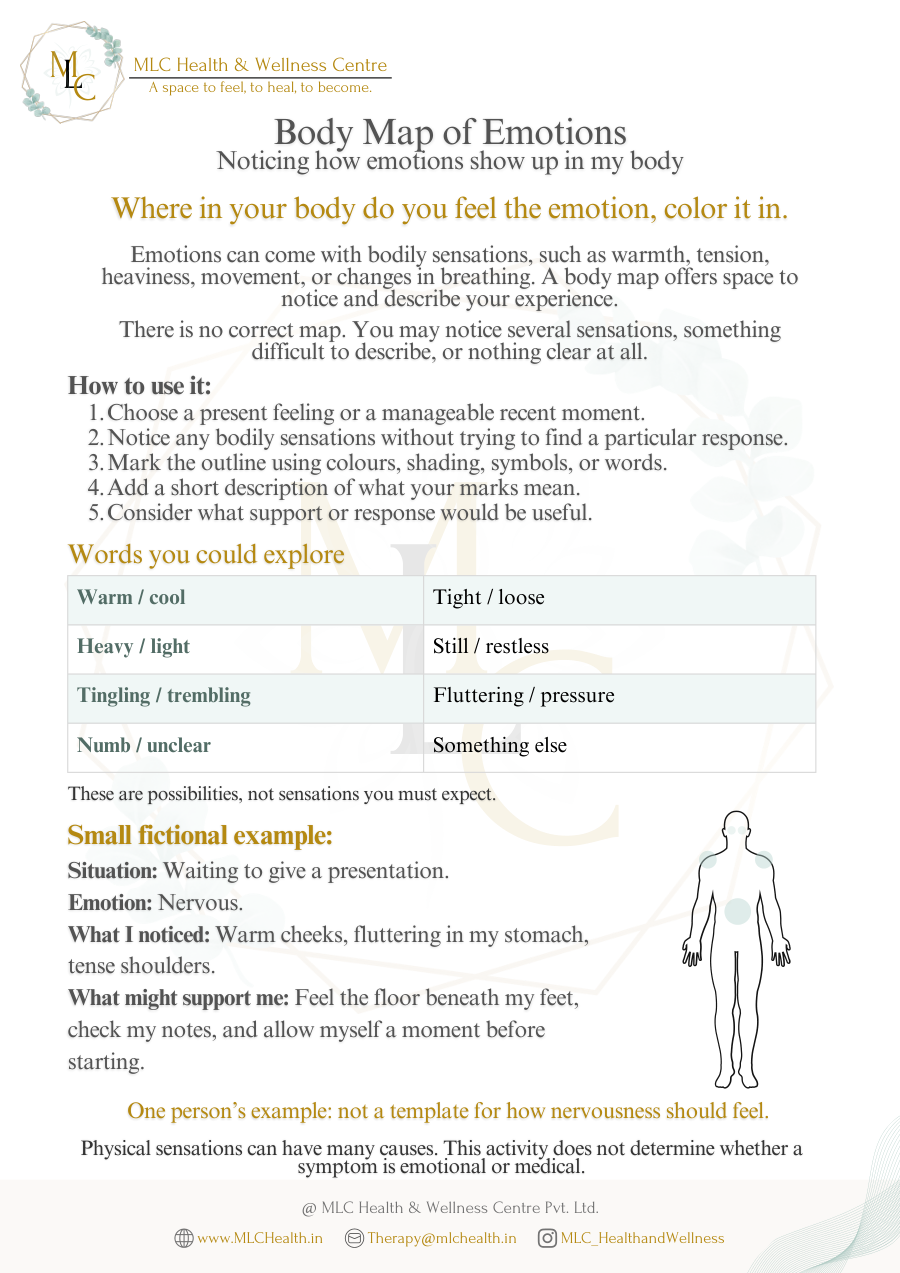
Page 1: Understanding and using the body map
The guide introduces bodily sensations associated with emotions, provides five steps for using the tool, offers sensation words, and includes a fictional example about feeling nervous before a presentation. It also explains that sensations can have many causes and that the activity cannot determine whether a symptom is emotional or medical.
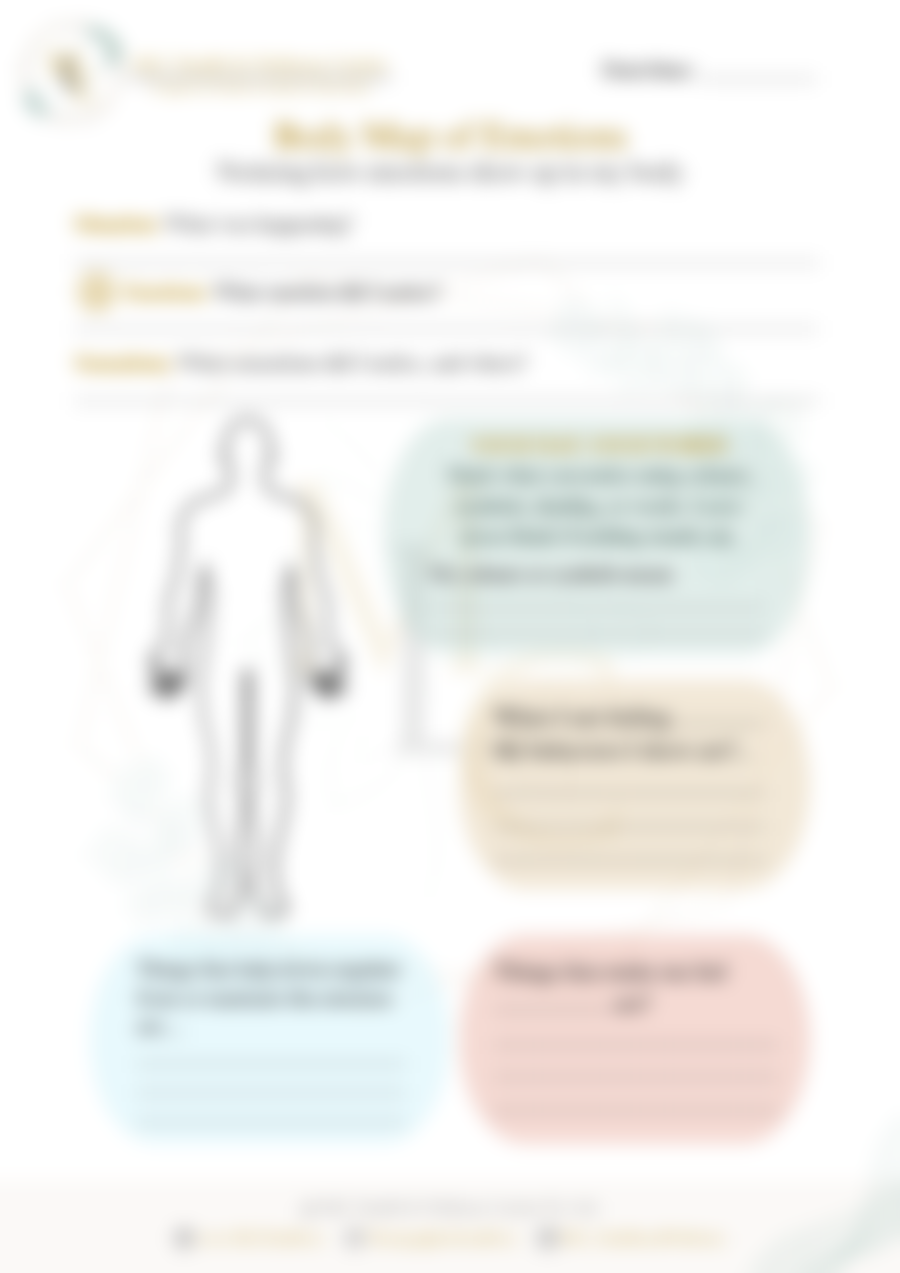
Page 2: Your personal body map
The worksheet includes:
- Date and time.
- Situation: “What was happening?”
- Emotions: “What emotion did I notice?”
- Sensations: “What sensations did I notice, and where?”
- A body outline to mark.
- Space to explain your colours or symbols.
- A prompt about the behaviours you show when feeling an emotion.
- A prompt about things that help down-regulate or maintain the emotion.
- A prompt about things associated with feeling that emotion.
How do I get started?
Reflecting on one moment takes approximately 5–10 minutes, and 10–15 minutes if you are discussing it with support. These are practical estimates, not research-established completion times.
- Choose a present feeling or a manageable recent moment.
- Briefly describe what was happening.
- Name an emotion if you can. “Mixed,” “unsure,” or your own wording is acceptable.
- Notice any bodily sensations without searching for a particular response.
- Mark the outline using colours, shading, symbols, or words.
- Explain your marks and complete whichever reflection prompts feel useful.
Keep the experience manageable. You do not need to recall your most distressing experience or complete a prolonged body scan.
How do I describe bodily sensations?
Try describing what you notice before deciding what it means.
Possible words include warm, cool, tight, loose, heavy, light, still, restless, tingling, trembling, fluttering, pressure, numb, or unclear.
These are vocabulary suggestions, not sensations you should expect. You can write something else or leave an area blank.
For example, “tightness around my shoulders” describes a sensation, while “worried” names an emotion. Both can belong on the worksheet, in their respective spaces.
How do colours and symbols work?
Choose colours or symbols that make sense to you and explain them in the space provided.
For example, you might use a zigzag for tension or a shaded patch for warmth. The same mark may mean something different to another person.
There is no universal colour key for this worksheet. Neither a colour nor a location on the body can independently identify an emotion, diagnosis, or personal history.
Words and pencil marks work just as well as colour.
How do I use the behaviour and support prompts?
For the behaviour prompt, describe what you actually did. Examples might include speaking quickly, going quiet, asking for reassurance, taking a break, or reaching out to someone.
In the support prompt, down-regulate means reducing the intensity of an emotion when that would be helpful. Maintain means supporting an emotional experience you would like to continue, such as contentment or connection.
You do not have to make every emotion disappear. Consider what would help you respond in a way that fits the situation and your needs.
For “Things that make me feel…,” note situations or experiences you associate with the emotion. A single entry does not establish a definite cause.
What might a completed example look like?
Fictional illustration:
- Situation: Waiting to give a presentation.
- Emotion: Nervous.
- Sensations: Warm cheeks, a fluttering stomach, and tense shoulders.
- Body map: Shading around the cheeks, stomach, and shoulders, with a short explanation of each mark.
- Behaviour: Checking my notes repeatedly and speaking quickly.
- Possible support: Feeling my feet against the floor, checking my opening sentence, and allowing myself a moment before speaking.
- Associated situation: Speaking in front of an unfamiliar group.
This illustrates one possible experience. It is not a template for how nervousness should feel, and these supports will not suit everyone.
What if I cannot identify an emotion or sensation?
You can write “unsure,” “nothing clear,” or “difficult to describe.” You can also describe the situation first and return to the other prompts later.
If a precise emotion word is unavailable, a broader description such as “uncomfortable,” “pleasant,” or “mixed” may be useful.
Leaving the outline blank is a valid response. The worksheet is not a test of how well you can notice your body, and an unclear or numb experience does not establish a diagnosis.
What if focusing on my body feels uncomfortable?
Keep participation optional and brief. You may skip a body area, write words instead of marking the outline, or stop.
If inward attention feels unsettling, look around the room and notice your surroundings. You can return to the activity with support if you choose.
You do not need to close your eyes, change your breathing, or continue through discomfort. This resource should not be used to pressure someone into revisiting distressing experiences.
How can I use it over time or with a therapist?
You can complete a fresh worksheet on another occasion and compare your own observations gently.
Consider whether certain situations, behaviours, or supports appear more than once. Look for possibilities to discuss rather than fixed rules about your body.
A therapist can help you explore the meaning of your own descriptions and consider responses that fit your circumstances. They should ask what your marks mean rather than interpret them on your behalf.
Repeated use is optional. There is no required frequency, score, or target pattern.
What does the evidence support, and what are the limits?
Research has examined how people report bodily sensations associated with emotions. Nummenmaa and colleagues’ study used body silhouettes to investigate these reported patterns (Nummenmaa et al., 2014).
This provides relevant scientific background for exploring emotion-related bodily experiences. It does not validate the specific MLC worksheet, establish that completing it improves emotional regulation, or provide an individual diagnostic key.
The worksheet records your observations. It does not measure physiological activity or determine why a sensation is happening.
Physical sensations can have many causes. Do not use the worksheet to dismiss a physical symptom as “just emotional” or to decide whether medical assessment is needed.
About this resource
Created by MLC Health & Wellness Centre Pvt. Ltd. The explanations, examples, design, and practice prompts were developed by MLC, informed by established psychological literature. Supporting references are provided below.
This resource is intended for reflection and psychoeducation. It is not a diagnostic assessment or a substitute for individualised psychological or medical care.
Frequently asked questions
References
- Nummenmaa, L., Glerean, E., Hari, R., & Hietanen, J. K. (2014). Bodily maps of emotions. Proceedings of the National Academy of Sciences, 111(2), 646–651. https://doi.org/10.1073/pnas.1321664111 Relevant background on self-reported bodily sensations associated with emotions. This study did not evaluate the MLC Body Map of Emotions worksheet or establish its therapeutic effectiveness.
Platform disclaimer: this is a reflection and planning tool. It is not a diagnostic instrument or a substitute for therapy. If you are in distress, call Tele-MANAS at 14416.