
Inside the worksheet
Unlocks after purchase
What is HALT?
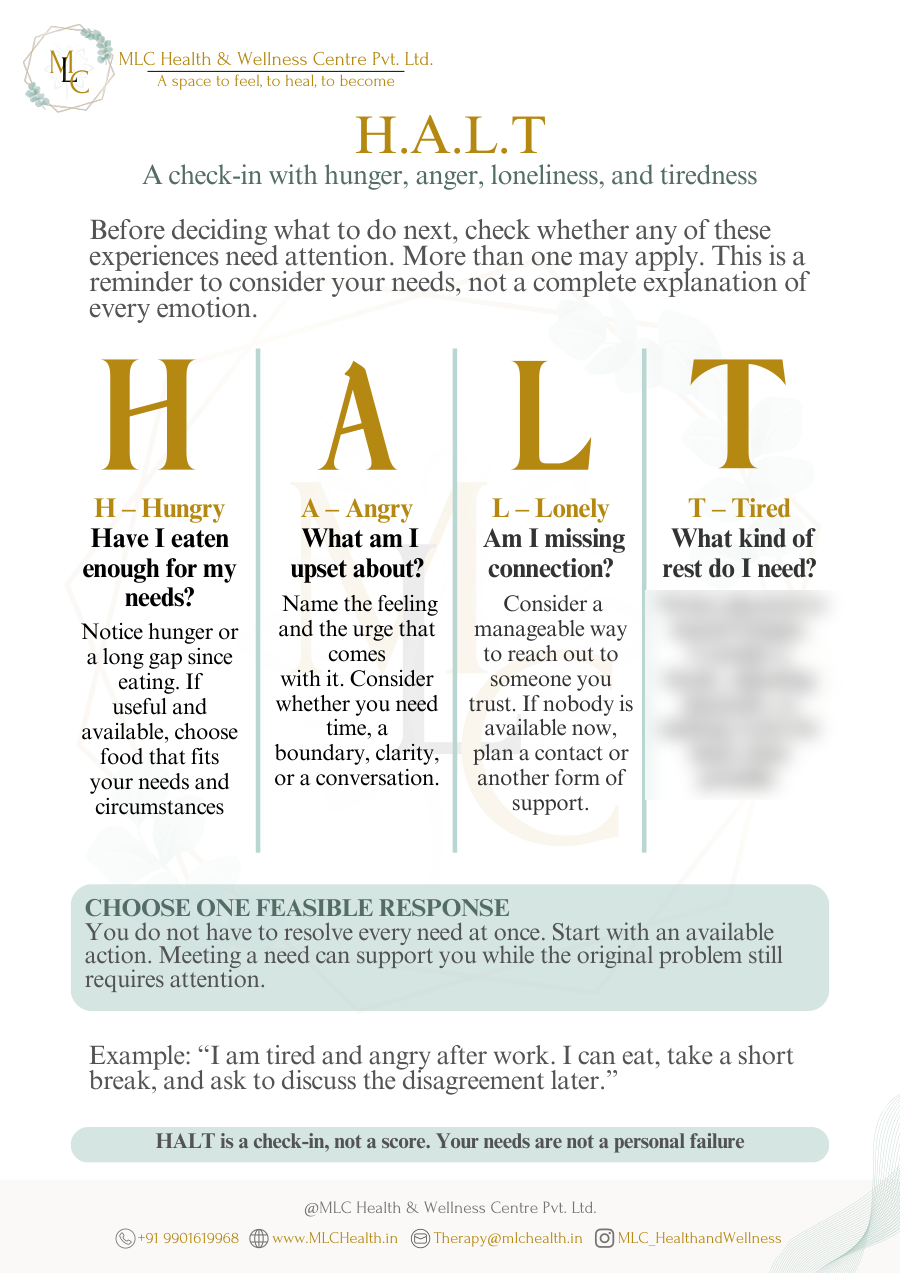
HALT is a brief mnemonic for checking four experiences that may deserve attention. It stands for Hungry, Angry, Lonely and Tired, and gives you four prompts to consider before deciding what to do next.
- Hungry: ask “Have I eaten enough for my needs?”
- Angry: ask “What am I upset about?”
- Lonely: ask “Am I missing connection?”
- Tired: ask “What kind of rest do I need?”
- Choose one feasible response: start with an available action. You do not have to resolve every need at once.
More than one may apply, and none may fully explain the situation. The exercise does not require finding a single cause for an emotion.
HALT is a check-in rather than an instruction to stop every activity. Its purpose is to help you notice whether something needs attention and identify a possible response.
What is this resource intended to help you practise?
These are the resource’s intended functions, not guaranteed outcomes.
If you remain distressed afterwards, that does not mean you have failed to look after yourself properly.
Notice your current experience
Check whether hunger, anger, loneliness, or tiredness is present.
Consider what might help
Move beyond naming the experience towards identifying an available response.
Choose one feasible action
You may not be able to meet every need immediately. The worksheet helps you select a first step and consider an alternative.
What is included in the PDF?
Page 1: Guide
The guide includes:
- A short introduction.
- Four columns explaining Hungry, Angry, Lonely, and Tired.
- Questions for exploring each experience.
- Possible responses.
- Guidance to choose one feasible action.
- A brief example involving tiredness and anger after work.
- A reminder that needs are not a personal failure.
Page 2: Worksheet
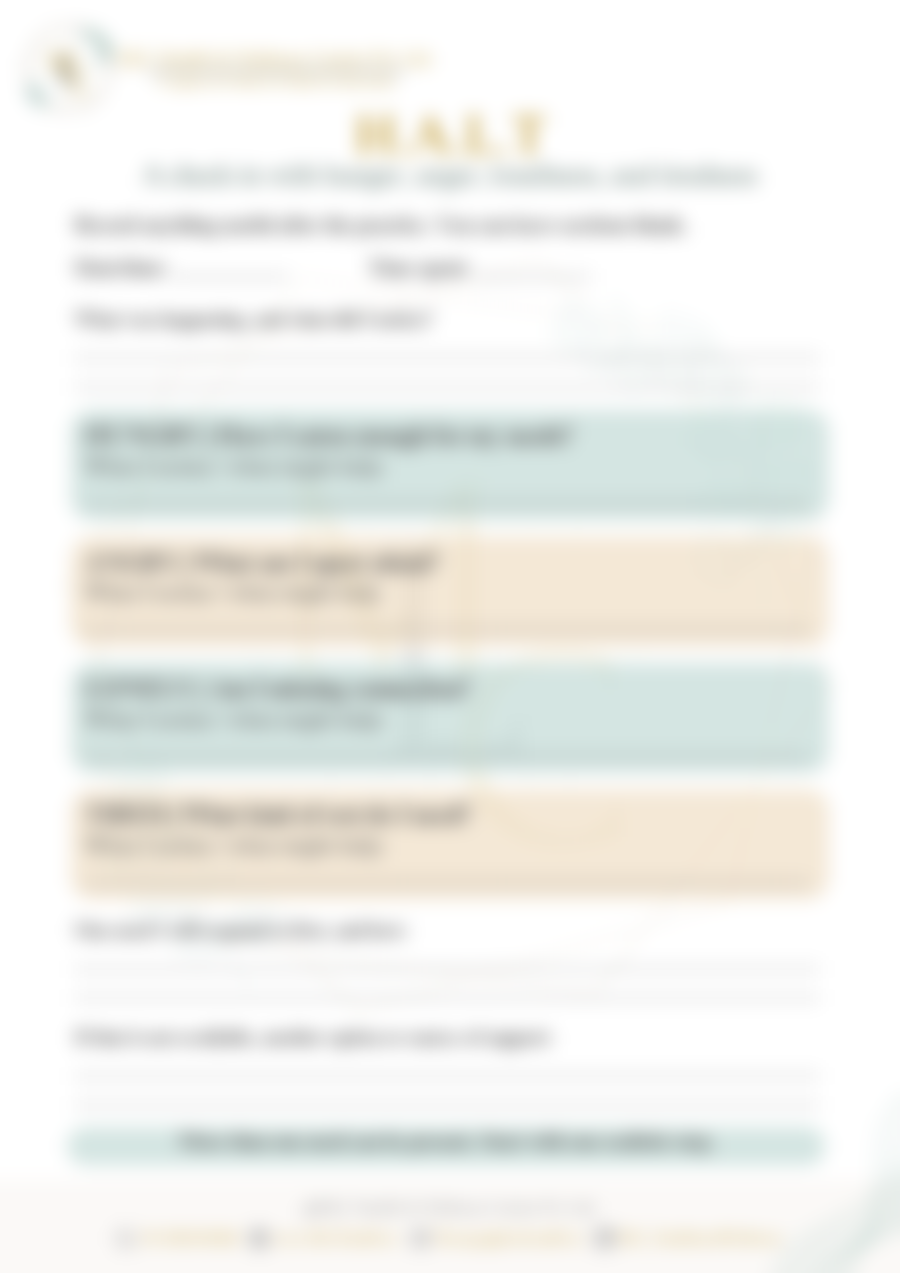
The worksheet contains:
- Date/time.
- Time spent.
- What was happening and what was noticed.
- A Hungry section.
- An Angry section.
- A Lonely section.
- A Tired section.
- One need to respond to first and how.
- Another option or source of support if the first response is unavailable.
What it does not include
Each HALT section asks what you notice and what might help. There are no checkboxes, severity scores, daily tracker, or additional fields. The PDF is printable, with writing spaces only, and has no embedded form fields.
When might you use it?
Everyday moments where a quick check-in might fit:
- After work, when feeling irritable or depleted.
- Before replying during a disagreement.
- When concentration is difficult and you want to consider your current circumstances.
- After a demanding day with little food, rest, or connection.
- In therapy, when reviewing what made a difficult moment harder.
You can use the check-in at an ordinary moment as well as during distress.
It should not delay addressing an urgent problem. Nor does it replace considering other factors such as pain, illness, grief, workload, discrimination, or relationship difficulties.
H - Hungry
The PDF’s question is: “Have I eaten enough for my needs?” Hunger is a physical state and a care need.
Notice hunger, a long gap since eating, or uncertainty about whether nourishment is needed. If it is useful and available, the next step might be eating something that fits your needs and circumstances, or planning access to food.
The resource does not prescribe calories, meal timing, food groups, or a universal eating schedule. It does not moralise food or treat eating as a reward for completing work.
If recognising hunger or making food decisions is difficult, this worksheet is not a nutritional assessment, and individual guidance may be more useful.
The point is to consider nourishment without assuming that food explains every feeling.
A - Angry
The PDF’s question is: “What am I upset about?” Anger is an emotion that may point towards a concern, an interpretation, a boundary, or a change you would like.
It helps to separate the feeling from the urge to act. For example: “I feel angry about the change in plans, and I want to send a sharp message.”
Anger may be connected with a boundary, unfairness, disappointment, an interpretation, or several factors. Not every angry interpretation is accurate, and anger itself is not wrong.
Possible responses include asking for time, clarifying what happened, setting a boundary, discussing a concern, or seeking support.
The goal is not to eliminate anger before responding.
L - Lonely
The PDF’s question is: “Am I missing connection?” Loneliness concerns how connected you feel, rather than simply whether other people are physically present.
A manageable response might be to:
- Send a message to someone trusted.
- Arrange a conversation or shared activity.
- Identify a supportive setting.
- Plan contact for a more suitable time.
Not every kind of social contact is helpful, and you should not approach someone who feels unsafe.
If nobody is available right now, that limitation is real. Planning support is one possible step, but it does not instantly replace connection or require you to stop feeling lonely.
T - Tired
The PDF’s question is: “What kind of rest do I need?” Tiredness is a physical state and a care need. Notice physical or mental fatigue and consider what is feasible:
- Taking a brief break.
- Reducing an optional demand.
- Changing the pace of a task.
- Asking for practical help.
- Making room for sleep when possible.
A short pause does not necessarily substitute for adequate sleep, and sleep does not always fit into the moment.
Not everyone can simply stop their responsibilities or sleep more on demand. Work, caregiving, health, and other circumstances may constrain the options.
Persistent or unexplained fatigue deserves attention beyond a worksheet.
What if several needs are present, or none fit?
More than one HALT experience can be present. After a demanding day, for example, you may be hungry, tired, and angry. You can choose an available response without deciding which factor caused the others.
If none of the four fits, do not force an answer. The mnemonic is not exhaustive, and other concerns may matter more.
Use the worksheet to support curiosity rather than to narrow the explanation of a complex experience.
How to complete the worksheet
Work through the fields in order. You can leave any space blank.
The worksheet is not a diagnostic tool, needs score, or validated outcome measure.
Date/time and time spent
Record the context if it is useful. Time is descriptive, not a target.
What was happening, and what did I notice?
Describe the situation and your starting experience.
Hungry, Angry, Lonely, and Tired
In each section, write what is present and what might help. “Not something I notice right now” or a blank space is fine.
One need I will respond to first, and how
Choose a specific action that is available and proportionate.
If that is not available, another option or source of support
Identify an alternative, a later opportunity, or someone who may help.
A completed example
This is an illustrative example, not a real client account or an expected result.
- Date/time: Monday, 6:30 p.m.
- Time spent: About 4 minutes.
- What was happening, and what did I notice? “I arrived home after a demanding day and felt irritated when asked to make another decision.”
- Hungry - What I notice / what might help: “I have not eaten since lunch and feel hungry. I can prepare an available meal.”
- Angry - What I notice / what might help: “I feel frustrated about having no pause between work and more requests. I can ask for some time before discussing plans.”
- Lonely - What I notice / what might help: “I do not particularly notice loneliness right now.”
- Tired - What I notice / what might help: “I feel mentally tired. I can postpone one optional task this evening.”
- One need I will respond to first, and how: “I will eat and ask to return to the planning conversation afterwards.”
- If that is not available, another option or source of support: “If the meal will take time, I can choose something available now and ask someone to help with preparation.”
These steps do not settle the underlying workload or relationship issue. Those may still require discussion.
Common difficulties and guidance for therapists
“I cannot tell what I need.”
Start with one observation rather than demanding an immediate explanation.
“I know what I need but cannot access it.”
Acknowledge the barrier. Explore practical support, alternatives, or when an opportunity might become available.
“I met a need and still feel upset.”
The original concern may remain. Meeting one need does not invalidate it.
“This feels like another self-care obligation.”
Use one prompt, leave the page, or discuss whether another tool would be more useful.
For therapists
Avoid treating the four categories as a complete formulation. Consider circumstances and access to resources, not only individual choices. Do not use the worksheet to dismiss an interpersonal concern as “just hunger” or “just tiredness.”
About this resource
Created by MLC Health & Wellness Centre Pvt. Ltd. The explanations, examples, design, and practice prompts were developed by MLC, informed by established psychological literature. Supporting references are provided below.
MLC created this resource’s presentation and practice material. The statement does not claim invention of the HALT mnemonic.
The reference does not imply that its author created, reviewed, endorsed, or validated the MLC resource.
What is the evidence basis?
Established skills literature discusses attending to physical-care factors and understanding emotions as part of broader emotion-regulation work. Linehan’s manual provides a relevant foundation, including consideration of eating and sleep.
This supports part of the rationale for checking current needs and circumstances. It does not establish that HALT is a validated assessment, that its four categories explain all distress, or that completing this worksheet prevents reactive behaviour.
The resource is an educational check-in informed by broader psychological principles. It is not a complete DBT intervention and should not be presented as equivalent to DBT’s PLEASE skill.
Frequently asked questions
Supporting reference
This reference supports broader principles. It does not imply that its author created, reviewed, endorsed, or validated this MLC resource, and it is not cited as the origin of HALT.
- Linehan, M. M. (2015). DBT skills training manual (2nd ed.). Guilford Press. Publisher-hosted teaching excerpt: https://www.guilford.com/add/linehan7_old/lin-p-3teaching.pdf Relevance: A clinical foundation for considering physical-care factors, including eating and sleep, within broader emotion-regulation work. It does not validate HALT or MLC’s particular worksheet.
Platform disclaimer: this is a reflection and planning tool. It is not a diagnostic instrument or a substitute for therapy. If you are in distress, call Tele-MANAS at 14416.