
Inside the worksheet
Unlocks after purchase
What is this belief-exploration worksheet?
This is a reflection resource, created by MLC, for examining one recurring belief, rule, or conclusion that seems to restrict your choices. It is a two-page printable guide and worksheet.
You explore when the belief appears, what you tend to do when you believe it, its possible usefulness and costs, the experiences that support it or do not fit, a more flexible response, a manageable action, and something to observe or discuss afterwards.
The worksheet invites curiosity rather than an argument with yourself. The aim is not to prove that you have been thinking wrongly. It is to explore whether a belief leaves enough room for your experience, circumstances, and available choices.
If you would like to see how thoughts, feelings and actions connect first, The CBT Model is a companion MLC guide.
What is the difference between a thought, a belief, and a personal rule?
A thought is usually tied to one moment, a belief is a broader conclusion, and a rule says how things must be done. These are loose distinctions, not rigid categories. The table gives an example of each.
| Kind of thinking | Example |
|---|---|
| Situation-specific thought | “They will think I am incapable if I ask this question.” |
| Broader belief or conclusion | “I am not capable.” |
| Personal rule | “I must manage everything without help.” |
| Conditional assumption | “If I need help, I have failed.” |
The PDF deliberately accommodates several kinds of recurring thinking, so you do not need to classify your entry perfectly. Not every recurring thought is a “core belief”, and the worksheet does not identify anyone’s deepest beliefs or schemas.
How can a belief narrow someone’s choices?
A rigid belief may make some options feel unavailable, even when they are possible. These examples show how that may happen. They are possibilities, not predictions:
- “I must never disappoint anyone” may be associated with agreeing to requests despite limited capacity.
- “Mistakes are unacceptable” may be associated with excessive checking or delaying a task.
- “Needing help means failure” may make asking for clarification difficult.
A belief does not necessarily produce a particular behaviour. Circumstances, resources, power differences, health, and other people’s behaviour also shape what is possible.
The worksheet does not suggest that thoughts alone create external problems, or that anyone is responsible for mistreatment because of the beliefs they hold.
When might you use this resource, and who is it for?
The worksheet is written for adults and older adolescents who want to reflect on a recurring personal rule, and for therapists and counsellors using it collaboratively with clients. The age range is a practical suggestion, not a validated one. Possible starting points include:
- Feeling unable to decline optional requests.
- Avoiding help because it feels like failure.
- Overworking to meet an inflexible standard.
- Withdrawing after a mistake.
- Noticing a repeated conclusion about personal worth or ability.
Begin with a manageable example. You do not need a diagnosis, a childhood explanation, or certainty about where the belief came from.
The worksheet cannot diagnose a disorder or determine what treatment someone needs. It will not suit everyone.
What is included in the two-page PDF?
The PDF has two A4 pages: a guide, then a reflection page with writing lines. It is designed to be printed and written on. It has no belief-strength ratings, no scores, no tracker, and no fillable form fields.
Page 1: Guide and examples
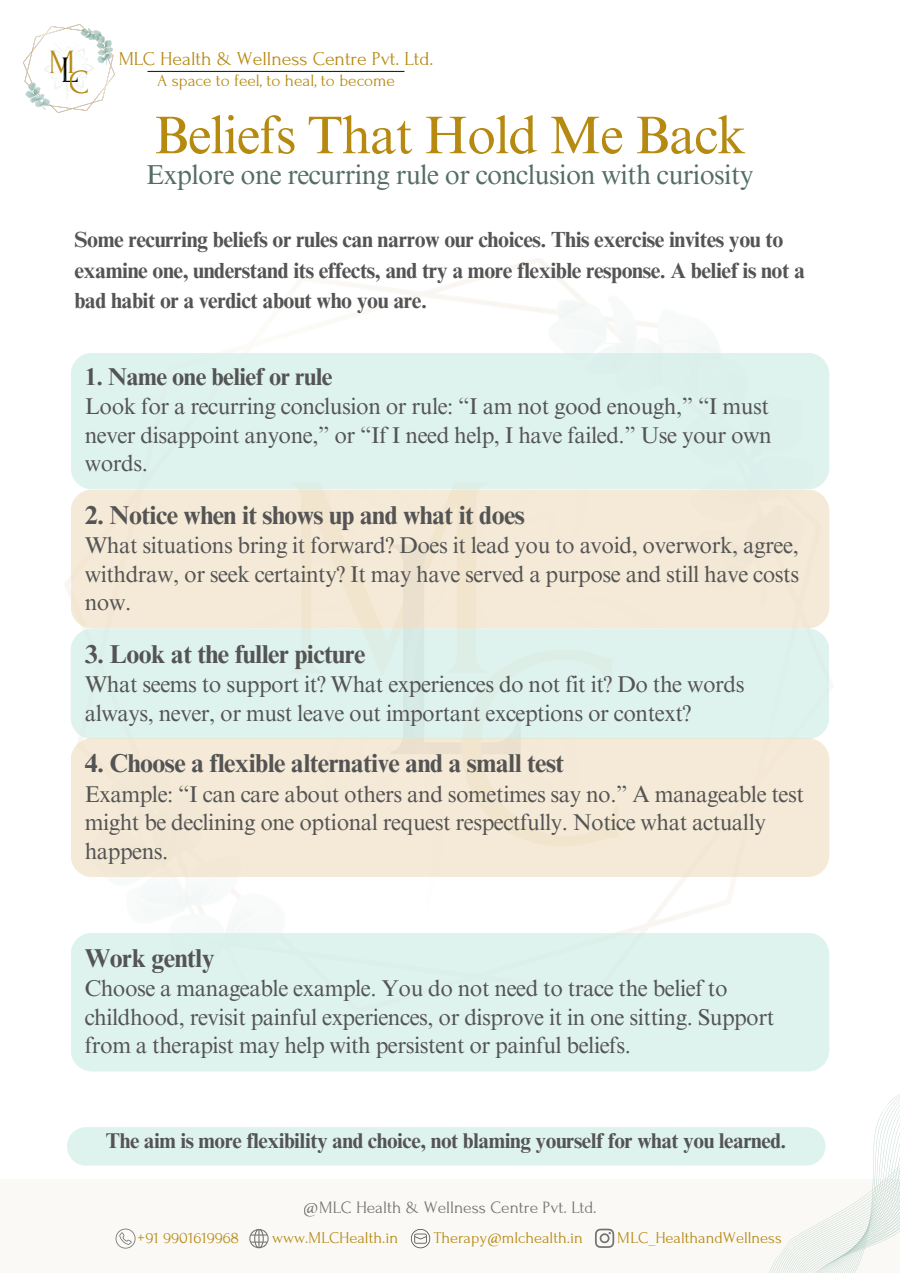
The first page, titled Beliefs That Hold Me Back, has an opening note and four steps.
- An opening note that a belief is not a bad habit or a verdict about who you are, and that the aim is flexibility and choice, not self-blame.
- Step 1, name one belief or rule, with three examples: “I am not good enough,” “I must never disappoint anyone,” and “If I need help, I have failed.”
- Step 2, notice when it shows up and what it does, including that it may have served a purpose and still have costs now.
- Step 3, look at the fuller picture: what supports it, what does not fit, and whether always, never or must leave out exceptions or context.
- Step 4, choose a flexible alternative and a small test, with the example “I can care about others and sometimes say no.” and the suggestion of declining one optional request respectfully.
- A “Work gently” note: choose a manageable example, you do not need to trace the belief to childhood, revisit painful experiences, or disprove it in one sitting, and support from a therapist may help with persistent or painful beliefs.
Page 2: Personal exploration
The second page, titled My Belief Exploration, has a date and time field and seven writing areas:
- A belief or rule that seems to limit my choices.
- When it shows up, and what I do when I believe it.
- How it might help me, and what it costs me.
- What seems to support it, and what does not fit it.
- A more flexible response I can reasonably believe.
- One small, manageable action to explore this response.
- What I will observe or discuss afterwards.
What it does not include
The worksheet introduces reflection and small-scale learning. It is not a detailed clinical behavioural experiment record, and it has no printed prediction field. A reminder on page 2 says that a small observation can inform the next step, and that one exercise need not settle the belief.
How to complete the worksheet
Work on one belief at a time. Take as long as you need, and stop whenever you wish.
- Choose one belief or rule. Use the words that actually come up, and avoid listing every difficult belief at once.
- Notice when it appears. Identify a recent situation and describe what you tend to do when the belief feels convincing.
- Explore possible usefulness and costs. Consider whether the rule offers protection, structure, approval, or another perceived benefit. It is acceptable not to identify a benefit.
- Look at the fuller picture. Record what seems to support the belief and what does not fit, including exceptions and circumstances.
- Draft a flexible response. Use wording that acknowledges relevant difficulties while allowing more than one possibility.
- Choose a manageable action. Select an appropriate way to explore the response. The action is optional and should fit your circumstances.
- Decide what to observe or discuss. Consider what happened, what remains uncertain, and what might inform a next step.
You can pause, leave fields blank, or complete the exercise with a therapist. One worksheet does not need to settle the belief.
A completed example
Illustrative example. It is original website content written for this page. It is not a real client’s story, and it is not an additional completed page in the PDF.
Belief or rule
“If I ask for help, it means I am incapable.”
When it appears and what I do
“When I am unsure about a work task, I stay quiet and spend a long time trying to work it out alone.”
How it might help and what it costs
“Staying quiet may help me avoid the immediate discomfort of asking. It can also leave me stuck and use more time.”
What seems to support it and what does not fit
“I remember being criticised for asking a question once. I have also seen experienced colleagues ask for clarification, and a colleague has previously answered me respectfully.”
More flexible response
“Asking a relevant question can be part of doing a task carefully. I can choose whom to ask and what information I need.”
Small action
“In a routine, low-stakes task, I will ask a trusted colleague one specific clarification question.”
What to observe or discuss afterwards
“What response did I receive? Did the information help? What can this interaction tell me, and what can it not tell me?”
What to keep in mind
This action does not guarantee a supportive response. One interaction cannot establish the person’s overall competence or prove that every workplace is safe for asking questions.
Why consider both usefulness and costs?
A personal rule may offer something you value, or may have made sense in a particular context. Considering both what it offers and what it costs helps you understand it without blaming yourself for following it.
For example, keeping quiet may have reduced immediate conflict or helped someone get through a demanding environment. Not every belief began as a protective strategy, and you do not have to identify a hidden benefit. Questions you can ask:
- What does following this rule seem to offer?
- What discomfort does it help me avoid?
- What does it make harder?
- Does its usefulness change across situations?
- What choices might become available if the rule were less rigid?
The purpose is understanding, not blaming yourself for continuing a pattern.
How can you look at the fuller picture without dismissing your experience?
Take your experience seriously first, then ask what it does and does not show. Experiences that support a belief should not be ignored or argued away. You may have met criticism, discrimination, rejection, or real consequences. The exercise acknowledges those events and asks whether a broader rule describes every relevant situation. Questions to try:
- What happened, specifically?
- What does that experience support?
- Does it establish the whole conclusion?
- Are there situations or people that do not fit?
- What context is missing?
- What remains uncertain?
Finding an exception does not erase harm, and it does not prove that a concern is irrational.
If you would like a structured way to look at one thought at a time, the Thought Journal is an MLC companion.
What makes an alternative response flexible and believable?
A flexible response makes room for context, limits, and different possibilities. It does not need to be strongly positive. The table shows examples to adapt, not correct answers.
| Rigid belief or rule | Possible flexible response |
|---|---|
| “I must never disappoint anyone.” | “I can care about others while recognising that I cannot meet every request.” |
| “If I need help, I have failed.” | “Some tasks require guidance, and asking can be part of learning.” |
| “One mistake proves I am incapable.” | “This mistake gives me information about this task; it does not describe all my abilities.” |
| “I must feel certain before deciding.” | “I can consider the information available and make a proportionate decision while some uncertainty remains.” |
Avoid replacing one absolute with another, such as “Everyone will respect my boundaries.” The test is whether you could reasonably believe the response, in your own words. If you are not sure, Cognitive Reframing offers further ways to build one.
How do you choose a small, manageable test?
Choose a low-stakes action that gives you useful information. The aim is to gather information, not to force a belief to disappear or to prove yourself courageous. A simple planning approach:
- Choose a low-stakes situation.
- Identify an action within your control.
- Consider likely consequences and practical constraints.
- Decide what observable information would be useful.
- Review the outcome without treating it as a verdict on your worth.
A practitioner may help you clarify what you expect to happen before you act. This is additional guidance. The PDF has no separate prediction field.
Please do not use the worksheet to plan experiments that involve real danger, significant financial or work consequences, medical decisions, or unsafe relationships. If an action is not suitable, you can discuss the belief, review an experience you already have, gather information, or put the test off.
What should you notice afterwards?
Notice what happened, what you actually observed, and what is still uncertain. An outcome can support the belief, complicate it, or leave the question unresolved. Review questions:
- What actually happened?
- What did I observe directly?
- What am I inferring?
- What did I learn about this situation?
- What remains uncertain?
- Does the response need adjusting?
- What support or next step would be useful?
An uncomfortable result does not mean you failed the exercise. One favourable result does not prove the old concern can never happen. The purpose is gradual learning, not certainty, reassurance, or a final judgement about you.
For an overview of how situations, thoughts and actions fit together, see The CBT Model. If a concern is mostly about things outside your control, the Circles of Control worksheet may help.
Guidance for therapists, adaptations, and limits
The worksheet works best as a collaborative aid. These suggestions keep it that way:
- Obtain agreement to explore the belief.
- Work with the client’s own wording.
- Understand its context and possible function.
- Validate real experiences before exploring broader conclusions.
- Avoid debating the client into agreement.
- Develop alternatives collaboratively.
- Check practical feasibility before suggesting an action.
- Review learning rather than compliance.
- Respect a decision to pause or not to test a belief.
In Indian and other contexts, examples may involve academic expectations, family responsibilities, workplace hierarchy, financial dependence, caregiving, and shared living arrangements. Please avoid stereotyping, and do not assume that direct confrontation is appropriate.
Respect language preferences and cultural or religious values. A value is not “limiting” simply because it differs from a practitioner’s own. Explore a specific personal interpretation or rigid rule in relation to the client’s goals. A person may write in their preferred language. This is guidance for using the English PDF flexibly, not a claim that translated versions exist.
This worksheet is an educational reflection aid. It is not a diagnostic assessment or a replacement for individual formulation and treatment.
Persistent or painful beliefs may be better explored with professional support. Please do not use this worksheet to diagnose or self-treat fixed persecutory beliefs, trauma-related experiences, or other complex clinical difficulties.
Frequently asked questions
Created by MLC and supporting references
Created by MLC Health & Wellness Centre Pvt. Ltd. The explanations, examples, design, and practice prompts were developed by MLC, informed by established psychological literature. Supporting references are provided below.
The references below support the cognitive behavioural principles informing this resource. They do not identify external authors as creators of the MLC worksheet, imply endorsement, or establish that this specific resource has been independently tested or validated.
- Beck, J. S. (2021). Cognitive behavior therapy: Basics and beyond (3rd ed.). Guilford Press. https://www.guilford.com/books/Cognitive-Behavior-Therapy/Judith-Beck/9781462544196 Relevance: an established clinical reference for cognitive conceptualisation and for exploring and modifying beliefs. It supports the underlying approach. It does not validate MLC’s exact worksheet or its four-step structure.
- Bennett-Levy, J., Butler, G., Fennell, M., Hackmann, A., Mueller, M., & Westbrook, D. (Eds.). (2004). Oxford guide to behavioural experiments in cognitive therapy. Oxford University Press. https://academic.oup.com/book/1220 Relevance: an established clinical reference on developing behavioural experiments in cognitive therapy. It informs the emphasis on planned observation and learning. MLC’s worksheet is a brief introduction and does not reproduce a comprehensive experiment protocol.
Platform disclaimer: this is a reflection and planning tool. It is not a diagnostic instrument or a substitute for therapy. If you are in distress, call Tele-MANAS at 14416.