
Inside the worksheet
Unlocks after purchase
What is this affirmations worksheet?
This affirmations worksheet is a two-page reflection resource, created by MLC. In this resource, “affirmations” means personal, credible statements of support, written in your own words.
You begin with a situation and consider what would be useful to remember. You then draft a statement, check its wording, and revise it if needed. The statement can acknowledge difficulty or uncertainty. It does not have to make a strong claim about your identity or predict a favourable outcome.
The contrast below shows the difference between a guarantee and a supportive statement.
| Type of statement | Example |
|---|---|
| A guarantee | “Everything will work out exactly as I want.” |
| A supportive statement | “I do not know the outcome yet. I can ask for support with the next step.” |
A sentence is a reminder. It is not proof that circumstances will change. If you would like a companion that looks at the thought behind a feeling, the Cognitive Reframing worksheet is an MLC guide you can use alongside this one.
What does “affirmation” mean here, and how is it different from research on self-affirmation?
In everyday use, “affirmations” often means repeating positive statements about yourself. In social psychological research, self-affirmation interventions often involve reflecting or writing about important personal values. These are not interchangeable practices.
This worksheet invites you to identify a relevant value or quality, but its central activity is drafting and reviewing supportive self-talk. It is not an implementation of a research-tested values-affirmation protocol.
Research that uses the term “self-affirmation” cannot automatically be used as evidence that repeating any positive sentence is effective. The reference list below includes a review of that research (Cohen & Sherman, 2014), included to explain the distinction and not to claim that this worksheet produces the same outcomes.
When might you use this resource?
You might use it when you would like some words of support and have enough space to reflect. Examples include:
- Before a difficult but necessary conversation.
- After a disappointment or mistake.
- When comparing yourself with someone else.
- When learning a skill and feeling discouraged.
- When facing uncertainty.
- When a familiar positive affirmation feels false or pressuring.
Begin with one manageable situation rather than trying to create a statement for your whole life. The worksheet does not ask you to use it at a particular time of day, in front of a mirror, every day, or a set number of times.
Who is it for?
The worksheet is written for adults and older adolescents who find reflective writing or discussion useful, and for therapists and counsellors working collaboratively with clients. The age range is a practical suggestion, not a validated one, and the resource has not been validated for a particular cultural group.
No diagnosis is required. The worksheet does not assess self-esteem, establish a diagnosis, or determine what treatment someone needs.
You can discuss the prompts aloud, use short phrases, or ask someone to help record your words. Language and pacing can be adjusted to the individual. The worksheet will not suit everyone.
What is included in the two-page PDF?
The PDF has two A4 pages: a guide with examples, then a practice page with writing lines. It is designed to be printed and written on. It does not include a score, a rating scale, a tracker or a calendar, and it has no fillable form fields. The only printed choice is a set of three boxes at the end of page 2.
Page 1: Guide and examples
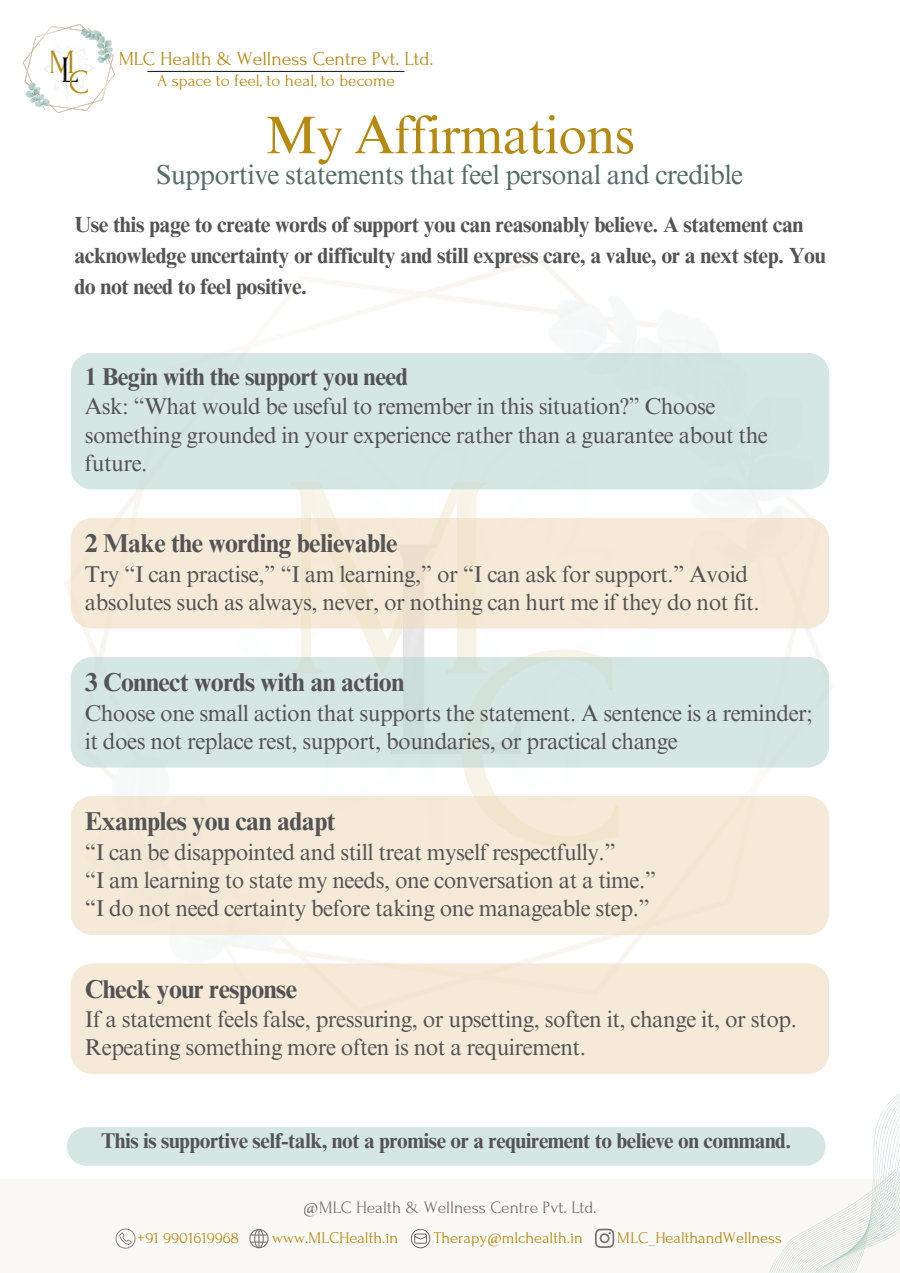
The first page, titled My Affirmations, introduces the exercise.
- An opening note that the page is for creating words of support you can reasonably believe, that a statement can acknowledge uncertainty or difficulty, and that you do not need to feel positive.
- Three steps: begin with the support you need, make the wording believable, and connect words with an action.
- Three examples you can adapt: “I can be disappointed and still treat myself respectfully.”, “I am learning to state my needs, one conversation at a time.”, and “I do not need certainty before taking one manageable step.”
- A “Check your response” note: if a statement feels false, pressuring, or upsetting, soften it, change it, or stop. Repeating something more often is not a requirement.
Page 2: Personal practice
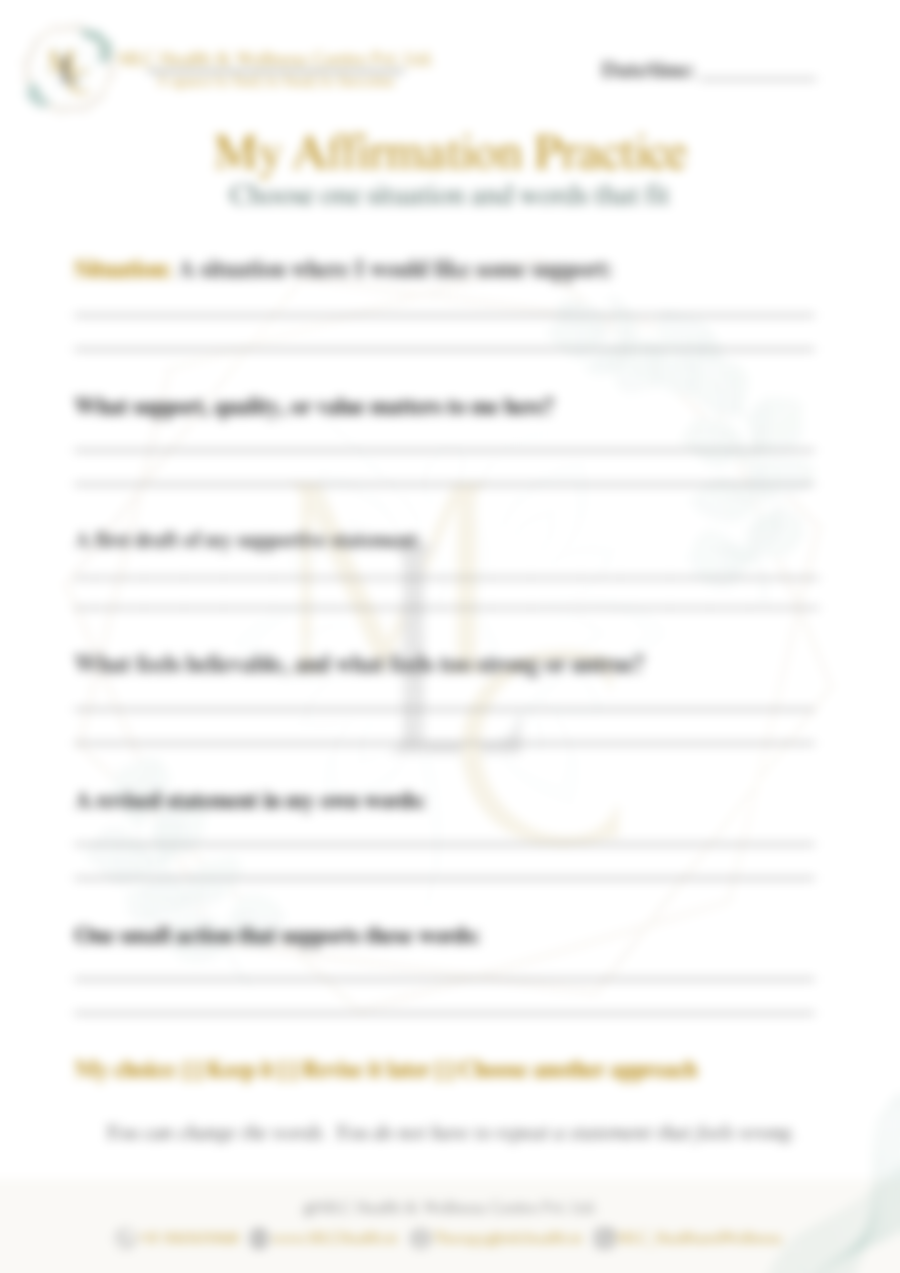
The second page, titled My Affirmation Practice, has space to work on one situation. Its fields are:
- Date and time.
- A situation where you would like some support.
- What support, quality, or value matters to you here.
- A first draft of your supportive statement.
- What feels believable, and what feels too strong or untrue.
- A revised statement in your own words.
- One small action that supports these words.
- Your choice: keep it, revise it later, or choose another approach.
Choosing another approach is a complete outcome
The worksheet does not require you to leave with a finished affirmation. “Choose another approach” is one of the three printed choices, and stopping is a legitimate result.
How to complete the worksheet
Work on one situation at a time. Take as long as you need, and stop whenever you wish.
- Choose one situation. Describe where you would like support, and keep it specific enough to work with.
- Identify what matters. Consider a quality, value, need, or form of support relevant to this situation, for example patience, honesty, rest, courage, learning, or asking for help.
- Write a first draft. Use ordinary language. You might begin with “I am learning…”, “I can practise…”, or “I can ask for…”. These are options, not required formulas.
- Check the wording. Ask what feels believable, and what feels exaggerated, pressuring, or untrue.
- Revise it. Make the statement more modest, more specific, or more closely grounded in the present situation.
- Choose a supporting action. Identify something feasible that fits the words. It might involve rest, preparation, a request, a boundary, or support.
- Decide what to do next. Keep the statement, revise it later, or choose another approach.
You do not need to feel positive before completing the exercise. You can pause or leave fields blank.
A completed example
Illustrative example. It is original website content written for this page. It is not a real client’s account, and it is not an additional completed page in the PDF.
Situation
“I need to ask my manager which task to prioritise, and I am worried about appearing incapable.”
Support, quality, or value
“Clarity, respectful communication, and a manageable workload.”
First draft
“I am completely confident, and everyone will respect my needs.”
What feels too strong or untrue
“I do not feel completely confident, and I cannot control how everyone responds.”
Revised statement
“I can feel nervous and still ask a clear question about priorities.”
One small action
“I will write down my current deadlines and ask which task should come first.”
My choice
“Keep it for this conversation, then review whether it was useful.”
What to expect
Nervousness may remain. The statement does not guarantee agreement, approval, or a particular response from the manager. It is a reminder of what the person can do.
What makes a supportive statement credible?
A credible statement fits your experience and leaves room for uncertainty. You could say it to yourself without wincing. The table gives examples of wording that may feel too strong, with a more specific alternative for each.
| Statement that may feel too strong | A more specific alternative |
|---|---|
| “I never make mistakes.” | “I can acknowledge a mistake and decide what to do next.” |
| “Everyone will approve of me.” | “I can express myself respectfully, even when I cannot control the response.” |
| “Nothing can upset me.” | “If I become upset, I can consider what support I need.” |
| “I am always confident.” | “I am learning to take part even when I feel unsure.” |
These alternatives are examples to adapt, not statements everyone must accept.
Absolute words such as “always” or “never” are not automatically wrong. The question is whether the wording is accurate and useful for you in this situation. A statement also does not have to begin with “I am” or be written only in the present tense.
How can a statement acknowledge difficulty without becoming self-critical?
Support can include honesty about disappointment, anxiety, uncertainty, or limitations. Naming a difficulty is not the same as criticising yourself for it. Examples include:
- “This is disappointing, and I can treat myself respectfully.”
- “I do not know how this will turn out. I can focus on the information available.”
- “I need more practice with this skill, and I can ask for guidance.”
- “I cannot manage everything today. I can decide what needs attention first.”
Supportive self-talk does not require minimising grief, injustice, discrimination, illness, or practical constraints. Some difficulties come from circumstances, not from the way a person thinks, and the worksheet does not suggest that distress means someone has failed to think in a particular way.
If it is hard to put a name to what you feel before you write, the Feelings Wheel & Emotional Check-In can help you find words first.
Why connect the words with an action?
The PDF asks for one small action so that the statement can work as a practical reminder. A sentence on its own does not change a situation. Examples of how words and actions can fit together:
- “I can ask for support”: identify whom to ask and what help is needed.
- “I am learning to state my needs”: prepare one clear request.
- “I can allow myself to rest”: consider a feasible pause, or discuss help with responsibilities.
- “I can approach this one step at a time”: identify the first manageable step.
Action does not have to mean productivity. Resting, receiving help, gathering information, or deciding not to continue an unhelpful exercise can also fit. The worksheet does not claim to be a validated implementation-intention tool, and it does not guarantee that anyone will change their behaviour.
What if an affirmation feels false, uncomfortable, or upsetting?
You do not have to repeat a statement that feels wrong. Some practical options:
- Make the wording more modest.
- Replace certainty with possibility.
- Acknowledge the difficulty directly.
- Use your own everyday language.
- Change the statement.
- Pause or choose a different approach.
One experimental study (Wood et al., 2009) found that repeating a particular positive self-statement was associated with worse feelings among some participants with low self-esteem. This supports caution about assuming that such statements help everyone. It does not show that all supportive statements are harmful, and it does not mean the same response occurs for everyone.
Discomfort is not a sign that a statement is working. If a statement upsets you, that is information about the wording or the timing, and you are free to change it or stop.
If a thought behind the statement keeps returning, the Thought Journal offers a different way to look at it.
Guidance for therapists and context-sensitive adaptations
The worksheet works best as a collaborative discussion aid. These suggestions keep it that way:
- Ask whether this way of working appeals to the client.
- Begin with the support they want, rather than supplying a positive statement.
- Explore whether the wording sounds credible in their own voice.
- Avoid pressuring them to endorse a sentence.
- Ask what happens when they read it: support, indifference, frustration, shame, or another response.
- Review the practical context and the choices available to them.
- Respect the option to stop or use another approach.
- Avoid turning completion or repetition into a compliance task.
Words of support are shaped by context. Pressures that may be relevant for some people, and not for others, include examination expectations, workplace hierarchy, caregiving, family comparisons, and shared responsibilities. These examples are not a description of any group.
A statement can respect relationships and interdependence while also acknowledging needs and limits. It does not have to dismiss other people’s opinions or promote confrontation.
Someone may develop their words in their preferred language. This is guidance for using the English PDF flexibly. It is not a claim that translated versions exist.
Limitations and created-by statement
Please keep these limits in mind:
- The resource is an educational reflection tool.
- It is not a diagnostic assessment or a complete treatment, and it is not a Mindful Self-Compassion programme.
- A supportive sentence does not replace rest, safety, practical change, relationships, or professional support.
- An immediate improvement in mood is not required.
- Persistent or severe distress deserves individual assessment and support.
Created by MLC Health & Wellness Centre Pvt. Ltd. The explanations, examples, design, and practice prompts were developed by MLC, informed by established psychological literature. Supporting references are provided below.
Frequently asked questions
Supporting references and evidence context
These sources inform the discussion of supportive self-talk, self-compassion, and the limitations of positive self-statements. They do not establish that this specific MLC worksheet has been independently tested or validated.
- Wood, J. V., Perunovic, W. Q. E., & Lee, J. W. (2009). Positive self-statements: Power for some, peril for others. Psychological Science, 20(7), 860–866. https://doi.org/10.1111/j.1467-9280.2009.02370.x Relevance: a caution that responses to positive self-statements vary between people. It is not an efficacy study of credible supportive self-talk or of this MLC worksheet.
- Cohen, G. L., & Sherman, D. K. (2014). The psychology of change: Self-affirmation and social psychological intervention. Annual Review of Psychology, 65, 333–371. https://doi.org/10.1146/annurev-psych-010213-115137 Relevance: helps distinguish values-based self-affirmation research from everyday positive statements. The outcomes of the interventions it reviews are not transferred to this worksheet.
- Neff, K., & Germer, C. (2018). The mindful self-compassion workbook: A proven way to accept yourself, build inner strength, and thrive. Guilford Press. https://www.guilford.com/books/The-Mindful-Self-Compassion-Workbook/Neff-Germer/9781462526789 Relevance: a practice-oriented book on responding to difficulty compassionately. This resource does not reproduce its exercises or provide the full Mindful Self-Compassion programme, and “a proven way” is part of the book’s title, not a claim about this worksheet.
Platform disclaimer: this is a reflection and planning tool. It is not a diagnostic instrument or a substitute for therapy. If you are in distress, call Tele-MANAS at 14416.