
Inside the worksheet
Unlocks after purchase
What is the Gratitude Note worksheet?
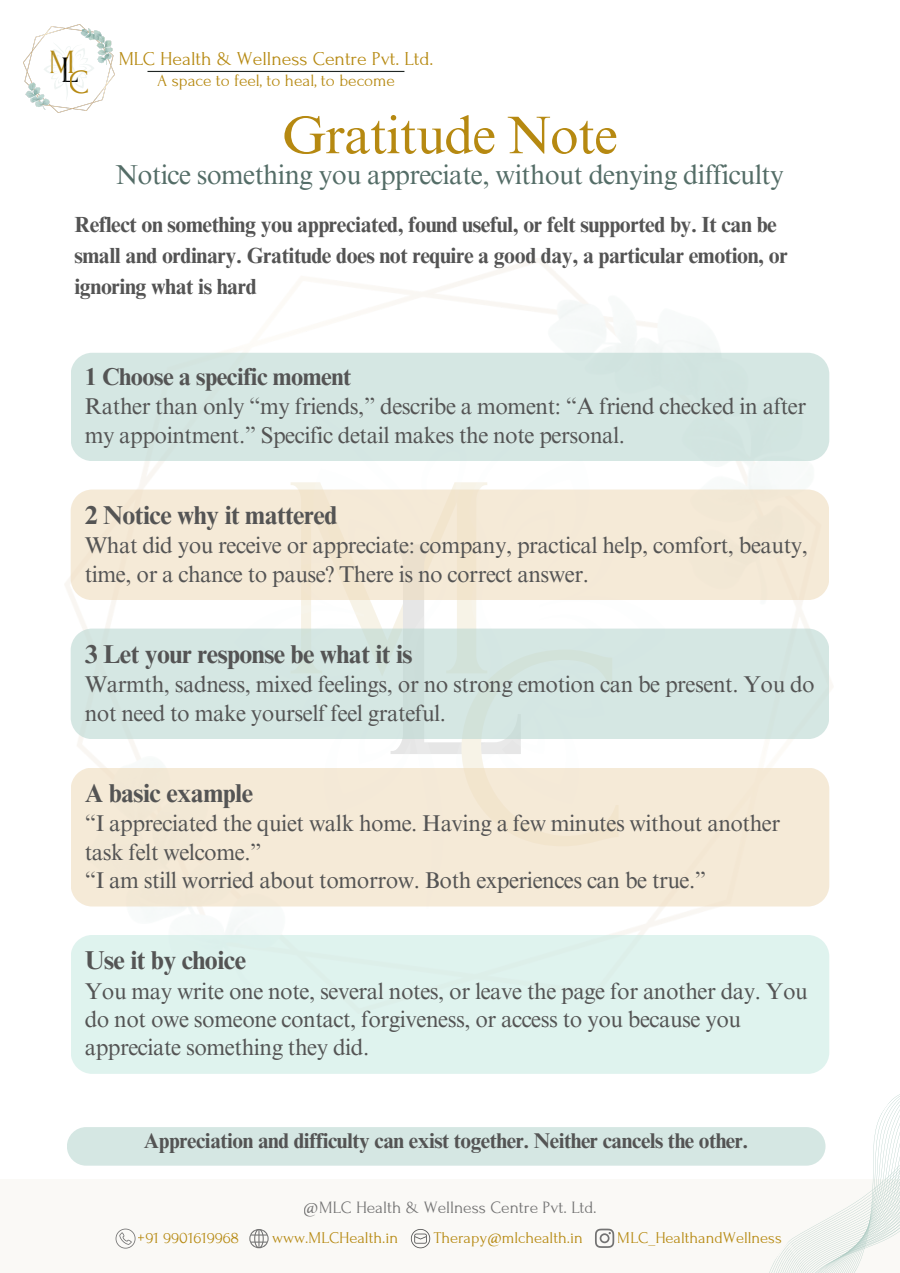
The Gratitude Note is a reflection resource created by MLC for noticing something you appreciated, found useful, or felt supported by, and exploring why it mattered. It is a two-page printable guide and worksheet.
The note can be about an ordinary experience: a quiet moment, practical help, enjoyable food, a conversation, something beautiful, or time to pause. It does not need a dramatic event or a strong feeling of gratitude. It is an invitation to notice, not a test of your attitude.
You can recognise something welcome without deciding that the whole day was good.
What does gratitude mean in this resource?
In this resource, gratitude means noticing appreciation, a helpful experience, or support, and writing down why it mattered to you. It is a practical working description for a reflection prompt.
Researchers define gratitude in different ways, and gratitude exercises vary a good deal. This is not the only scientific definition. Not every entry needs to involve another person, a gift, or a sense of owing something.
The table separates three parts of a note, using an original example.
| Part of the note | Example |
|---|---|
| What happened | A friend checked in. |
| What was appreciated | Their time and attention. |
| Why it mattered | I felt less alone during a difficult afternoon. |
When might you use it?
You might use it when you would like to pause and notice something. Examples include:
- At the end of an ordinary day.
- After receiving practical or emotional support.
- During a therapy conversation about what felt meaningful.
- When you want to remember a small welcome moment.
- As an optional pause during a stressful period.
Taking part is voluntary. You do not need to complete it every evening, keep a streak, or use it during acute distress. Difficult periods are not an obligation to practise gratitude, and nobody should feel they have to find a benefit in a harmful experience.
Who is it for?
The worksheet is written for adults and older adolescents who find reflective writing or conversation useful, and for therapists and counsellors using it collaboratively with clients. The age range is a practical suggestion, not a validated one.
No diagnosis or earlier gratitude practice is needed. The worksheet does not assess whether someone is grateful, psychologically healthy, or coping well.
You can speak your response, use short phrases, or ask someone to help record your words. It will not suit everyone, and it has not been tested for a particular cultural group.
What is included in the two-page PDF?
The PDF has two A4 pages: a guide with an example, then a reflection page with writing lines. It is designed to be printed and written on. It has no score, no tracker or calendar, and no fillable form fields. It is not a multi-day journal, a gratitude letter or a gratitude visit.
Page 1: Guide and example
The first page, titled Gratitude Note, introduces the exercise.
- An opening note that you can reflect on something small and ordinary, that gratitude does not require a good day or a particular emotion, and that appreciation and difficulty can exist together.
- Three steps: choose a specific moment, notice why it mattered, and let your response be what it is.
- A short example of appreciating a quiet walk home while still feeling worried about tomorrow, showing that both can be true.
- A “Use it by choice” note: you may write one note, several notes, or leave the page for another day, and you do not owe someone contact, forgiveness, or access to you because you appreciate something they did.
Page 2: Personal reflection
The second page, titled My Gratitude Note, has space for:
- Date and time.
- Three optional spaces for something you appreciated, found useful, or felt supported by, each followed by a “Why it mattered to me” line.
- A space for what else was true about your day, where mixed feelings are welcome.
- An optional prompt for something you would like to carry forward or do next.
- A reminder that a blank space does not make you ungrateful.
One entry is enough
The three spaces are options. They are not a prescribed “three good things” routine, and completing all three is not required.
How to use the worksheet
Take as long as you need, and stop whenever you wish.
- Choose one specific moment. Describe something that happened, rather than relying only on a broad category such as “family” or “health”.
- Write what you appreciated, found useful, or felt supported by. Keep the wording personal and ordinary. It does not need to sound impressive.
- Explore why it mattered. Consider whether it offered company, comfort, practical help, beauty, time, relief from a task, or something else.
- Allow your actual response. Warmth, sadness, uncertainty, mixed feelings, or no strong emotion can all be recorded without correction.
- Add another entry only if it is useful. Leave the other spaces blank if you prefer.
- Include what else was true. Acknowledge difficulty alongside appreciation.
- Choose an optional next step. There is no requirement to act, send a message, thank someone, or repeat the experience.
You can stop after one sentence, leave fields blank, or return another time.
A completed example
Illustrative example. It is original website content written for this page. It is not a real client’s account, and it is not an additional completed page in the PDF.
Something I appreciated, found useful, or felt supported by
“A colleague shared their notes after I missed part of a meeting.”
Why it mattered to me
“It helped me understand what I had missed and reduced the amount of catching up I needed to do.”
What else was true about my day
“I still felt tired and worried about my workload.”
Optional: something to carry forward or do next
“I would like to remember that practical help can be available. I may ask for clarification earlier next time.”
The other two spaces
The other two appreciation spaces can stay blank. The example does not require an improved mood or a thank-you message.
Why choose a specific moment?
A specific detail makes a note personal and helps you see what exactly you appreciated. The table compares broad entries with more specific ones.
| Broad entry | More specific entry |
|---|---|
| “My friends.” | “A friend checked in after my appointment.” |
| “Nature.” | “I noticed the evening breeze during a short walk.” |
| “Support.” | “Someone helped with a task when I was tired.” |
| “Time.” | “I had ten quiet minutes without another demand.” |
Specificity is a practical writing suggestion, not a rule. A short or general answer is still welcome. The worksheet does not claim that adding detail makes the exercise work better.
Can appreciation and difficulty exist together?
Yes. Appreciation and difficulty can sit side by side, and one does not cancel the other. You can appreciate company and still feel lonely, notice practical help and still feel overwhelmed, or enjoy a moment while grieving.
The mixed-feelings prompt on page 2 exists so that appreciation does not erase the rest of the experience.
Noticing one welcome moment does not mean the situation was acceptable, the problem is solved, or your distress is less legitimate.
The worksheet avoids messages such as “others have it worse”, “focus only on the positive”, “everything happens for a reason”, or “you should be grateful instead of upset”. It does not ask anyone to find a lesson or benefit in mistreatment, illness, loss, or trauma.
If it is hard to name what you feel, the Feelings Wheel & Emotional Check-In can help you find words for the mixed feelings first.
Does gratitude create an obligation to someone else?
No. Appreciation does not require contact, forgiveness, reconciliation, or continued access to you.
You can recognise that a person did something helpful while keeping a boundary, or while acknowledging other behaviour that was harmful. The worksheet does not ask you to send the note, thank anyone publicly, offer something in return, or resume a relationship.
This does not mean every difficult relationship is unsafe. Your circumstances and your choices matter, and the decision about what to do, if anything, is yours.
If thinking about what is and is not yours to carry feels useful, the Circles of Control worksheet is an MLC companion.
What if nothing comes to mind, or the exercise feels uncomfortable?
A blank page does not mean you are ungrateful. Some days nothing comes to mind, and that is an acceptable result. Some options:
- Return another day.
- Use a neutral description such as “something that made one task easier”.
- Record a small ordinary moment, if one comes naturally.
- Discuss why the exercise feels difficult.
- Choose a different reflective activity.
- Stop without completing it.
You do not have to search until you find something positive. If the exercise brings up sadness, guilt, obligation, or frustration, those responses can be acknowledged. Discomfort is not a sign that the exercise is working. It is information about whether this activity suits you right now.
Guidance for therapists and culturally responsive use
The worksheet works best as a collaborative discussion aid. These suggestions keep it that way:
- Ask whether this exercise fits the client’s goals.
- Explore the client’s own understanding of gratitude.
- Avoid using the worksheet to redirect away from distress.
- Let the client choose the moment and the wording.
- Welcome mixed feelings.
- Respect blank spaces and the decision not to continue.
- Avoid judging the size or significance of an entry.
- Discuss whether the practice felt useful or pressuring.
In Indian and other contexts, examples may involve family support, shared responsibilities, community, education, work, or faith, if these matter to the individual. Please do not impose religious language, family obligation, or an expectation to feel indebted. Relational values and personal boundaries can both be respected.
A person can write in their preferred language. This is guidance for using the English PDF flexibly. It is not a claim that translated versions exist.
What can research tell us, and what are the limits?
Gratitude activities have been studied in psychological research, but the exercises, populations, schedules, and comparison conditions vary.
Research suggests that some gratitude activities can offer modest wellbeing benefits in some settings. Results depend on what is being measured and what the activity is compared with. This does not mean that everyone will benefit or that a single note should change how someone feels.
A meta-analysis by Davis and colleagues (2016) found that conclusions differed according to the comparison activity. It did not establish consistent advantages over psychologically active alternatives, so gratitude should not be described as better than therapy or other established approaches. An earlier experimental study by Emmons and McCullough (2003) looked at gratitude-focused activities and subjective wellbeing in daily life. Neither study tested this worksheet.
This specific MLC worksheet has not been independently tested or validated. It is an educational reflection resource, not a treatment or substitute for individual assessment and support. It is not a treatment for depression, anxiety, trauma, or grief, and persistent or severe distress deserves individual assessment and support.
Frequently asked questions
Created by MLC and supporting references
Created by MLC Health & Wellness Centre Pvt. Ltd. The explanations, examples, design, and practice prompts were developed by MLC, informed by established psychological literature. Supporting references are provided below.
These references provide context for gratitude research. They do not identify the authors as creators of this MLC resource, imply endorsement, or establish that this particular worksheet has been validated.
- Emmons, R. A., & McCullough, M. E. (2003). Counting blessings versus burdens: An experimental investigation of gratitude and subjective well-being in daily life. Journal of Personality and Social Psychology, 84(2), 377–389. https://doi.org/10.1037/0022-3514.84.2.377 Relevance: experimental research on gratitude-focused activities and subjective wellbeing. The study does not validate this particular MLC worksheet, its optional completion format, or its exact wording.
- Davis, D. E., Choe, E., Meyers, J., Wade, N., Varjas, K., Gifford, A., Quinn, A., Hook, J. N., Van Tongeren, D. R., Griffin, B. J., & Worthington, E. L., Jr. (2016). Thankful for the little things: A meta-analysis of gratitude interventions. Journal of Counseling Psychology, 63(1), 20–31. https://doi.org/10.1037/cou0000107 Relevance: synthesises findings across gratitude interventions and highlights the importance of comparison conditions when interpreting results. It does not establish universal benefit or validate the MLC resource.
Platform disclaimer: this is a reflection and planning tool. It is not a diagnostic instrument or a substitute for therapy. If you are in distress, call Tele-MANAS at 14416.