
Inside the worksheet
Unlocks after purchase
What are the 3 C’s?
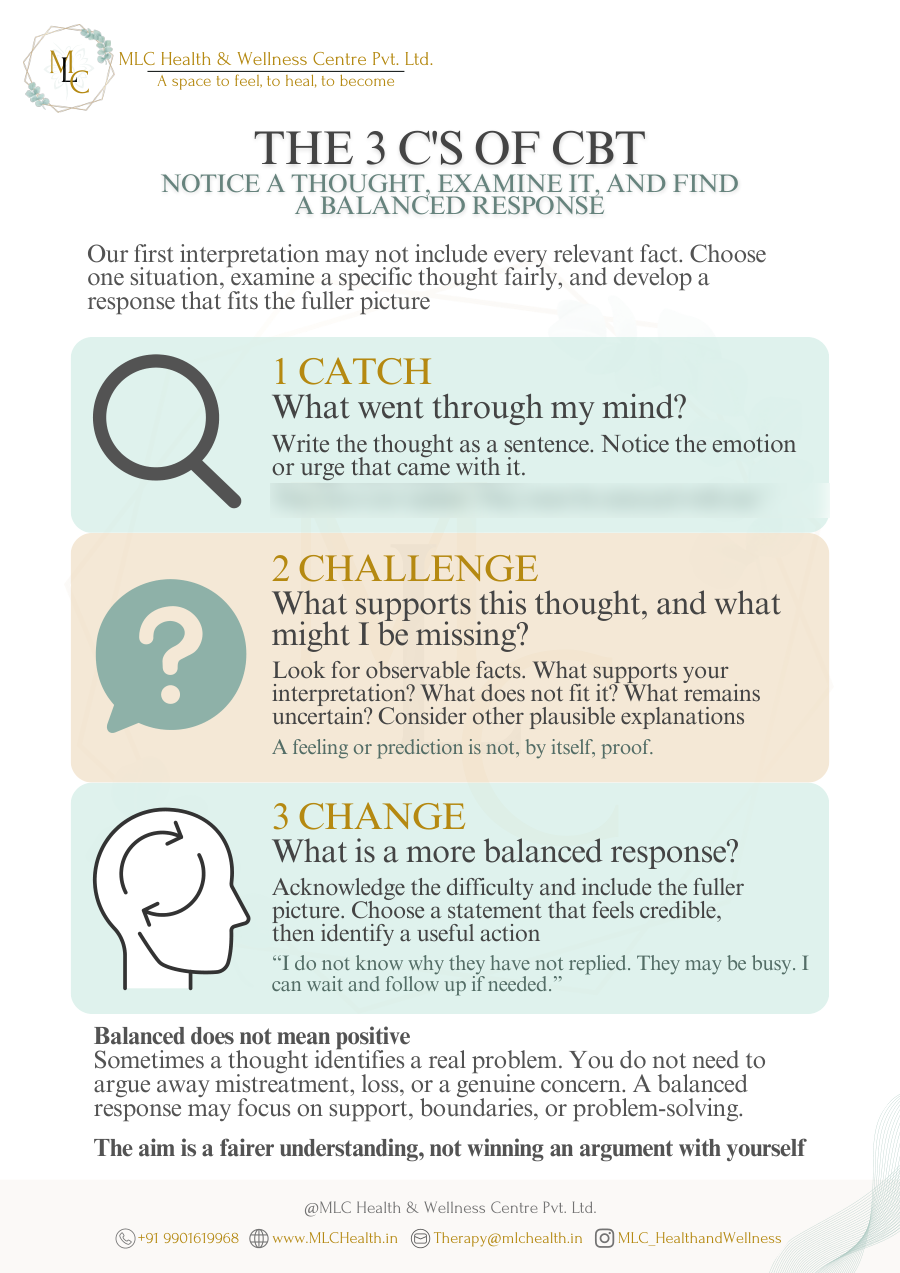
The resource organises a short thinking exercise into three steps:
“Change” does not mean replacing every upsetting thought with a cheerful one. The aim is a fuller, more accurate understanding.
The three steps are a memorable introduction to practices used in CBT. They do not represent the whole of CBT.
Catch
Identify the thought that went through your mind.
Challenge
Examine what supports it, what does not fit it, and what you do not yet know.
Change
Develop a more balanced response and choose a useful action.
How does this relate to CBT?
How we interpret a situation can influence how we feel and what we do. An unanswered message, for example, may be interpreted as rejection, busyness, forgetfulness, or simply uncertainty. Different interpretations can lead to different emotional and behavioural responses.
This does not mean thoughts are the only influence on emotion. Events, relationships, physical states, past experiences, and social circumstances also matter.
The worksheet focuses on one part of that larger picture: examining a specific interpretation and deciding how to respond.
What is included in the PDF?
Page 1: Guide
The guide includes:
- An introduction to examining an interpretation fairly.
- Catch, Challenge, and Change.
- Brief examples involving an unanswered message.
- A reminder that a feeling or prediction is not, by itself, proof.
- An explanation that balanced thinking does not mean positive thinking.
- Permission to acknowledge genuine problems and respond through support, boundaries, or problem-solving.
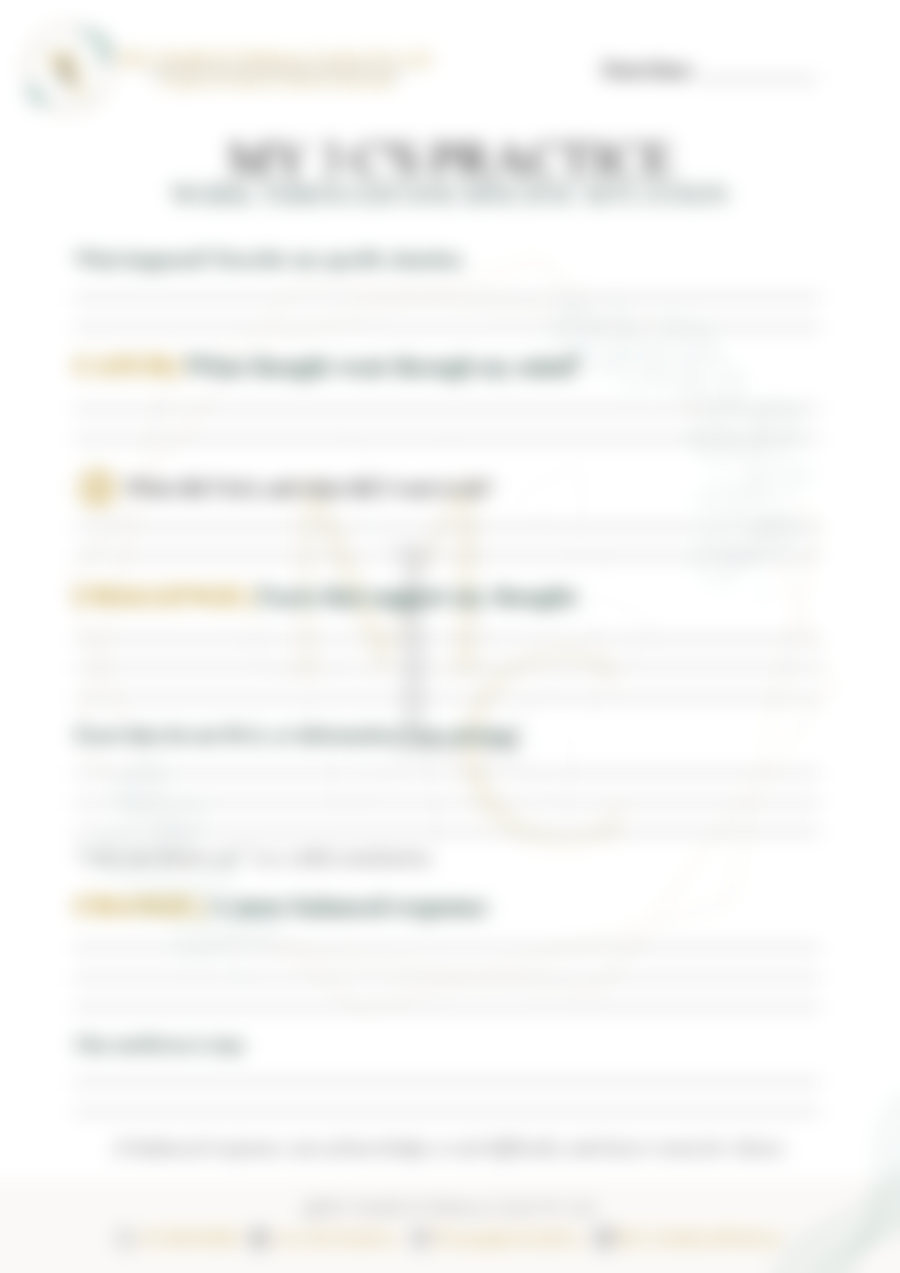
Page 2: My 3 C’s Practice worksheet
The worksheet contains:
- Date/time.
- What happened.
- The thought that went through your mind.
- What you felt and wanted to do.
- Facts that support the thought.
- Facts that do not fit it, or information that is missing.
- A more balanced response.
- One useful next step.
What it does not include
There are no emotion-rating scales, belief percentages, separate outcome section, or extra pages. The PDF is printable, with writing spaces only, and has no embedded form fields.
When might this exercise be useful?
Situations where examining one interpretation may be worthwhile:
- Interpreting a delayed reply as evidence that someone dislikes you.
- Turning a mistake into a global conclusion about your ability.
- Predicting an unfavourable outcome before all the information is available.
- Reviewing an upsetting interaction and distinguishing what happened from what you inferred.
The exercise is easiest to use when you have enough space to reflect. You can complete it afterwards rather than during the most intense part of an experience.
You do not need to analyse your thinking before responding to an immediate practical need or reaching out for support.
Start with one specific situation
Use the first worksheet field to describe an event that could be observed. For example: “My colleague had not replied to my email by the end of the afternoon.”
Compare that with: “My colleague ignored me because they do not respect me.” The second statement includes an interpretation of intention, so it belongs in the thought field rather than the situation field.
If your concern is broad, such as “work is always terrible,” narrow it to one moment you can examine. You do not need to solve the whole concern on one sheet.
Give enough context to understand the thought, without writing a long account of every related event.
Catch: identify the thought, emotion, and urge
It helps to tell these three apart:
For example: the thought “They must be annoyed with me,” the emotion anxiety, and the urge to send several follow-up messages.
You do not need precise psychological vocabulary; your own words are fine. If several thoughts appear, choose one that seems central rather than examining them all at once.
Thought
An interpretation, prediction, image, or conclusion. For this worksheet, try putting it into a sentence.
Emotion
A feeling such as sadness, anger, anxiety, shame, or disappointment.
Urge
What you wanted to do, such as withdraw, send another message, argue, avoid a task, or seek reassurance.
Challenge: examine the evidence fairly
“Challenge” means investigate, not criticise yourself. Ask:
- What actually happened that supports my thought?
- What facts do not fit it?
- What information am I missing?
- Is there another plausible explanation?
Separate observation from inference. “They have not replied” is observable. “They are annoyed with me” is a possible explanation, unless further evidence establishes it.
A strong feeling deserves acknowledgment, but it does not by itself establish an external fact. Equally, finding no support for a thought does not automatically prove the opposite.
If the evidence is unclear, the balanced conclusion may remain uncertain. Do not list imaginary positive possibilities as if they were facts.
Change: write a credible balanced response
A balanced response reflects the evidence and the uncertainties you identified. For example: “I do not know why they have not replied. They may be busy. If it is time-sensitive, I can send one clear follow-up.”
That is more balanced than “They definitely like me and everything will be fine.” The first acknowledges uncertainty and offers an action. The second makes a reassuring claim without evidence.
Use language you can reasonably believe. A modest statement is often more useful than an ambitious affirmation.
The original emotion may remain present. That does not make your response invalid.
What if the thought identifies a real problem?
Then a balanced response does not have to deny it. If someone has repeatedly spoken disrespectfully, you might write: “That comment was disrespectful. I do not know everything about their intention, but I can decide what boundary I want to set.”
The next step may involve support, documenting a concern, asking a question, setting a boundary, or practical problem-solving.
Cognitive restructuring is not a way to explain away mistreatment, and distress is not merely a thinking error. Changing an interpretation and changing a situation can both be relevant.
How to complete the worksheet
Work through the fields in order. Brief entries are fine.
The worksheet is a practice aid, not a test, diagnostic instrument, or validated outcome measure.
Date/time
Record the context if it is useful.
What happened?
Describe one specific event.
Catch: What thought went through my mind?
Write the thought as a sentence.
What did I feel, and what did I want to do?
Record the emotion and the urge.
Challenge: Facts that support my thought
Include relevant observations, not only conclusions.
Facts that do not fit it, or information I am missing
Include contradictory facts and uncertainty. “I do not know yet” is a valid conclusion.
Change: A more balanced response
Write a response that fits the fuller picture.
One useful next step
Choose an action within your control.
A completed example
This is an illustrative example, not a real client account or an expected result.
- Date/time: Wednesday, 6:00 p.m.
- What happened? “I sent a friend a message yesterday evening and have not received a reply.”
- Catch: What thought went through my mind? “They are annoyed with me and do not want to talk.”
- What did I feel, and what did I want to do? “I felt anxious and hurt. I wanted to send another message asking what I had done wrong.”
- Challenge: Facts that support my thought: “There has been no reply. Their replies are sometimes quicker.”
- Facts that do not fit it, or information I am missing: “They have mentioned a busy week. We had a friendly conversation recently. I do not know whether they have had time to respond.”
- Change: A more balanced response: “The delay is upsetting, but it does not tell me why they have not replied. Being busy is one possibility. I can wait rather than treating my first interpretation as certain.”
- One useful next step: “I will return to my evening plans and decide tomorrow whether a follow-up is needed.”
The example does not prove the friend’s intention, and it does not require the anxiety to disappear.
Common difficulties and guidance for therapists
“I cannot identify the thought.”
Ask what the situation seemed to mean or what you feared might happen. A therapist should not supply an answer and assume it is the client’s.
“I keep finding evidence for the thought.”
Check whether your entries are observations, predictions, or repeated interpretations. Also allow that the concern may be realistic.
“The balanced response feels fake.”
Make it more modest and acknowledge uncertainty or difficulty.
“I keep reviewing the same thought without reaching certainty.”
Notice when further analysis no longer adds information. Choose a practical action, leave the uncertainty unresolved, or discuss the pattern with a therapist.
For therapists
Emphasise collaborative curiosity. Avoid arguing, pushing reassurance, or judging the worksheet by whether distress decreases.
About this resource
Created by MLC Health & Wellness Centre Pvt. Ltd. The explanations, examples, design, and practice prompts were developed by MLC, informed by established psychological literature. Supporting references are provided below.
The cited authors did not create, review, endorse, or validate this MLC resource.
What is the evidence basis?
The resource draws on established CBT practices of identifying automatic thoughts, evaluating evidence, and developing balanced responses. Beck’s clinical textbook and Greenberger and Padesky’s practical workbook provide relevant foundations for these skills.
These references support the underlying approach. They do not establish that this particular MLC worksheet or the Catch–Challenge–Change mnemonic has been separately validated.
The resource is a brief practice aid, not a complete course of CBT. Treatment outcomes from broader CBT programmes should not be transferred to this worksheet.
Frequently asked questions
Supporting references
These references support the underlying CBT practices. The cited authors did not create, review, endorse, or validate this MLC resource, and neither book is credited with the Catch–Challenge–Change mnemonic.
- Beck, J. S. (2020). Cognitive behavior therapy: Basics and beyond (3rd ed.). Guilford Press. https://www.guilford.com/books/Cognitive-Behavior-Therapy/Judith-Beck/9781462544196 Relevance: A clinical foundation for identifying, evaluating, and responding to automatic thoughts.
- Greenberger, D., & Padesky, C. A. (2015). Mind over mood: Change how you feel by changing the way you think (2nd ed.). Guilford Press. https://www.guilford.com/books/Mind-Over-Mood/Greenberger-Padesky/9781462520428 Relevance: A practical foundation for examining evidence, developing balanced thinking, and connecting new perspectives with action.
Platform disclaimer: this is a reflection and planning tool. It is not a diagnostic instrument or a substitute for therapy. If you are in distress, call Tele-MANAS at 14416.