
Inside the worksheet
Unlocks after purchase
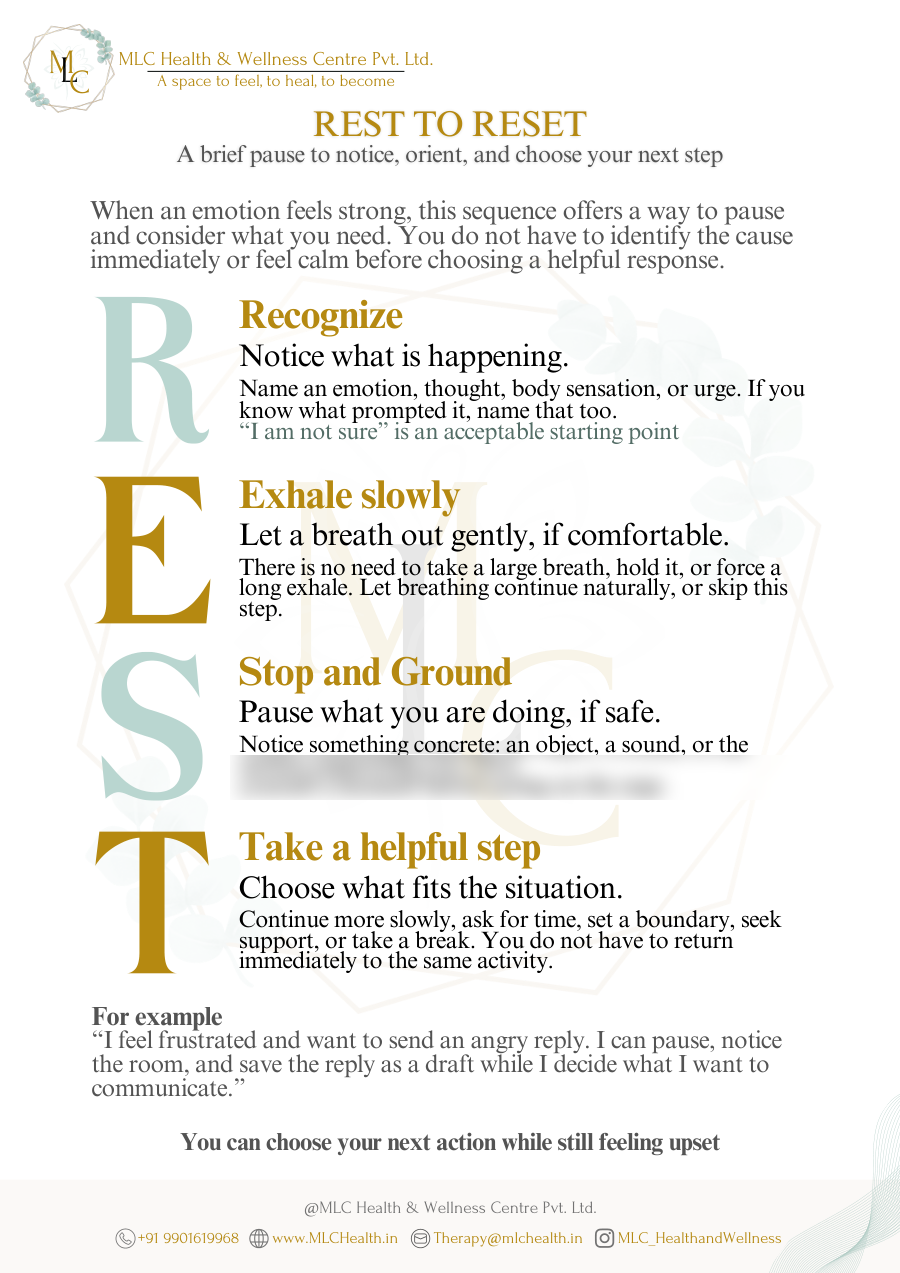
What is REST to Reset?
REST to Reset offers four prompts:
REST is the organising sequence used in this MLC resource. The sequence creates an opportunity to consider a response; it does not require emotions to disappear.
“Reset” is the resource’s title for taking a pause and reconsidering a response. It is a practical metaphor for pausing and choosing, not a claim that your brain or nervous system has been reset.
R - Recognize
Notice what is happening in your experience.
E - Exhale slowly
Let a breath out gently if comfortable, continue ordinary breathing, or skip this step.
S - Stop and Ground
Pause what you are doing, if safe, and notice something concrete around you.
T - Take a helpful step
Choose an action that fits the situation and what you need.
What is the resource intended to help you practise?
These are the resource’s intended functions. Following four prompts is not promised to change emotional intensity reliably or to prevent every reactive response.
Noticing before acting
Identify what is present, including an urge to send a message, withdraw, argue, or rush.
Making room for a choice
Use a brief pause to consider whether the first impulse is the action you want to take.
Connecting a need with an action
Move from “I feel overwhelmed” towards something specific, such as asking for time, clarifying a task, taking a break, or seeking support.
What is included in the PDF?
Page 1: Practice guide
The guide includes:
- An introduction explaining that calm and immediate certainty are not required.
- Four REST stages.
- Permission to continue ordinary breathing or skip the breathing step.
- Examples of grounding through an object, sound, or supporting surface.
- Options for choosing an action.
- A short example involving an angry reply.
- A reminder that action can be chosen while someone still feels upset.
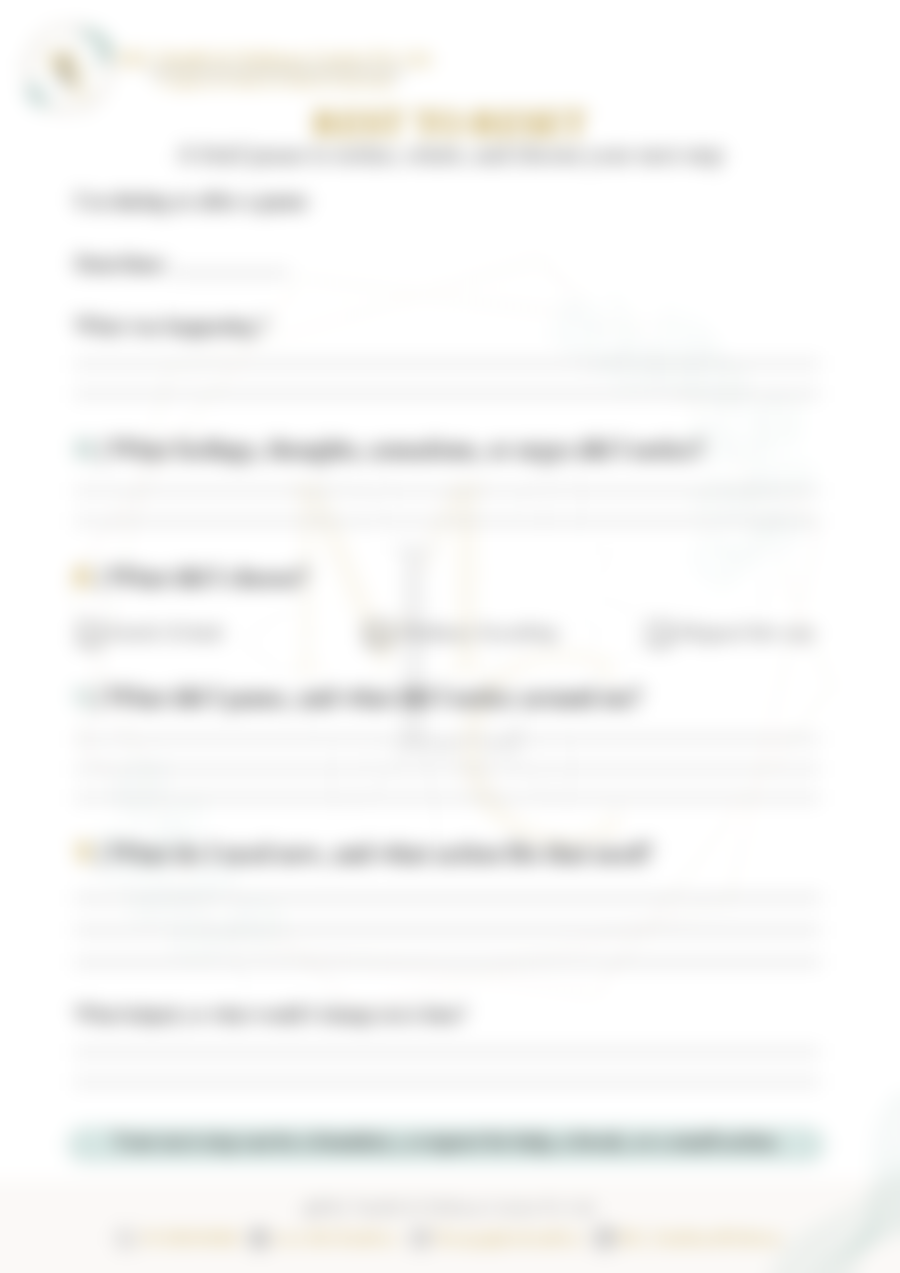
Page 2: Worksheet
The worksheet contains:
- Date/time.
- What was happening.
- R: feelings, thoughts, sensations, or urges noticed.
- E: gentle exhale, ordinary breathing, or skipped this step.
- S: what was paused and what was noticed nearby.
- T: what is needed and what action fits that need.
- What helped or could change next time.
What it does not include
There are no emotion scores, breathing counts, trigger checklist, or mandatory practice schedule. The PDF is printable, with writing spaces and tick boxes, and has no embedded form fields.
When might you choose to use it?
Concrete moments where a brief pause might fit:
- Before replying to a message while frustrated.
- During a disagreement, when you want time to consider your words.
- When several tasks feel urgent and you are moving between them without choosing a priority.
- After noticing an urge to withdraw or agree automatically.
- During a therapy session while practising how to pause and respond.
A pause should fit the situation. Immediate safety or another urgent practical need takes priority over completing the sequence.
The exercise does not ask you to delay every decision or suppress a necessary response.
R - Recognize what is happening
Notice one or more of the following. They are different parts of an experience, and you do not need to identify all four:
- Recognize: name an emotion (“I feel angry”), a thought (“I am thinking that nobody is listening”), a sensation (“My jaw feels tight”), or an urge (“I want to send the reply immediately”).
- Exhale slowly: let a breath out gently if comfortable, continue ordinary breathing, or skip this step.
- Stop and Ground: pause what you are doing, if safe, and notice something concrete around you.
- Take a helpful step: ask what you need now, then choose an action that fits that need and the situation.
If the event that prompted the feeling is clear, you can name it. If not, “I am not sure” is an acceptable answer, and you can continue without it.
This stage is not a demand to analyse the whole history or cause of an emotion. Noticing an urge does not mean you have to act on it.
E - Choose how to approach breathing
The worksheet shows three options:
The PDF does not ask for a large inhale, a breath hold, a counted ratio, repeated sighs, or a prolonged exhale.
If deliberate breathing feels uncomfortable, return to ordinary breathing or direct your attention elsewhere. Skipping this step is an option built into the resource, not a sign of unsuccessful practice.
Gentle exhale
Let a breath out gently if this feels comfortable.
Ordinary breathing
Allow breathing to continue without deliberate adjustment.
Skipped this step
Move on without focusing on breathing.
S - Stop and ground
Pause your current action if it is safe and practical. That may mean taking your hands off the keyboard, putting down your phone, or asking for a moment before responding.
Then notice something concrete:
- The colour or shape of an object.
- A sound in the room.
- Contact with the chair or floor.
You do not need to complete a full five-senses exercise.
“Stop” refers to pausing an action where possible. It does not mean forcing thoughts or emotions to stop.
T - Take a helpful step
Ask two questions: “What do I need now?” and “What action fits that need and this situation?” Some examples:
- Need for time: ask to continue the conversation later.
- Need for clarity: ask which task is the priority.
- Need for support: contact someone appropriate.
- Need for a boundary: decline or negotiate a request.
- Need for rest: take a feasible break.
- Readiness to continue: return to the activity more deliberately.
A helpful step does not need to be large or to resolve the problem immediately.
Taking a break is not always preferable to continuing, and returning to the original task is not always the goal.
What if the emotion remains strong?
The guide explicitly allows you to choose an action while still upset. A pause may change the response without noticeably changing the feeling. You may remain angry but decide to ask a clear question instead of sending an insulting message.
Do not judge the practice only by whether you feel calm.
If the sequence feels demanding, use one prompt, stop, or seek support. There is no requirement to repeat it until a particular internal state appears.
If the same practical problem remains, it may need communication, planning, boundaries, or other support beyond a coping exercise.
How to complete the worksheet
You can complete it during or after a pause. Short entries are fine.
The worksheet is a reflection aid, not a diagnostic instrument or validated measure of emotional regulation.
Date/time
Record the context if it is useful.
What was happening?
Briefly describe the situation.
R: What feelings, thoughts, sensations, or urges did I notice?
One observation is enough.
E: What did I choose?
Tick gentle exhale, ordinary breathing, or skipped this step.
S: What did I pause, and what did I notice around me?
Describe both the action you paused and something concrete you noticed nearby.
T: What do I need now, and what action fits that need?
Identify what you need and an action that fits.
What helped, or what would I change next time?
Record a useful observation or adjustment.
A completed example
This is an illustrative example, not a real client account or an expected outcome.
- Date/time: Thursday, 5:30 p.m.
- What was happening? “I received a message requesting another change to a task I had finished.”
- R: What feelings, thoughts, sensations, or urges did I notice? “I felt frustrated. I thought, ‘They do not appreciate my work.’ I wanted to send a sharp reply.”
- E: What did I choose? “Ordinary breathing.”
- S: What did I pause, and what did I notice around me? “I stopped typing. I noticed the notebook beside me and the chair supporting my back.”
- T: What do I need now, and what action fits that need? “I need clarity about the request and the deadline. I will ask which change is essential and explain what I can complete today.”
- What helped, or what would I change next time? “Putting the phone down gave me time to choose my wording. I was still annoyed, but I preferred the message I sent.”
Choosing ordinary breathing is as valid as choosing a gentle exhale, and the example does not depend on the frustration disappearing.
Common difficulties and guidance for therapists
“I do not know what I feel.”
Begin with a thought, sensation, or urge. An exact emotion label is not required.
“I already reacted.”
You can use the worksheet afterwards to understand the situation and consider a repair or a future response.
“Breathing exercises do not suit me.”
Use the ordinary-breathing or skip option.
“I do not know what I need.”
Consider a small next step, such as asking for time or clarifying the problem.
“The pause becomes avoidance.”
Consider whether your next action needs to include a clear plan to return to an important conversation or task.
For therapists
Emphasise choice and collaborative reflection. Avoid requiring every step, treating calm as the outcome, or interpreting skipped breathing as resistance.
About this resource
Created by MLC Health & Wellness Centre Pvt. Ltd. The explanations, examples, design, and practice prompts were developed by MLC, informed by established psychological literature. Supporting references are provided below.
The reference supports broader skills principles. It does not imply that the cited author created, reviewed, endorsed, or validated this MLC resource.
What is the evidence basis?
The resource is informed by broader principles of mindful noticing, distress tolerance, and choosing a response. Linehan’s skills literature provides a relevant clinical foundation for these areas.
This is not evidence that the specific REST sequence used here has been separately validated. The resource is not identical to DBT’s STOP skill and does not constitute a complete DBT intervention.
It is an MLC-created practice resource informed by established psychological literature. Treatment outcomes from comprehensive DBT programmes should not be transferred to this brief worksheet.
Frequently asked questions
Supporting reference
This reference supports broader skills principles. It does not imply that the cited author created, reviewed, endorsed, or validated this MLC resource, and the REST sequence is not presented as a named skill from the book.
- Linehan, M. M. (2025). DBT skills training handouts and worksheets (Rev. ed.). Guilford Press. https://www.guilford.com/books/DBT-Skills-Training-Handouts-and-Worksheets/Marsha-Linehan/9781462556342 Relevance: An established clinical skills reference covering mindfulness, emotion regulation, interpersonal effectiveness, and distress tolerance. It supports the broader background, not validation or authorship of MLC’s REST sequence.
Platform disclaimer: this is a reflection and planning tool. It is not a diagnostic instrument or a substitute for therapy. If you are in distress, call Tele-MANAS at 14416.