
Inside the worksheet
Unlocks after purchase
What is a body scan?
A body scan is a practice of moving attention through different areas of the body and noticing the experience in each area.
You might notice pressure where your feet meet the floor, warmth in your hands, contact with clothing, movement with breathing, or tension around your shoulders. Some areas may feel indistinct. You may notice very little.
The task is to observe what is available without needing to produce a particular sensation or make your body feel a particular way.
In this resource, attention moves between body areas and eventually returns to the surrounding room. The instructions allow you to change position, skip an area, change the order, or stop.
“Scan” does not mean checking the body for illness or searching for a hidden problem. It describes the movement of attention.
What is this resource intended to help you practise?
These are skills the exercise invites you to practise. One use is not promised to produce lasting changes in attention or emotional regulation.
Noticing specific sensations
Instead of only describing yourself as “stressed,” you might notice that your jaw is held tightly, your hands feel warm, or your shoulders are raised. You do not need to decide what caused each sensation.
Moving attention deliberately
The sequence gives you somewhere to place attention. If you become caught up in planning or remembering, you can notice that shift and return to the current area.
Describing without immediately judging
“Pressure in my shoulders” describes an experience. “I am doing this badly because my shoulders are still tense” adds an evaluation. The reflection page makes room for description without requiring an improvement.
Choosing a response
After noticing your experience, you might adjust your sitting position, take a break, continue an activity, or ask for support.
What is included in the four-page PDF?
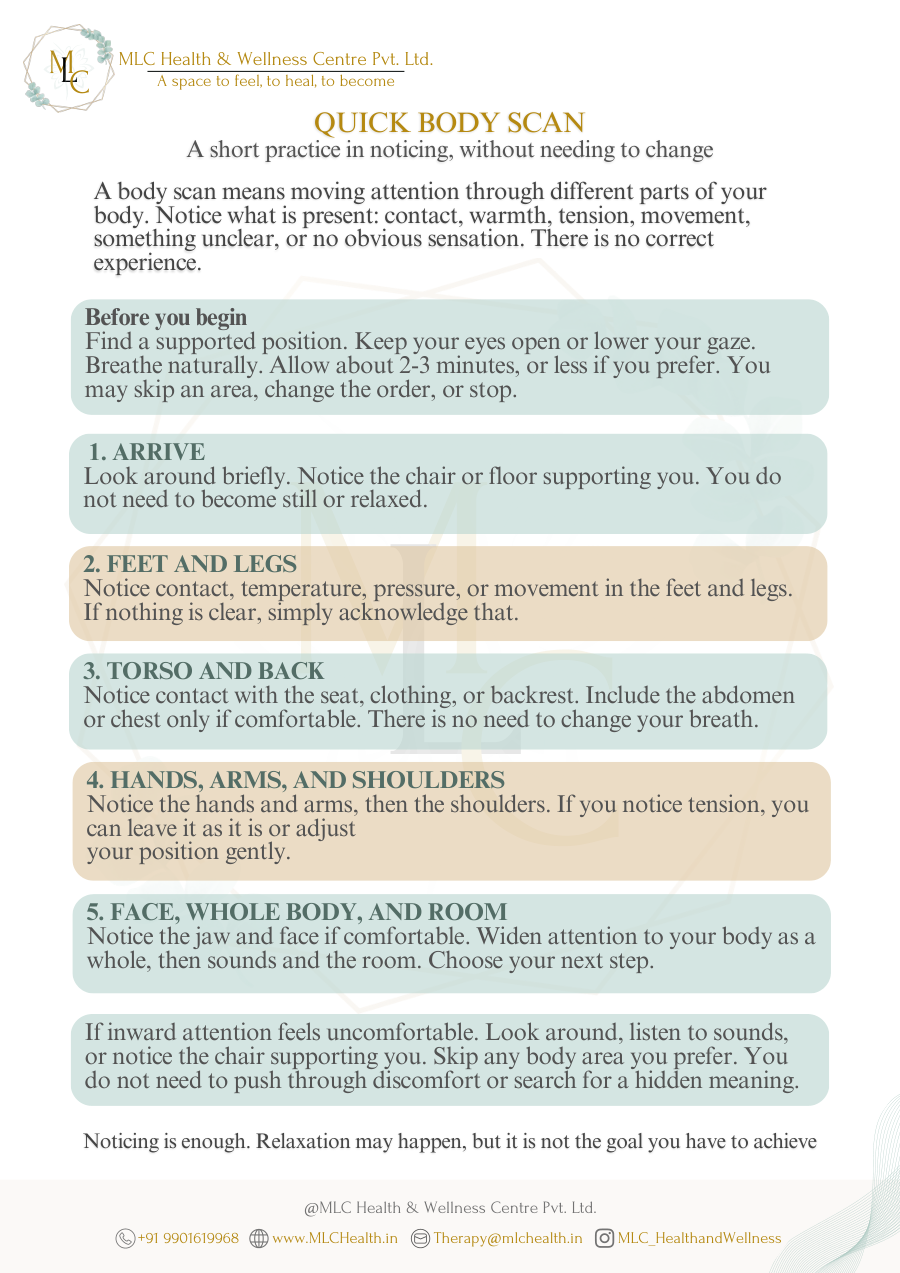
Page 1: Brief practice guide
A short introduction, preparation instructions, and five stages:
- Arrive.
- Feet and legs.
- Torso and back.
- Hands, arms, and shoulders.
- Face, whole body, and room.
About page 1
The page suggests approximately 2–3 minutes or less, and includes alternatives when inward attention feels uncomfortable.
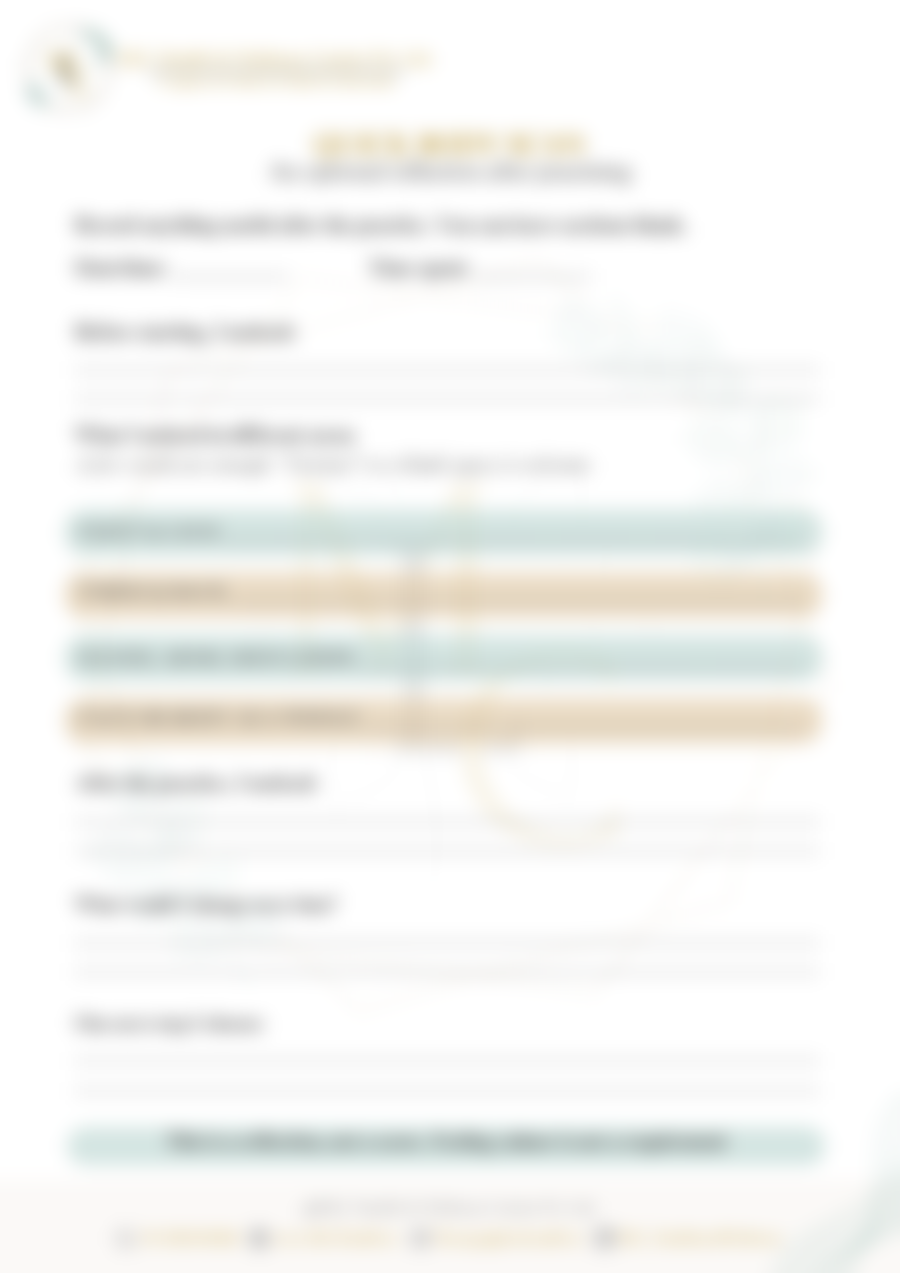
Page 2: Optional reflection worksheet
Writing spaces for:
- Date/time.
- Time spent.
- Before starting, I noticed.
- Feet and legs.
- Torso and back.
- Hands, arms, shoulders.
- Face or body as a whole.
- After the practice, I noticed.
- What would I change next time?
- One next step I choose.
Pages 3–4: Therapist-guided script
A longer spoken script with pauses, beginning with settling into a supported position and moving from the head down towards the feet before returning attention to the whole body and the room.
Using all or part of it
You can use the brief guide alone. Completing all four pages is not required each time. The PDF has writing spaces; it does not have embedded form fields, so print it to write by hand or use a PDF annotation tool.
When might you use it?
- Between activities, when you want a deliberate pause before moving on.
- After sitting at a desk, when you want to notice your position and points of contact.
- During a therapy session, when you and your therapist agree to practise attending to bodily experience.
- At a relatively ordinary moment, when you want to become familiar with the instructions without expecting an immediate emotional change.
The practice does not need to be reserved for times of high distress.
It is not presented as a universal first response to panic, dissociation, or traumatic memories. Your own experience of inward attention should guide whether to continue, adapt, or choose something else.
How do I follow the brief practice?
Prepare. Find a supported position. Keep your eyes open or lower your gaze, as the brief guide suggests. Let breathing continue naturally. Allow approximately 2–3 minutes, or choose a shorter practice.
Then move through the five stages on page 1:
- Arrive: Look around briefly and notice the surface supporting you. There is no need to become completely still before beginning.
- Feet and legs: Notice contact, pressure, temperature, or movement. You do not need to inspect every toe or identify a sensation in every area.
- Torso and back: Notice contact with the seat, backrest, or clothing. Include the chest or abdomen only if comfortable. There is no need to alter your breathing.
- Hands, arms, and shoulders: Notice how these areas feel and where they rest. If you notice tension, you can leave it as it is or make a small adjustment.
- Face, whole body, and room: Notice the face or jaw if comfortable. Widen attention to the body as a whole, then to sounds and the room. Choose what to do next.
There are no breath holds, muscle contractions, fixed breath counts, or required timings for individual body areas. This is not progressive muscle relaxation: it does not ask you to tense and release muscle groups.
How does the longer guided script differ?
Pages 3–4 provide a fuller experience for a therapist to read aloud. The sequence is:
Settling and support → two comfortable, unforced breaths → head → forehead → jaw → neck and shoulders → arms and hands → chest, if comfortable → back → stomach, if comfortable → hips and thighs → knees → calves and ankles → feet → whole body → room and next step.
Unlike the short guide, the script offers closing the eyes as an option while also allowing them to remain open.
After its opening breaths, it invites breathing to return to its natural rhythm. Later instructions do not require deeper or slower breathing.
The script includes pauses but does not assign a fixed number of seconds to them. A therapist can leave space for noticing and adjust the pace in collaboration with the person. It takes longer than the brief guide, and the PDF does not specify a fixed duration, so the script should not be rushed to fit the brief guide’s 2–3 minutes.
What should you notice, and what if you notice nothing?
There is a difference between a sensation and an interpretation. Examples of descriptions include:
- “Warmth in my palms.”
- “Pressure where my legs meet the chair.”
- “My jaw feels held tightly.”
- “I can feel my sleeve against my arm.”
- “Nothing clear in this area.”
An interpretation would be: “This tightness means something bad is about to happen” or “This body part is holding a particular emotion.” The worksheet does not require interpretations like these, and it does not assign universal emotional meanings to body areas.
Sensations do not have to be strong or interesting. Ordinary contact, position, and temperature are enough to describe. If an area is unclear, move on without searching harder.
If thoughts or emotions appear, you may acknowledge them. You do not need to analyse them during the practice.
Does the practice need to make you relaxed?
No. The PDF explicitly allows the body to feel different afterwards or much the same.
Some people may experience relaxation. Others may notice tension more clearly, remain distracted, or simply become more aware of how they are sitting. The practice invites noticing and choice; it does not require a particular mood at the end.
The longer script contains optional invitations to soften the forehead, loosen the jaw, and settle the shoulders. These are optional adjustments, and they do not turn the exercise into a task of removing all tension. You can leave a sensation as it is.
Returning attention after distraction is part of following the exercise. A wandering mind does not mean you have failed. Feeling distress does not show that the exercise is working, and you do not need to push through discomfort.
How do I use the reflection worksheet?
Each field has a simple purpose:
The worksheet is not a diagnostic instrument, symptom scale, or validated measure of treatment progress.
Date/time and time spent
Record when you practised and approximately how long you spent, if useful. These entries are for context, not a target to beat.
Before starting, I noticed
Briefly describe your starting experience. This might include a thought, sensation, emotion, or what you were doing beforehand.
Different body areas
Write a few descriptive words for any areas you noticed. “Unclear” and blank spaces are acceptable.
After the practice, I noticed
Describe what is present now. You do not need to demonstrate improvement or compare yourself against a score.
What would I change next time?
Identify a practical adjustment: a different position, a shorter practice, more time on an easy-to-notice area, or keeping attention on the room.
One next step I choose
Name a manageable action that fits your situation.
What does a completed worksheet look like?
Illustrative example (not a real client account or an expected result):
- Date/time: Tuesday, 4:30 p.m.
- Time spent: About 2 minutes.
- Before starting, I noticed: “I was thinking about the next task and holding my shoulders up.”
- Feet and legs: “Pressure under my heels. Not much else was clear.”
- Torso and back: “My back touching the chair. Clothing around my waist.”
- Hands, arms, shoulders: “Warm hands. Tightness around my shoulders.”
- Face or body as a whole: “My jaw felt held. I noticed several places where the chair supported me.”
- After the practice, I noticed: “I am still thinking about work. I can also notice how I am sitting.”
- What would I change next time? “I would sit back in the chair before starting and spend less time trying to find sensations.”
- One next step I choose: “I will adjust my position and choose the first task to work on.”
This example is useful because it records an ordinary experience and a chosen action. It does not depend on a dramatic reduction in stress.
What if the practice feels difficult?
“My mind keeps wandering.”
When you notice, return to the area you were exploring or move to the next one. You do not need to restart.
“I cannot feel much.”
Notice an obvious point of contact, such as a hand resting on a surface. If nothing is clear, record that or leave the space blank.
“I feel restless.”
You can change position, move slightly, or shorten the practice. Remaining motionless is not required.
“Paying attention inside my body feels uncomfortable.”
Open your eyes if they are closed. Look around, listen to sounds, or choose an external object to notice. You may skip the remaining body areas or stop.
“I keep checking whether the sensation has gone away.”
Return to a simple description of what you notice, rather than repeatedly testing for improvement. If the exercise is becoming another form of unwanted checking, discuss a different approach with your therapist.
“Writing afterwards feels like another task.”
Use one or two words, complete only the most useful field, or leave the reflection page unused.
Guidance for therapists
How to facilitate the supplied script thoughtfully:
This is guidance for using the MLC resource, not a separately validated treatment protocol.
Agree on the purpose
Ask whether the person wants to try noticing bodily experience. Do not assume that the purpose is relaxation.
Offer concrete choices before beginning
Discuss position, eyes open or closed, any areas they prefer to skip, and how they can indicate that they want to pause.
Choose the appropriate version
Use page 1 for a brief introduction. Use pages 3–4 when there is time for a longer guided practice. Do not require the full script merely because it is included.
Read with space between invitations
Allow time to notice without turning pauses into a test of endurance. The PDF does not prescribe a rigid timing protocol.
Keep examples open
When naming warmth, pressure, or tingling, make clear that these are possibilities rather than sensations the person should find.
Debrief without leading
Ask “What did you notice?” or “Was there anything you would change?” rather than “Do you feel calmer now?”
Use the worksheet selectively
The person may write, discuss an answer, or leave it blank. Do not interpret an empty field as lack of engagement.
Respond to the person’s experience
If inward attention is unwelcome or distress increases, pause and collaboratively choose an alternative. Completing the sequence matters less than the person’s preference.
About this resource
Created by MLC Health & Wellness Centre Pvt. Ltd. The explanations, examples, design, and practice prompts were developed by MLC, informed by established psychological literature. Supporting references are provided below.
The references support the background practice and the evidence discussion. They do not imply that the cited authors created, reviewed, endorsed, or validated MLC’s PDF.
What does the evidence support?
Established practice background
Body scanning is an established practice within mindfulness-based stress reduction. Kabat-Zinn’s book provides background on the broader approach and its practices. A brief worksheet and script should not be presented as equivalent to the complete programme described in that literature.
Research on body scans themselves
Gan, Zhang, and Chen’s 2022 systematic review and meta-analysis included 14 independent articles. It found a small improvement in mindfulness compared with passive controls, while highlighting low study quality and substantial variation between studies. It did not establish broad health benefits from body scanning alone. A subsequent randomized multisite study by Sparacio and colleagues, published in 2024, tested 15-minute mindfulness exercises. Participants in the body-scan condition reported lower immediate stress than those in an active control condition involving listening to story excerpts. This supports a specific short-term finding under the study’s conditions; it does not establish lasting improvement or treatment of a diagnosed disorder. The two findings concern different bodies of evidence, dates, and outcomes.
What this means for MLC’s resource
These sources provide a credible foundation for discussing the practice, alongside its limitations. Neither study tested this MLC PDF, its reflection worksheet, or its 2–3-minute instructions. The resource is informed by established mindfulness literature; it is not a clinically validated intervention.
Frequently asked questions
Supporting references
These references support the background practice and the evidence discussion. They do not imply that the cited authors created, reviewed, endorsed, or validated MLC’s PDF.
- Kabat-Zinn, J. (2013). Full catastrophe living: Using the wisdom of your body and mind to face stress, pain, and illness (Revised edition). Bantam. https://penguinrandomhousehighereducation.com/book/?isbn=9780345536938 Relevance: Foundational background for mindfulness-based stress reduction and body-scan practice. This book does not validate the specific MLC worksheet.
- Gan, R., Zhang, L., & Chen, S. (2022). The effects of body scan meditation: A systematic review and meta-analysis. Applied Psychology: Health and Well-Being, 14(3), 1062–1080. https://doi.org/10.1111/aphw.12366 Relevance: Reviews research specifically on body-scan meditation and provides important limits on claims about its benefits.
- Sparacio, A., et al. (2024). Self-administered mindfulness interventions reduce stress in a large, randomized controlled multi-site study. Nature Human Behaviour, 8, 1716–1725. https://doi.org/10.1038/s41562-024-01907-7 Relevance: Provides evidence concerning immediate self-reported stress following a 15-minute body scan in a randomized study. It did not test MLC’s resource.
Platform disclaimer: this is a reflection and planning tool. It is not a diagnostic instrument or a substitute for therapy. If you are in distress, call Tele-MANAS at 14416.