
Inside the worksheet

Unlocks after purchase
What is a physiological sigh?
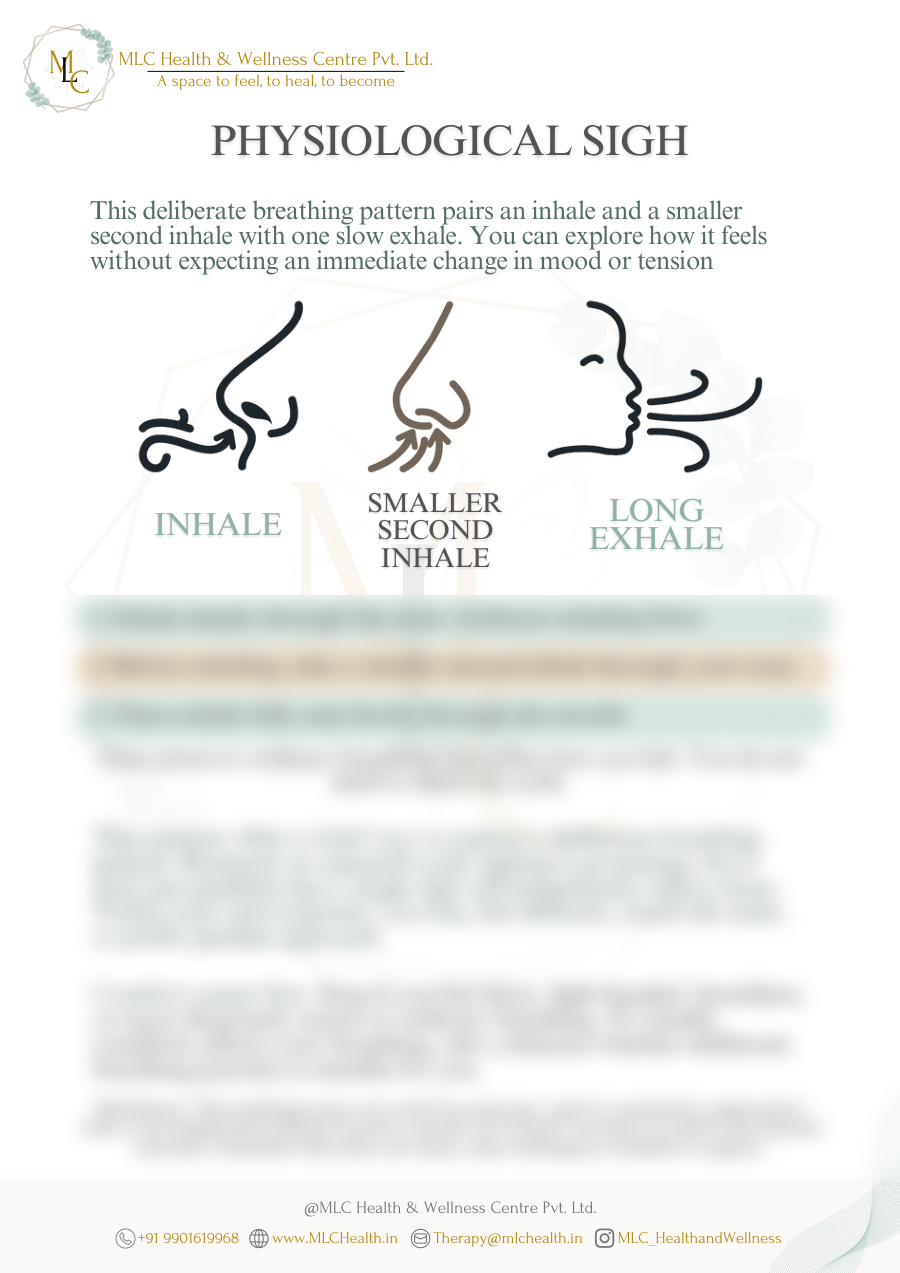
In this resource, “physiological sigh” refers to a deliberately practised breathing pattern: an inhale, a smaller second inhale before breathing out, and then a slow exhale.
The two inhalations are connected. There is no exhalation between them.
The exercise gives you a simple sequence to try and observe. It does not require you to achieve a particular emotional state, measure your breathing, or continue until you feel calm.
A spontaneous sigh and deliberately practising this sequence are related concepts, but they are not interchangeable evidence claims. Research about naturally occurring sighs does not automatically establish the effectiveness of a coping exercise.
What is this resource intended to help you do?
These are the resource’s intended functions. Not everyone will experience relief, and no number of cycles guarantees a benefit.
Learn the sequence clearly
The illustration and numbered instructions show how the smaller second inhale follows the first before the exhale begins.
Notice your response
The reflection page asks whether the practice felt comfortable, uncomfortable, or mixed. It also separates what you noticed during the exercise from what you noticed after returning to ordinary breathing.
Decide what is useful for you
You can choose to use it again, adjust your approach, discuss it with a therapist, or choose another tool.
What is included in the PDF?
Page 1: Illustrated practice guide
A visual sequence of two inhalations followed by an exhalation, accompanying instructions, and guidance to stop if the practice causes dizziness, light-headedness, breathlessness, or increased distress.
Page 2: Optional reflection worksheet
The worksheet includes:
- Date/time.
- Cycles tried.
- What was happening before the practice.
- What you noticed before starting.
- Whether the practice felt comfortable, uncomfortable, or unsure/mixed.
- Anything noticed while breathing.
- What you noticed after returning to normal breathing.
- Whether you would use it again, adapt it, or choose another tool.
- One next step you choose.
Using it
The reflection page is optional. You can try the practice without completing a written record. The PDF has printable writing spaces and tick boxes but no embedded form fields, and it has no symptom score, progress chart or daily tracker.
When might you choose to try it?
- Before responding to a difficult message.
- During a pause between demanding tasks.
- When noticing that you feel keyed up and want to try a brief coping action.
- In a therapy session, while exploring which approaches feel comfortable.
- At an ordinary moment, simply to become familiar with the sequence.
The breathing exercise does not solve the situation that prompted it. A difficult conversation, workload problem, or unmet need may still require a practical response.
It is not presented as something everyone should use during panic or intense distress. Whether focusing on breathing is helpful is part of your own experience to assess.
How do you practise the physiological sigh?
Follow these five steps, at a comfortable pace:
- Settle into a supported position. Allow your breathing to continue ordinarily before beginning.
- Take a comfortable inhale through your nose, without straining.
- Before exhaling, take a smaller second inhale through your nose.
- Let the breath out slowly through your mouth, without forcing.
- Return to ordinary breathing and notice how you feel.
The smaller second inhale follows the first; it is not a new full breath after an exhale.
There is no prescribed breath hold, numerical breathing ratio, or requirement to empty the lungs forcefully.
For an initial exploration, you can try one cycle and then return to ordinary breathing. This is a cautious introductory option, not a scientifically established minimum effective dose. Repetition is not required.
How should the breathing feel?
The first inhale should not be a competition to take in as much air as possible. The second is smaller, and the exhale should be unhurried without being pushed beyond comfort.
You do not need to create a loud sighing sound, raise the shoulders dramatically, or hold the breath between stages.
If the second inhale feels awkward or requires straining, do not keep forcing the sequence. Return to ordinary breathing.
A stronger sensation does not mean a more effective exercise. Comfort and willingness to continue matter more than making the breath large or impressive.
What might you notice afterwards?
Possible observations include a subjective sense of settling, no clear change, awkwardness with the sequence, or a preference for another approach. These are examples of experiences someone might report, not predictions or a list of established effects.
There is a difference between two kinds of statement:
- “I feel a little less tense” is a personal observation.
- “My nervous system has reset” is a physiological conclusion the worksheet cannot establish.
You do not need to monitor your pulse or determine whether the practice changed a physiological measurement.
If you feel much the same, you can record that and move on. Repeating the exercise until a desired feeling appears is not a requirement.
When should you stop or choose another approach?
Stop if you feel dizzy, light-headed, breathless, or more distressed, and return to ordinary breathing. These experiences are not evidence of emotional release or successful practice, and they are not something to push through.
If a health condition affects your breathing, ask an appropriate clinician whether deliberate breathing practice is suitable for you.
If attention to breathing itself feels uncomfortable, choose a different activity, such as looking around the room, noticing an object, changing position, or taking a practical pause.
This exercise is not suitable for everyone, and you are always free to choose another tool.
How do you complete the reflection page?
The worksheet is not a diagnostic instrument or validated outcome measure.
Date/time and cycles tried
Record the context and what you actually tried. The cycle count is descriptive, not a target.
What was happening before the practice
Describe the situation, for example reading a difficult message or finishing a demanding task.
Before starting, I noticed
Record thoughts, emotions, or sensations present before beginning.
How did the practice feel?
Choose comfortable, uncomfortable, or unsure/mixed. This asks about the experience of practising, not whether you passed or achieved the right result.
Anything I noticed while breathing
Describe the process, including whether the sequence felt easy, awkward, or effortful.
After returning to normal breathing, I noticed
Record your experience after the deliberate sequence has ended.
Would I use this again, adapt it, or choose another tool?
Reflect on whether it suited you. Adaptation might mean a more supported position or practising with guidance; it does not mean increasing effort.
One next step I choose
Identify a concrete action relevant to the original situation.
What does a completed worksheet look like?
Illustrative example (not a real client account or an expected outcome):
- Date/time: Wednesday, 3:15 p.m.
- Cycles tried: 1.
- What was happening before I started the practice? “I had received a message asking for another change to a task I had already finished.”
- Before starting, I noticed: “I felt irritated and wanted to reply immediately.”
- How did the practice feel? “Unsure/mixed.”
- Anything I noticed while breathing: “The second inhale felt unfamiliar. I did not try to make it bigger.”
- After returning to normal breathing, I noticed: “I was still irritated. I had taken a short pause before replying.”
- Would I use this again, adapt it, or choose another tool? “I might try it with my therapist. For now, I prefer a brief walk.”
- One next step I choose: “I will clarify which change is the priority before agreeing to more work.”
The record remains useful even without a clear calming effect. It helps the person identify a preference and choose an action.
What are the common misunderstandings?
“Both inhalations should be equally short.”
The intended sequence uses a first inhale followed by a smaller second inhale. The illustration on page 1 shows the difference.
“I should exhale between the two inhalations.”
The smaller second inhale comes before the exhale.
“A bigger breath will work better.”
There is no need to strain or maximise the breath.
“I should keep repeating until I feel calm.”
The worksheet explicitly permits no change and does not require repetition.
“If it did not help, I did it wrong.”
A technique can feel unhelpful or uncomfortable even when someone understands the instructions.
“The point is to get rid of as much carbon dioxide as possible.”
That is not how this resource frames the exercise. It is not a method for measuring or correcting blood gases.
Guidance for therapists
Explain the purpose before demonstrating
Invite the person to explore the pattern and notice whether it suits them.
Describe the sequence accurately
Emphasise that the second inhale is smaller and comes before the exhale. Avoid making forceful breathing the model.
Agree on an endpoint
A brief introduction can finish with a return to ordinary breathing and a check-in. There is no need to continue until the person reports relief.
Ask neutral questions
“What was that like?” and “Would you choose this again?” leave room for mixed responses.
Separate observation from explanation
If someone reports feeling calmer, acknowledge that without claiming a particular autonomic mechanism has been demonstrated.
Use the worksheet collaboratively
Offer writing, discussion, or leaving fields blank. Do not use cycle counts as compliance targets.
Connect the exercise to what comes next
A pause may be followed by communication, problem-solving, rest, or another therapeutic task. Breathing does not need to replace addressing the underlying concern.
About this resource
Created by MLC Health & Wellness Centre Pvt. Ltd. The explanations, examples, design, and practice prompts were developed by MLC, informed by established psychological literature. Supporting references are provided below.
The references support the background discussion. They do not imply that the cited researchers created, reviewed, endorsed, or validated this MLC resource.
What does the evidence support?
Human intervention research
Yilmaz Balban and colleagues (2023) studied five-minute daily breathing practices over one month. Cyclic sighing showed promising results for positive mood and respiratory rate compared with mindfulness meditation. The exploratory design, small groups, and absence of longer follow-up limit conclusions. This study did not validate MLC’s worksheet or establish guaranteed immediate relief from a single cycle.
Basic-science background
Li and colleagues (2016) investigated neural control of sighing in mice. This provides physiological background, not evidence that the present exercise treats human anxiety.
What this means for MLC’s resource
The resource is informed by relevant research. Its particular instructions, reflection questions, and brief use format have not themselves been clinically validated.
Frequently asked questions
Supporting references
These references support the background discussion. They do not imply that the cited researchers created, reviewed, endorsed, or validated this MLC resource.
- Yilmaz Balban, M., Neri, E., Kogon, M. M., Weed, L., Nouriani, B., Jo, B., Holl, G., Zeitzer, J. M., Spiegel, D., & Huberman, A. D. (2023). Brief structured respiration practices enhance mood and reduce physiological arousal. Cell Reports Medicine, 4(1), 100895. https://doi.org/10.1016/j.xcrm.2022.100895 Relevance: Human intervention research on repeated cyclic sighing; not validation of this resource.
- Li, P., Janczewski, W. A., Yackle, K., Kam, K., Pagliardini, S., Krasnow, M. A., & Feldman, J. L. (2016). The peptidergic control circuit for sighing. Nature, 530, 293–297. https://doi.org/10.1038/nature16964 Relevance: Animal research on the biological control of sighing; not a human treatment trial.
Platform disclaimer: this is a reflection and planning tool. It is not a diagnostic instrument or a substitute for therapy. If you are in distress, call Tele-MANAS at 14416.