
Inside the worksheet

Unlocks after purchase
Overview
Cognitive distortions are patterns of thinking, named in CBT, that can be one-sided, rigid or quick to reach conclusions. This MLC resource is a printable two-page PDF: a reference guide to ten common thinking patterns with examples, and a practice worksheet for exploring one thought in context. It is for personal reflection and for therapists introducing thinking patterns in collaborative work.
Sometimes our thinking becomes one-sided, rigid, or quick to reach conclusions. We may turn one mistake into a judgement about ourselves, assume we know another person’s thoughts, or overlook information that does not fit our first impression.
In CBT, patterns like these are often called cognitive distortions. The term describes a possible feature of a thought, not a defect in the person having it.
This resource introduces ten patterns and provides space to explore one thought in context.
For personal use
Choose a manageable example and approach it with curiosity. You do not have to find a label or decide that the thought is wrong.
For therapists
Use the guide as shared vocabulary for collaborative exploration. Begin with the person’s experience and circumstances, rather than assigning a label before understanding the situation.
Inside the PDF
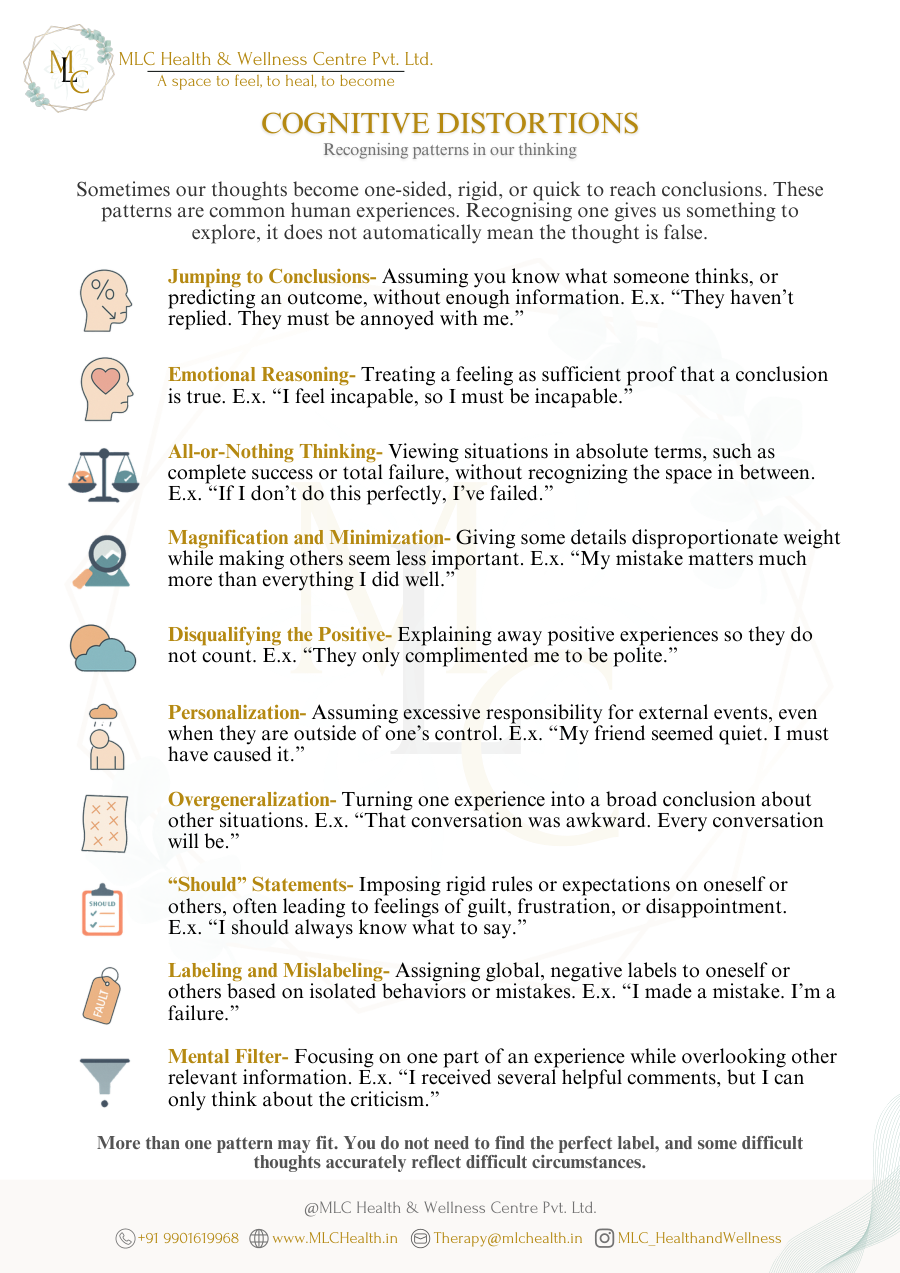
- Page 1: ten thinking patterns with explanations and examples.
- Page 2: a practice worksheet covering situation, thoughts, emotions, possible patterns, known information, wider context, and a response.
- A personal 0–10 emotional intensity scale.
- Reminders that more than one pattern may fit and that some difficult thoughts accurately reflect difficult circumstances.
Quick start
If you only read one section, read this one. The reference guide takes approximately 5–10 minutes and the practice worksheet approximately 10–15 minutes; these are suggested use times, not measured completion times.
- Choose one recent, manageable situation.
- Write the thought in your own words.
- Notice the emotions that accompanied it.
- If useful, rate emotional intensity using the printed 0–10 scale.
- Look through page 1 and consider whether a pattern might fit.
- Separate what you know happened from what you are assuming or predicting.
- Consider relevant information or context you may have overlooked.
- Explore a response that offers more fairness, flexibility, or support.
You can choose more than one pattern, write “not sure,” or decide that none fits.
Naming a pattern is a starting point for exploration, not a verdict about the thought.
The ten thinking patterns
Ten patterns are described below, in the order they appear on page 1. Patterns can overlap. The purpose is to understand the thought’s shape and context, not to achieve a perfect classification.
Jumping to conclusions
Reaching a conclusion without enough information. This can involve assuming another person’s thoughts or predicting an outcome as though it were established.
- Example: “They have not replied. They must be annoyed with me.”
- Question to explore: “What do I know, and what am I filling in?”
Emotional reasoning
Treating a feeling as sufficient proof that a conclusion is true.
- Example: “I feel incapable, so I must be incapable.”
- Question to explore: “What is the feeling telling me about my experience, and what other information matters?”
- A note: feelings deserve attention even when they do not establish every conclusion attached to them.
All-or-nothing thinking
Seeing only extremes and overlooking the possibilities between them.
- Example: “If I do not do this perfectly, I have failed.”
- Question to explore: “What would a middle ground look like?”
Magnification and minimisation
Giving some information disproportionate weight while making other relevant information seem less important.
- Example: “My mistake matters much more than everything I did well.”
- Question to explore: “Am I weighing the different parts of this fairly?”
Disqualifying the positive
Explaining away positive experiences so they do not count.
- Example: “They only complimented me to be polite.”
- Question to explore: “Is there a fair reason to dismiss this, or could I allow it to count?”
Personalisation
Taking more responsibility for an event than the available information supports.
- Example: “My friend seemed quiet. I must have caused it.”
- Question to explore: “What was my actual role, and what else might have contributed?”
- A note: recognising excessive responsibility does not mean avoiding genuine responsibility.
Overgeneralisation
Turning one experience into a broad conclusion about other situations.
- Example: “That conversation was awkward. Every conversation will be.”
- Question to explore: “What does this experience tell me, and what does it not establish?”
“Should” statements
Applying inflexible expectations that leave little room for circumstances, limitations, or choice.
- Example: “I should always know what to say.”
- Question to explore: “Is this a useful standard, or an absolute rule that needs more flexibility?”
- A note: the word “should” is not automatically a problem. Context and rigidity matter.
Labelling and mislabelling
Turning a particular action or difficulty into a global judgement about a person.
- Example: “I made a mistake. I am a failure.”
- Question to explore: “Can I describe what happened without defining the whole person?”
Mental filter
Focusing on one part of an experience while overlooking other relevant information.
- Example: “I received several helpful comments, but I can only think about the criticism.”
- Question to explore: “What else belongs in the picture?”
Using the worksheet
Use page 2 for one situation and one main thought.
Date/time
Record when the experience happened or when you completed the reflection.
Situation
Describe what was happening. Keep the event separate from your interpretation where possible.
Thoughts
Write what went through your mind in your own words. Avoid replacing it immediately with what you think you ought to have thought.
Emotions and intensity
Name the emotions you noticed. If useful, use the printed scale from 0, not noticeable, to 10, extremely strong. The rating is personal, not a test score. You can leave it blank.
Possible pattern
Consider whether one or more patterns on page 1 might fit, and explain why. “Not sure” and “none fits” are valid responses.
What I know
Separate what you know happened from assumptions, interpretations, or predictions. If the available information is incomplete, record that uncertainty.
Wider picture
Consider relevant context, other information, previous experiences, practical circumstances, and alternative explanations. This does not require inventing a reassuring explanation or overlooking evidence of harm.
Response
Explore what would help you respond with more fairness, flexibility, or support. You might consider a different perspective, practical action, a boundary, clarification, or help from someone else. A positive replacement thought is not required.
Curiosity, not criticism
The aim is curiosity about the thought, not criticism of yourself for having it.
Therapist guide
Introduce the resource collaboratively:
“Would it help to look at the way this thought is put together, while keeping the situation itself in view?”
Begin with a specific example in the client’s own words. Understand the meaning and emotional impact before suggesting a pattern.
Useful questions include:
- “What makes this thought convincing?”
- “What information supports the concern?”
- “Where is there uncertainty?”
- “Does any pattern seem relevant to you?”
- “What information might be receiving too much or too little weight?”
- “What would a fair description include?”
- “What support or action is needed?”
Offer pattern names tentatively and accept disagreement.
Do not use “distortion” to dismiss a realistic concern, moral judgement, cultural difference, or report of mistreatment.
If the thought appears accurate, explore its impact, possible coping responses, and available support. If parts are uncertain or overly broad, examine those collaboratively.
Close by asking what the client found useful. Agree further practice rather than assigning repeated monitoring automatically.
These are suggested facilitation steps, not a standardised treatment protocol.
Worked examples
These examples are fictional. Pattern labels are tentative, and intensity ratings are omitted because they are personal.
Example 1: A mistake at work
- Situation: I noticed an error in a report I submitted.
- Thought: “I made a mistake. I am terrible at my job.”
- Emotions: Embarrassed and anxious.
- Possible patterns: Labelling and overgeneralisation.
- What I know: There is an error in this report. That does not establish the quality of all my work.
- Wider picture: I can consider the error’s significance, previous feedback, workload, and how it can be corrected.
- Response: Correct the error and describe the specific learning point without defining myself by it.
Example 2: A quiet friend
- Situation: My friend was quieter than usual during lunch.
- Thought: “I must have upset them.”
- Emotion: Worried.
- Possible patterns: Jumping to conclusions and personalisation.
- What I know: They were quiet. They have not told me why.
- Wider picture: There may be several explanations. I do not need to choose one without information.
- Response: Check in gently if appropriate and allow room for uncertainty.
Example 3: An inflexible expectation
- Situation: I struggled to respond when someone shared difficult news.
- Thought: “I should always know the right thing to say.”
- Emotions: Guilty and disappointed.
- Possible patterns: “Should” statements and all-or-nothing thinking.
- What I know: I did not know what to say in that moment.
- Wider picture: Being supportive can include listening, acknowledging difficulty, or asking what would help.
- Response: “I can care about someone without always having the right words.”
Example 4: A concern supported by events
- Situation: A colleague has repeatedly made belittling comments.
- Thought: “The way they are speaking to me is disrespectful.”
- Emotions: Angry and hurt.
- Possible pattern: None necessarily fits.
- What I know: I can identify specific comments and when they occurred.
- Wider picture: The repeated behaviour and relevant workplace circumstances matter.
- Response: Consider support, documentation, a boundary, or an appropriate reporting route.
A note on harmful behaviour
The exercise should not be used to explain away harmful behaviour.
When it feels difficult
“Several labels fit.”
Choose whichever helps you understand the thought. You do not need to resolve every overlap.
“I cannot find a pattern.”
Write “none” or “not sure.” The thought may still be worth exploring without a label.
“The word distortion feels critical.”
You can use “thinking pattern” instead. Discuss what language feels useful.
“My thought might be true.”
Consider the information carefully. A pattern label does not settle whether a thought is accurate.
“I am trying to prove that everything is fine.”
Return to a fair account of the information. The goal is not reassurance at any cost.
“I keep checking my thinking.”
You do not need to inspect every thought. Keep practice limited to what is useful and discuss distressing repetition with your therapist.
“I feel worse after writing.”
Pause. Choose a less intense example or explore the experience with support.
Noticing patterns
If the worksheet is useful, compare a few entries over time.
Ask:
- Which kinds of situations bring up similar thoughts?
- Are there expectations I apply rigidly to myself?
- What information do I tend to overlook?
- When am I taking too much or too little responsibility?
- What responses have been helpful?
- Is this practice increasing understanding or becoming another source of self-criticism?
Progress may involve noticing a pattern sooner, tolerating uncertainty, describing a difficulty more specifically, or seeking appropriate support.
It does not require eliminating negative thoughts or reducing every emotion rating.
Do not count pattern labels or add intensity ratings into a diagnostic score.
Adapting it
Adolescents
Use examples they choose and explain one or two patterns at a time. Avoid making classification feel like a test.
Reading or writing difficulties
Use brief phrases, spoken reflection, or fewer prompts.
Language and culture
Explore the meaning of statements in the person’s own language and circumstances. Do not assume unfamiliar expressions indicate distorted thinking.
Neurodivergent users
Offer concrete examples, clear distinctions, and time to process. Do not treat a communication style or preference for precision as a distortion.
Perfectionism
Emphasise that choosing the correct label is unnecessary. Keep the exercise from becoming another performance standard.
Real-world adversity
Consider discrimination, financial pressure, illness, loss, and relationship circumstances. Some concerns call for practical support or protection.
A note on these suggestions
These are practical facilitation suggestions, not evidence that this particular worksheet has been validated for each group.
Limits & ethics
This resource is educational and reflective. It is not a diagnostic instrument, a complete clinical assessment, or a stand-alone treatment.
The ten categories are a practical selection, not an exhaustive or universally fixed classification.
A distressing thought is not automatically distorted. A named pattern does not prove a thought false, and an emotion is not itself a thinking error.
Do not use the worksheet to invalidate reports of danger, abuse, discrimination, or mistreatment.
Users may disagree, skip prompts, or stop.
Completed worksheets may contain sensitive information. Consider how they will be stored and shared.
The resource does not replace clinical assessment, safeguarding procedures, or urgent support when needed.
Background & evidence
The reference texts below describe CBT approaches to identifying and evaluating thoughts.
Judith S. Beck’s Cognitive Behavior Therapy: Basics and Beyond provides clinical guidance on identifying, evaluating, and responding to automatic thoughts (Beck, 2020).
Greenberger and Padesky’s Mind Over Mood describes practical work with thoughts, evidence, and alternative or balanced perspectives (Greenberger & Padesky, 2016).
These books provide conceptual and practical background. They do not establish that this particular MLC worksheet, its wording, or its ten-category list has been independently validated.
This resource introduces recognition and reflection. It does not represent a complete CBT treatment programme, and no treatment-effect claim is made for the worksheet alone.
Using the PDF
The PDF contains two pages.
- Page 1 provides the ten-pattern reference guide with explanations and examples.
- Page 2 provides the practice worksheet, including date/time, situation, thoughts, emotions and intensity, possible pattern, what I know, wider picture, and response.
It is a printable PDF. Keep page 1 as a reference and print page 2 again for a new example.
Write on a printed copy or annotate the PDF using a suitable app. This file does not contain interactive typing fields.
Use a print size that keeps the reference text readable. Store completed sheets privately.
Attribution
Created by MLC Health & Wellness Centre Pvt. Ltd. The explanations, examples, design, and practice prompts were developed by MLC, informed by established psychological literature.
The concepts discussed here are described within the CBT literature, including the reference texts below. The references do not imply that their authors created, reviewed, or endorsed this particular resource.
Frequently asked questions
References
- Beck, J. S. (2020). Cognitive behavior therapy: Basics and beyond (3rd ed.). The Guilford Press. https://www.guilford.com/books/Cognitive-Behavior-Therapy/Judith-Beck/9781462544196
- Greenberger, D., & Padesky, C. A. (2016). Mind over mood: Change how you feel by changing the way you think (2nd ed.). The Guilford Press. https://www.guilford.com/books/Mind-Over-Mood/Greenberger-Padesky/9781462520428
Platform disclaimer: this is a reflection and planning tool. It is not a diagnostic instrument or a substitute for therapy. If you are in distress, call Tele-MANAS at 14416.