
Inside the worksheet

Unlocks after purchase
What is box breathing?
Box breathing, also called square breathing, follows four phases:
- Breathe in.
- Hold after breathing in.
- Breathe out.
- Hold after breathing out.
Each phase uses the same count. In this resource, four counts is the example.
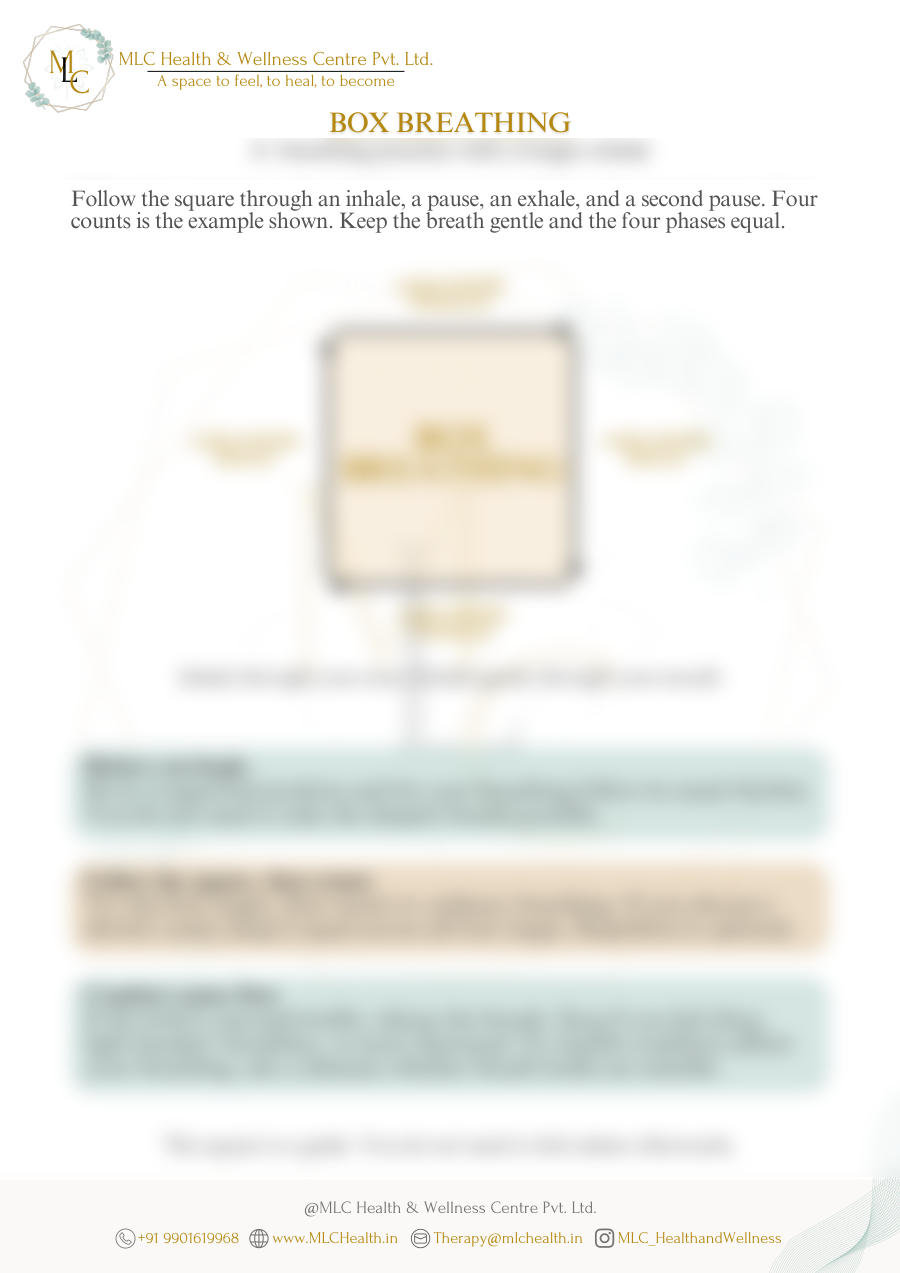
The square provides a visual reminder: one side represents each phase. Following the arrows helps you keep track of the order.
Unlike 4–7–8 breathing, the exhale is not longer than the inhale. Equal phase lengths are the defining feature.
The exercise is a deliberate breathing practice, not a test of lung capacity or how long you can tolerate a pause.
What is this resource intended to help you practise?
These are the resource’s intended functions. They are not promised improvements in concentration, emotional control, or lasting change from one use.
Following a clear sequence
The diagram offers a simple structure, particularly when remembering several instructions feels cumbersome.
Noticing how the practice feels
The reflection page invites observations about comfort, effort, distraction, and preference.
Choosing what suits you
You can decide whether to use the exercise again, seek guidance, or choose another tool.
What is included in the PDF?
Page 1: Visual practice guide
The first page includes:
- A short introduction to the four equal phases.
- A square diagram with directional arrows.
- Instructions to inhale through the nose and exhale gently through the mouth.
- Preparation guidance.
- Instructions to try the four stages and return to ordinary breathing.
- Permission to choose a shorter equal count.
- Optional repetition.
- Comfort guidance.
Page 2: Optional reflection worksheet
The second page includes:
- Date/time.
- Cycles tried.
- What was happening before the practice.
- What was noticed before starting.
- One overall comfort choice: comfortable, uncomfortable, or unsure/mixed.
- Anything noticed while breathing.
- Observations after returning to normal breathing.
- Whether to use it again, adapt it, or choose another tool.
- One next step.
What it does not include
There are no separate phase-rating tables, count-used field, symptom scores, or practice tracker. The PDF is printable, with writing spaces and tick boxes, and has no embedded form fields.
When might you choose to try it?
Ordinary moments where a short, structured practice might fit:
- Between demanding tasks.
- Before replying to a difficult message.
- During a planned pause in the day.
- In a therapy session while exploring coping options.
- At a quiet moment when learning the sequence.
Trying the exercise does not remove the need to address the original situation. A workload problem may still need planning; a disagreement may still need communication.
The resource offers a possible pause before action. It is not a requirement to feel calm before doing something important.
How to follow the square
- Sit in a supported position.
- Let your breathing follow its usual rhythm before beginning.
- Start at the top-left corner of the square.
- Follow the top arrow: inhale gently through the nose for four counts.
- Follow the right arrow: hold after inhaling for four counts.
- Follow the bottom arrow: exhale gently through the mouth for four counts.
- Follow the left arrow: pause after exhaling for four counts.
- Return to ordinary breathing.
Completing all four phases is one cycle.
You do not need to take the largest possible inhale or force your lungs completely empty. Keep every phase gentle.
Understanding the two holds
You may find these pauses feel different. The worksheet’s “Anything I noticed while breathing” field is a place to describe that difference, even though it has no separate phase checkboxes.
Neither hold needs to be pushed through. If either pause feels uncomfortable, return to ordinary breathing.
Discomfort is not a necessary part of improving breath control.
The first hold
It comes after inhaling, with the lungs comfortably full.
The second hold
It comes after exhaling, with little breath left to hold.
Finding a manageable count
Four counts is the example shown in the resource.
The PDF allows a shorter count, provided it stays equal across all four stages. For example, you might choose three counts for each stage rather than four. This is an adaptation the resource offers, not a separately validated clinical protocol.
Use a comfortable, consistent counting pace. There is no need to work towards longer holds or higher counts over time.
If you prefer not to pause your breathing, you can choose a different practice. Removing the holds changes the exercise, and choosing another approach is acceptable.
What might you notice?
These are examples of individual experiences, not promised outcomes.
- The counting gives attention a clear task.
- One pause feels less comfortable than the other.
- The sequence feels unfamiliar.
- You feel somewhat more settled.
- There is little noticeable change.
- Another approach feels preferable.
An observation
“I felt less tense” describes a subjective response.
A claim the worksheet cannot establish
“My nervous system has reset” cannot be established by completing this worksheet.
No checking required
You do not need to check your pulse or repeatedly test whether the exercise has worked.
Comfort and choosing another approach
The PDF asks you to stop if the practice causes dizziness, light-headedness, breathlessness, or increased distress, and to return to ordinary breathing.
If a health condition affects your breathing, ask a clinician whether breath-holding practices are suitable.
If paying attention to your breathing is uncomfortable, you can choose an external focus, such as looking around the room or noticing an object, or simply move on to another activity.
How to use the reflection worksheet
Short phrases are enough, and you can leave any field blank.
The worksheet is a personal reflection, not a diagnostic assessment or validated measure of treatment progress.
Date/time and cycles tried
Record what actually happened. Cycle count is descriptive, not a target.
What was happening before I started the practice?
Describe the situation, such as finishing a meeting or preparing for a conversation.
Before starting, I noticed
Record thoughts, feelings, or sensations present beforehand.
How did the practice feel?
Choose comfortable, uncomfortable, or unsure/mixed for the overall experience.
Anything I noticed while breathing
Describe ease, effort, distraction, counting, or the experience of either hold.
After returning to normal breathing, I noticed
Record what was present after ending the deliberate sequence.
Would I use this again, adapt it, or choose another tool?
Reflect on suitability rather than whether you completed the exercise perfectly.
One next step I choose
Identify a manageable action relevant to the situation.
A completed example
This is an illustrative example, not a real client account or an expected result.
- Date/time: Thursday, 2:30 p.m.
- Cycles tried: 1.
- What was happening before I started the practice? “I had several messages to answer and was switching between them.”
- Before starting, I noticed: “I felt hurried and kept thinking about everything at once.”
- How did the practice feel? “Unsure/mixed.”
- Anything I noticed while breathing: “Following the arrows was straightforward. The pause after breathing out felt uncomfortable, so I returned to ordinary breathing before finishing the count.”
- After returning to normal breathing, I noticed: “I still had the same tasks to do, but I had stopped switching between messages for a moment.”
- Would I use this again, adapt it, or choose another tool? “I would prefer a practice without holds, or discuss another option with my therapist.”
- One next step I choose: “I will choose one message to answer first.”
Stopping early and identifying a preference are useful observations. This example does not depend on immediate relief.
Guidance for therapists
Ways to introduce this resource in a session:
Completing the four stages is not a measure of motivation or engagement.
Introduce the purpose collaboratively
Invite the person to explore whether the rhythm is useful and comfortable.
Explain both pauses
Do not assume that tolerating the hold after inhaling means the hold after exhaling will feel the same.
Demonstrate gentle breathing
Avoid exaggerated inhalation, forceful exhalation, or visible bracing.
Agree on a stopping point
Return to ordinary breathing and check the experience before considering repetition.
Ask neutral questions
“What did you notice?” and “Would you choose this again?” allow honest feedback.
Use the worksheet selectively
Writing, discussing observations, or leaving fields blank are all options.
Connect the pause to a next action
The practice can be followed by communication, planning, rest, or another therapeutic task.
About this resource
Created by MLC Health & Wellness Centre Pvt. Ltd. The explanations, examples, design, and practice prompts were developed by MLC, informed by established psychological literature. Supporting references are provided below.
The supporting reference does not imply that its authors created, reviewed, endorsed, or validated this MLC resource.
What does the evidence support?
Yilmaz Balban and colleagues (2023) included box breathing in a randomized study comparing daily five-minute breathing practices with mindfulness meditation over one month. The box-breathing group reported improved positive mood and reduced negative mood and state anxiety from before to after practice. These within-group findings do not establish that box breathing is superior to other approaches.
The study was exploratory, with small individual groups and no longer-term follow-up. It did not test MLC’s worksheet or establish a guaranteed benefit from one cycle.
This resource is informed by relevant research. Its particular guide, reflection questions, and brief introductory format have not themselves been clinically validated.
Frequently asked questions
Supporting reference
This reference supports the background discussion. It does not imply that its authors created, reviewed, endorsed, or validated this MLC resource.
- Yilmaz Balban, M., Neri, E., Kogon, M. M., Weed, L., Nouriani, B., Jo, B., Holl, G., Zeitzer, J. M., Spiegel, D., & Huberman, A. D. (2023). Brief structured respiration practices enhance mood and reduce physiological arousal. Cell Reports Medicine, 4(1), 100895. https://doi.org/10.1016/j.xcrm.2022.100895 Relevance: Human intervention research that included box breathing. It supports discussion of the practice without validating this particular MLC resource.
Platform disclaimer: this is a reflection and planning tool. It is not a diagnostic instrument or a substitute for therapy. If you are in distress, call Tele-MANAS at 14416.