
Assessment
PHQ-9: Patient Health Questionnaire-9
The PHQ-9 is a 9-question self-report measure of depressive symptoms over the past 2 weeks. It takes about 2 minutes, gives a score from 0 to 27, and is used to screen and to track change over time. It does not diagnose depression.
- Questions
- 9
- Time
- About 2 minutes
- Recall period
- Past 2 weeks
- Score range
- 0 to 27
- Age
- 13 and over
Last updated
The MLC form, and using it with MLC Pro
This is the PHQ-9 as an MLC form: the questions on page 1, and how to score it on page 2. It is shown here for reference only, with credit to its authors, and the score table on page 2 is blurred. MLC does not sell it or offer it as a download. Therapists with MLC Pro can use it with their clients online.
- Assign it from the client's file in your dashboard, under Assigned Forms.
- The client completes it securely in their own portal.
- The total and the level are calculated for you, and you can download a PDF report that lists each answer.
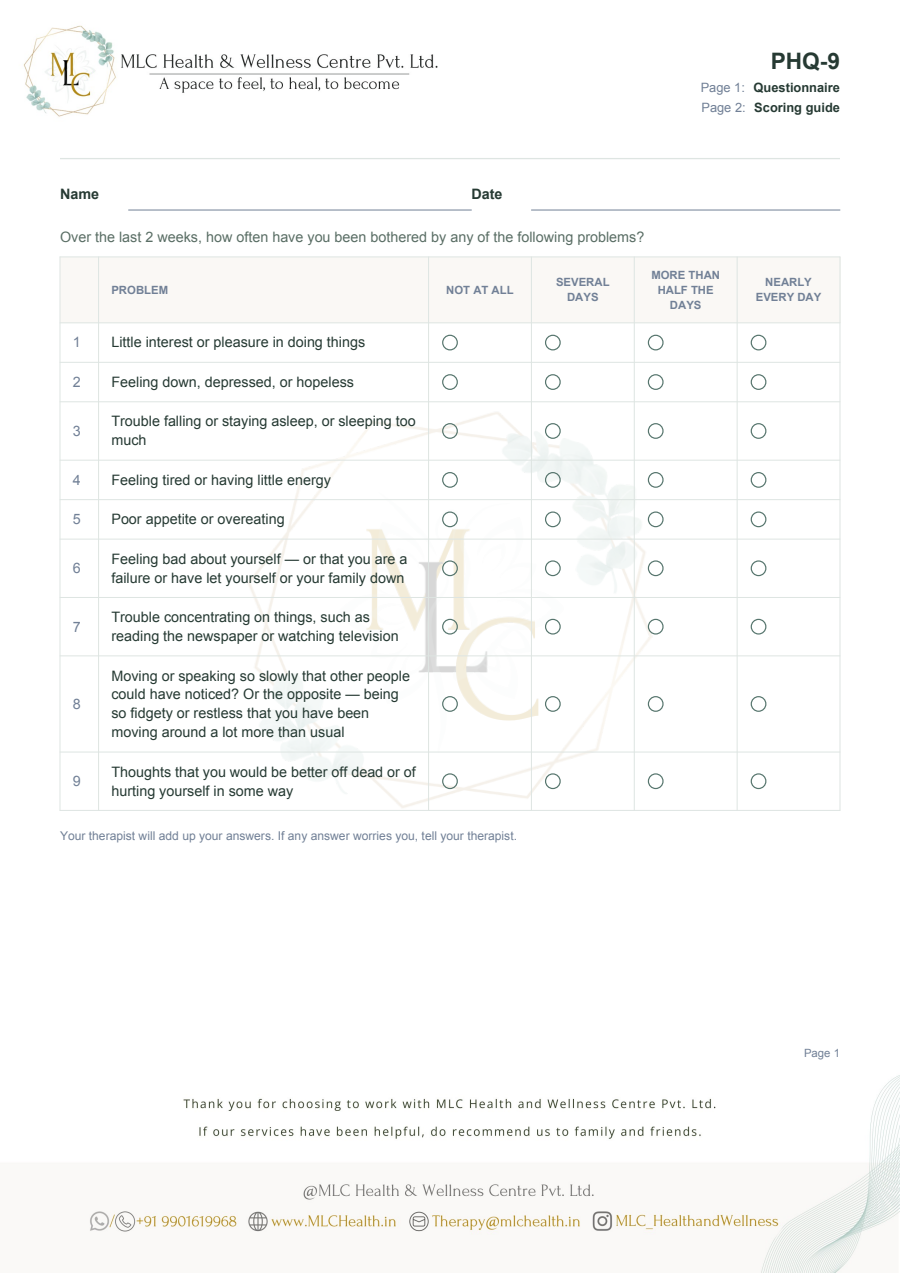
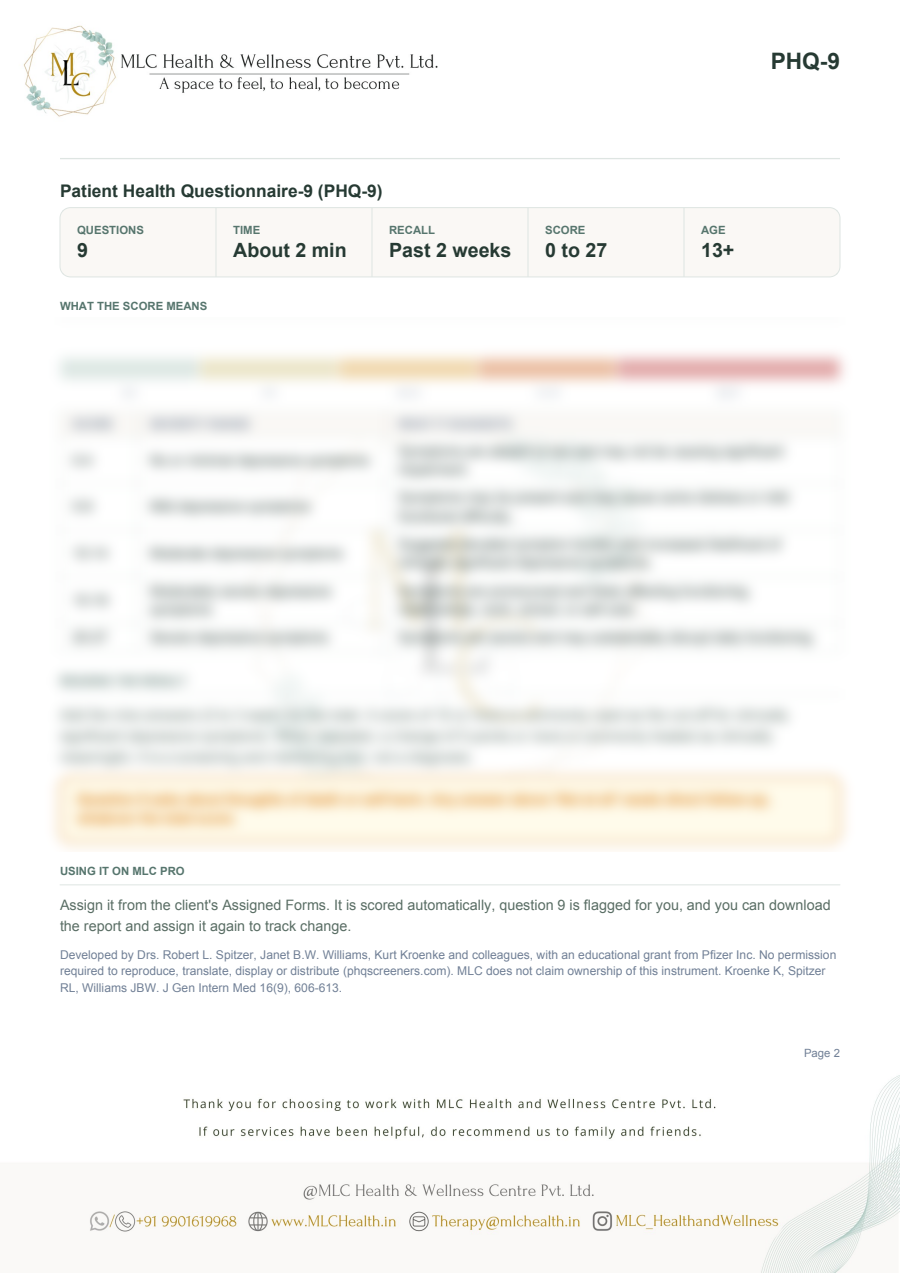
What is the PHQ-9?
The Patient Health Questionnaire-9 (PHQ-9) is a short self-report questionnaire for depressive symptoms. Each of its nine questions asks how often a symptom has bothered the person over the last 2 weeks, from "Not at all" to "Nearly every day".
The questions map to the symptom areas used to describe depression, so the total gives a quick picture of how heavy the symptoms are. Therapists use it as a screening tool and as a repeatable measure of progress, alongside a clinical conversation.
For clients
It is a short list of questions about how you have been feeling lately. Your answers help your therapist see how much low mood is affecting you and whether things are changing as therapy goes on. It is not a test you can pass or fail.
How do therapists use the PHQ-9?
The PHQ-9 supports structured screening, a baseline measurement, treatment planning and progress monitoring for adolescents and adults aged 13 and over. A therapist reviews it with the person's concerns, history, daily functioning, medical context, supports and recent stressors.
- Intake: a baseline score at the start of care.
- Treatment planning: which symptoms to focus on first.
- Progress monitoring: repeat it and compare scores across sessions.
- Review and follow-up: spot relapse or a stall in progress.
How is the PHQ-9 completed?
The person answers all nine questions in private, rating each by how often it applied in the past 2 weeks: 0 = Not at all, 1 = Several days, 2 = More than half the days, 3 = Nearly every day. It takes about 2 minutes. A therapist, not the questionnaire, interprets the result.
How is the PHQ-9 scored and what do the scores mean?
The total is the sum of the nine answers, so it runs from 0 to 27. Higher scores mean more frequent depressive symptoms. There is no reverse scoring and no subscales.
| Total score | Severity range |
|---|---|
| 0 to 4 | No or minimal depressive symptoms |
| 5 to 9 | Mild depressive symptoms |
| 10 to 14 | Moderate depressive symptoms |
| 15 to 19 | Moderately severe depressive symptoms |
| 20 to 27 | Severe depressive symptoms |
A score of 10 or more is commonly used as the cut-off for a higher likelihood of clinically significant depressive symptoms. When the PHQ-9 is repeated, a change of 5 points or more between two administrations is commonly treated as clinically meaningful.
What happens when someone answers the question about self-harm?
Question 9 asks about thoughts of being better off dead or of hurting oneself. Any answer above "Not at all" is a risk signal, whatever the total score is, and it needs direct follow-up by a clinician. It does not replace a full risk assessment that looks at intent, plan, means, history and protective factors. On MLC, an endorsed question 9 is flagged for the therapist to review.
If you or someone you know is in distress or at risk right now, please see our crisis support page.
What are the limitations of the PHQ-9?
- It is a screening and monitoring tool, not a diagnosis. Only a clinical assessment can diagnose depression.
- Scores can be affected by grief, trauma, medical conditions, medicines and substance use, so context matters.
- It measures symptoms over the last 2 weeks only, and relies on the person's own answers.
- How well it screens varies by population, setting, language and the standard it is compared with.
How well does the PHQ-9 work?
The original validation study (Kroenke, Spitzer and Williams, 2001) reported good internal consistency (Cronbach's alpha of about .89) and short-term test-retest reliability of about .84. Since then it has been studied in primary care, adolescent, community and international samples. Its screening accuracy and the best cut-off differ between groups, so findings from one population should not be assumed to hold for another.
Frequently asked questions
What does the PHQ-9 measure?
The PHQ-9 measures how often a person has had nine common symptoms of depression over the last 2 weeks, giving a total from 0 to 27.
How long does the PHQ-9 take?
About 2 minutes.
Does a high PHQ-9 score mean I have depression?
No. A higher score means more frequent symptoms and is a reason for a closer conversation. A diagnosis needs a full clinical assessment.
Who can complete the PHQ-9?
Adolescents and adults aged 13 and over. On MLC it is assigned and interpreted by your therapist.
Can the PHQ-9 track progress in therapy?
Yes. Completed again over time, the scores can be compared. A change of 5 points or more is commonly treated as clinically meaningful.
How do I get the PHQ-9 on MLC?
Therapists with MLC Pro assign it directly to their clients from the dashboard. Clients complete it in their MLC portal.
Disclaimer and attribution
This page is for information. The PHQ-9 is a screening and progress-monitoring tool, not a standalone diagnostic instrument, and its results need professional interpretation in context. It is not a substitute for advice from a qualified mental health professional.
The PHQ-9 was developed by Drs. Robert L. Spitzer, Janet B.W. Williams, Kurt Kroenke and colleagues, with an educational grant from Pfizer Inc. No permission is required to reproduce, translate, display or distribute it (phqscreeners.com). MLC does not claim ownership of this instrument.
References
- Bianchi R et al. Is the PHQ-9 a unidimensional measure of depression? Psychological Assessment, 34(6), 595-603 (2022).
- Kocalevent R-D et al. Standardization of the PHQ-9 in the general population. General Hospital Psychiatry, 35(5), 551-555 (2013).
- Kroenke K, Spitzer RL, Williams JBW. The PHQ-9: validity of a brief depression severity measure. Journal of General Internal Medicine, 16(9), 606-613 (2001).
- Löwe B, Unützer J, Callahan CM, Perkins AJ, Kroenke K. Monitoring depression treatment outcomes with the Patient Health Questionnaire-9. Medical Care, 42(12), 1194-1201 (2004).
- McMillan D et al. Defining successful treatment outcome in depression using the PHQ-9. Journal of Affective Disorders, 127(1), 122-129 (2010).
- Richardson LP et al. Evaluation of the PHQ-9 for detecting major depression among adolescents. Pediatrics, 126(6), 1117-1123 (2010).
- Urtasun M et al. Validation and calibration of the PHQ-9 in Argentina. BMC Psychiatry, 19, 291 (2019).
MLC Pro
Use the PHQ-9 with your clients on MLC Pro
The PHQ-9 is included with MLC Pro. Assign it directly to a client from their file in your dashboard, set an optional due date, and the client completes it securely in their own portal.
- Open the client in your dashboard and choose Assigned Forms.
- Assign the PHQ-9 with an optional due date.
- Your client completes it in their portal. The score and severity range are calculated automatically.
- You review the result and any flagged answer, and can download it as a PDF.
- Assign it again later to track change over time.
The PHQ-9 is not offered as a free test on this page. Results are shared with the therapist who assigned it.