
Assessment
PCL-5: PTSD Checklist for DSM-5
The PCL-5 is a 20-item self-report measure of post-traumatic stress symptoms over the past month. It takes 5 to 10 minutes, gives a score from 0 to 80, and a score of about 31 to 33 or more suggests probable PTSD. It screens and tracks symptoms; it does not diagnose PTSD.
- Questions
- 20
- Time
- 5 to 10 minutes
- Recall period
- Past month
- Score range
- 0 to 80
- Age
- Adults
Last updated
The MLC form, and using it with MLC Pro
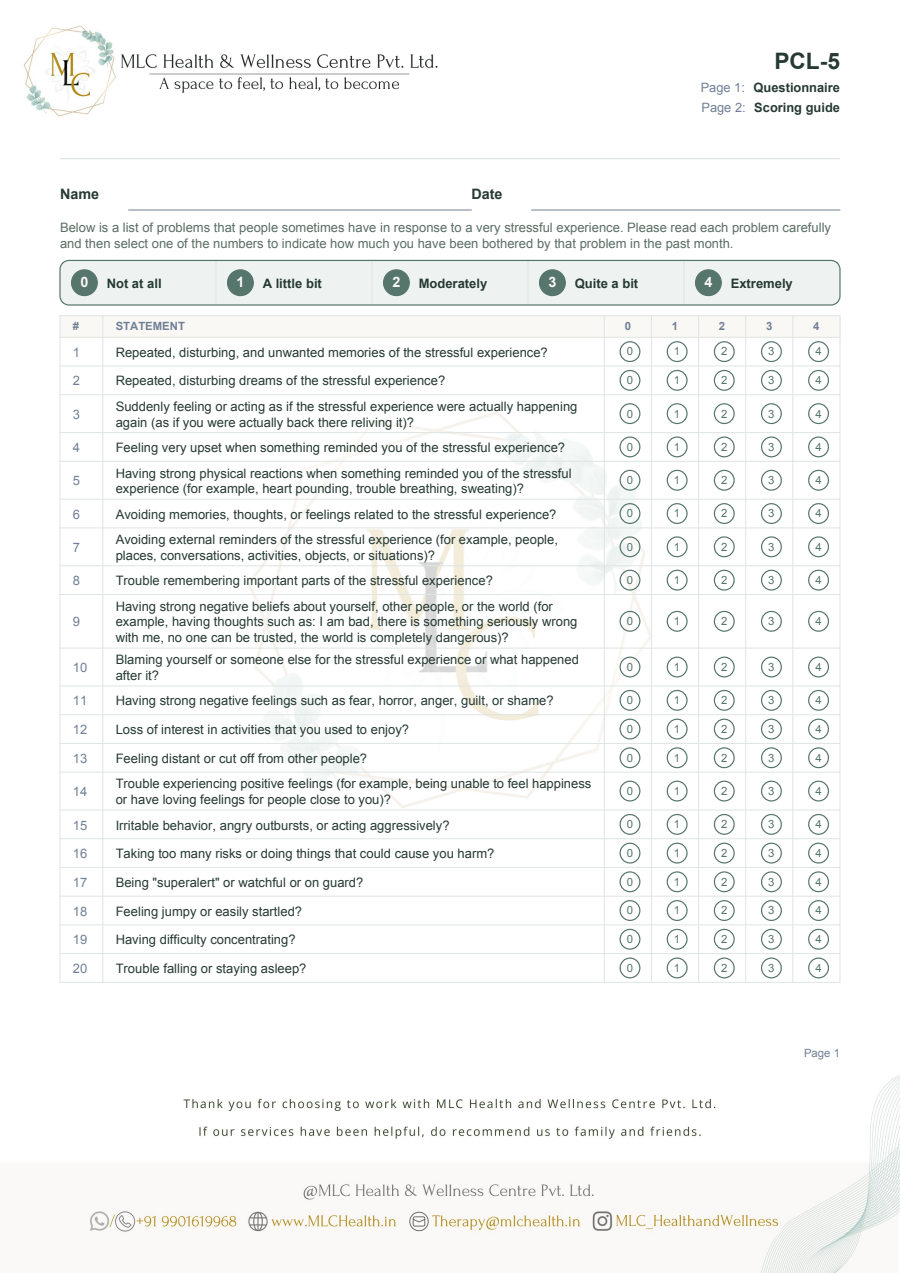
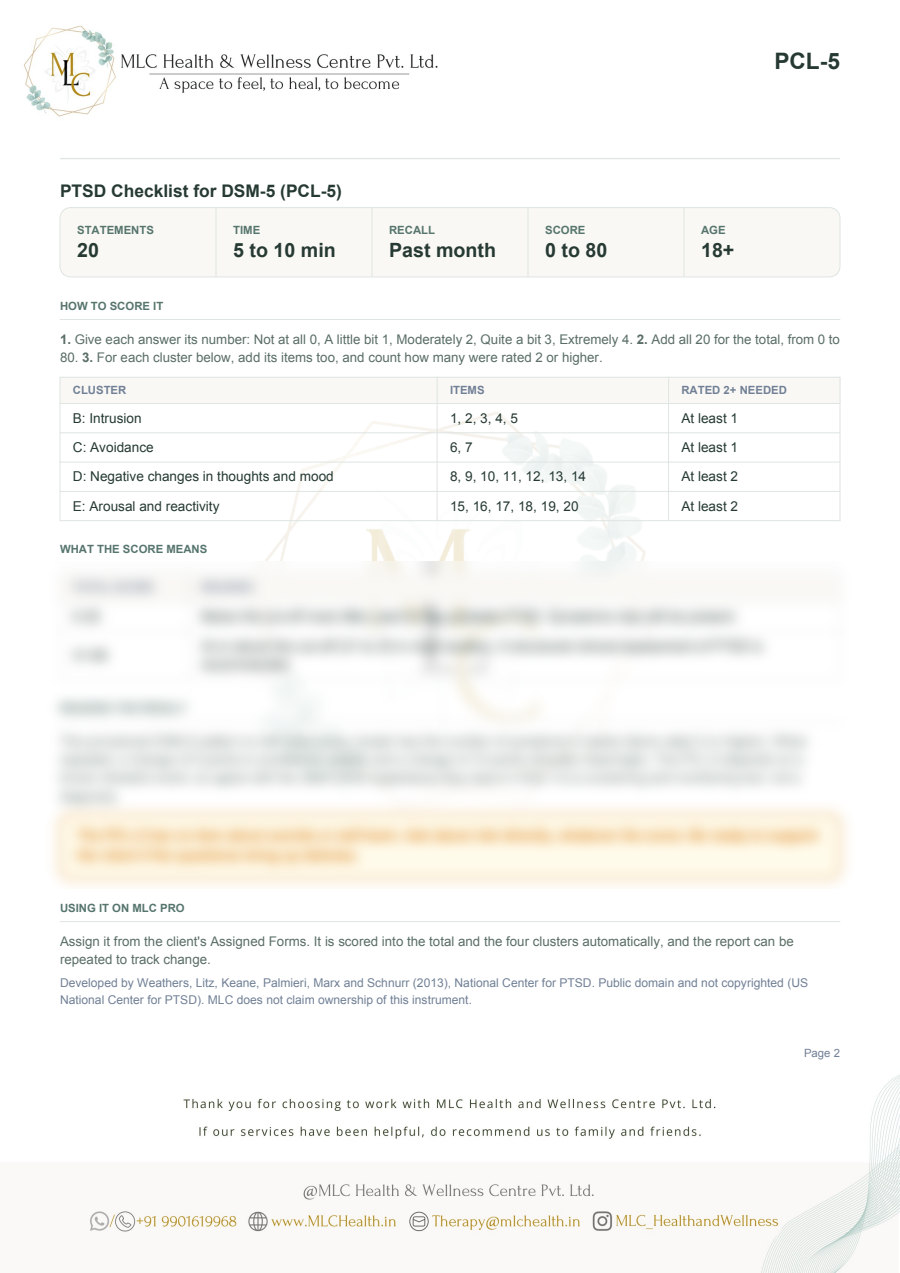
This is the PCL-5 as an MLC form: the questions on page 1, and how to score it on page 2. It is shown here for reference only, with credit to its authors, and the score table on page 2 is blurred. MLC does not sell it or offer it as a download. Therapists with MLC Pro can use it with their clients online.
- Assign it from the client's file in your dashboard, under Assigned Forms.
- The client completes it securely in their own portal.
- The total and the level are calculated for you, and you can download a PDF report that lists each answer.
What is the PCL-5?
The PTSD Checklist for DSM-5 (PCL-5) is a 20-item self-report questionnaire. Each item is one of the symptoms of post-traumatic stress disorder (PTSD) listed in the DSM-5, and the person rates how much it has bothered them in the past month, from "Not at all" to "Extremely". It was developed by the National Center for PTSD (Weathers and colleagues, 2013) and is in the public domain.
Therapists use it to screen for PTSD, to make a provisional diagnosis alongside an interview, and to track symptoms over the course of treatment.
For clients
It is a list of reactions people sometimes have after a very stressful experience. Your answers help your therapist see which of these have been hard for you this month, and whether they ease as therapy goes on. It is not a test you can pass or fail.
How do therapists use the PCL-5?
The PCL-5 supports screening, a baseline measurement, treatment planning and progress monitoring in adults who have lived through a traumatic event. A therapist reads it with the person's history, the event itself, current safety, other symptoms such as low mood or substance use, and daily functioning.
- Screening: flag people who may need a full trauma assessment.
- Baseline: a starting score before trauma-focused work begins.
- Progress monitoring: repeat it and compare scores across sessions.
- Treatment planning: see which symptom cluster is most active.
How is the PCL-5 completed?
The person first thinks of a stressful experience, ideally the one that troubles them most. They then rate each of the 20 problems for how much it has bothered them in the past month: 0 = Not at all, 1 = A little bit, 2 = Moderately, 3 = Quite a bit, 4 = Extremely. It takes 5 to 10 minutes.
Because the questions are about a specific event, the person should be supported to do this at their own pace. The questionnaire may bring distress to the surface, so a therapist should be available to talk it through.
How is the PCL-5 scored?
There is one total score, found in three steps.
- Give each of the twenty answers its number, from 0 (Not at all) to 4 (Extremely).
- Add the twenty numbers. The total runs from 0 to 80. There is no reverse scoring.
- Compare the total with the cut-off, and look at the four symptom clusters, below.
Example: if every answer is 2 (Moderately), the total is 40, which is above the cut-off.
What are the four PCL-5 symptom clusters?
The twenty items follow the four groups of PTSD symptoms in the DSM-5. Adding the items in each group shows where the distress sits.
| Cluster | Items | What it covers |
|---|---|---|
| B: Intrusion | 1 to 5 | Unwanted memories, nightmares, flashbacks, and distress at reminders |
| C: Avoidance | 6 to 7 | Avoiding memories, thoughts, feelings or external reminders |
| D: Negative thoughts and mood | 8 to 14 | Memory gaps, negative beliefs, blame, fear, loss of interest, feeling cut off, low positive feeling |
| E: Arousal and reactivity | 15 to 20 | Irritability, risky behaviour, being on guard, startle, poor concentration, poor sleep |
A provisional DSM-5 pattern can be found by counting each item rated 2 (Moderately) or higher as a symptom. The pattern is met when there is at least 1 symptom in cluster B, 1 in cluster C, 2 in cluster D and 2 in cluster E. This is a rough guide, and a full diagnosis needs a structured clinical interview.
What is the PCL-5 cut-off score?
The PCL-5 has two ways to read the total.
| Reading | Total score |
|---|---|
| Below the suggested cut-off | 0 to 30 |
| At or above the suggested cut-off | 31 to 80 |
The National Center for PTSD suggests a cut-off of 31 to 33 for probable PTSD. Services differ on the exact number, and a lower cut-off catches more people at the cost of more false alarms. When the PCL-5 is repeated, a change of 5 points is considered reliable, and a change of 10 points is considered clinically meaningful.
These readings are guides, not diagnoses. A low score does not rule out trauma-related difficulties the person has described, and a high score is a reason for a closer assessment, not a conclusion.
Does the PCL-5 measure suicide risk?
No. None of its questions asks about suicide or self-harm, so a clinician needs to ask about risk directly, whatever the score is. PTSD often occurs with depression, anxiety and substance use, so the PHQ-9 and GAD-7 are commonly used alongside the PCL-5.
If you or someone you know is in distress or at risk right now, please see our crisis support page.
What are the limitations of the PCL-5?
- It is a screening and monitoring tool, not a diagnosis. Only a clinical assessment can diagnose PTSD.
- It does not itself check that the person experienced a traumatic event as the DSM-5 defines it. That has to be established separately, and the person should name the event they are thinking of.
- It covers the past month only, and relies on the person's own answers.
- Scores can be affected by other conditions, such as depression, sleep problems, substance use and ongoing stress.
- The best cut-off differs between populations, settings and languages.
How is the PCL-5 different from the PHQ-9, GAD-7 and DASS-21?
The PHQ-9 measures depression and the GAD-7 measures anxiety. The DASS-21 measures depression, anxiety and stress together. None of them asks about trauma. The PCL-5 is the one that measures post-traumatic stress symptoms, tied to a specific event.
Many therapists use the PCL-5 alongside the PHQ-9 and GAD-7, because trauma often comes with low mood and anxiety.
How well does the PCL-5 work?
Validation studies (for example Blevins and colleagues, 2015, and Bovin and colleagues, 2016) found good internal consistency (Cronbach's alpha of about .94) and good test-retest reliability. The total score separated people with and without PTSD well in veteran and community samples. As with any cut-off, how well it works depends on the group tested, so findings from one population should not be assumed to hold for another.
Frequently asked questions
What does PCL-5 stand for?
PCL-5 stands for PTSD Checklist for DSM-5. It is a 20-item questionnaire about post-traumatic stress symptoms.
What does the PCL-5 measure?
The PCL-5 measures how much each of the 20 symptoms of post-traumatic stress disorder has bothered a person over the past month, giving a total from 0 to 80.
How is the PCL-5 scored?
Give each answer 0 to 4 (Not at all, A little bit, Moderately, Quite a bit, Extremely) and add the twenty numbers. The total runs from 0 to 80.
What is the PCL-5 cut-off score?
A total of about 31 to 33 or more suggests probable PTSD and a need for a closer assessment. MLC flags 31 or more.
What are the four PCL-5 symptom clusters?
They are intrusion (items 1 to 5), avoidance (items 6 and 7), negative thoughts and mood (items 8 to 14), and arousal and reactivity (items 15 to 20).
How long does the PCL-5 take?
About 5 to 10 minutes.
Is the PCL-5 a diagnostic test?
No. The PCL-5 is a screening and monitoring tool. A high score is a reason for a closer conversation, and a diagnosis needs a structured clinical interview.
Does the PCL-5 measure suicide risk?
No. None of its questions asks about suicide or self-harm, so a clinician needs to ask about risk directly whatever the score is.
How much change on the PCL-5 is meaningful?
A change of 5 points is considered reliable, and a change of 10 points is considered clinically meaningful.
Who can complete the PCL-5?
Adults who have experienced a stressful or traumatic event. On MLC it is assigned and interpreted by your therapist.
Is the PCL-5 free to use?
The PCL-5 is in the public domain and free to use. MLC shows its own form on this page for reference and does not sell it. It is available to therapists as an online form on MLC Pro.
How do I get the PCL-5 on MLC?
Therapists with MLC Pro assign it directly to their clients from the dashboard, and clients complete it in their MLC portal.
Disclaimer and attribution
This page is for information. The PCL-5 is a screening and progress-monitoring tool, not a standalone diagnostic instrument, and its results need professional interpretation in context. It is not a substitute for advice from a qualified mental health professional.
The PTSD Checklist for DSM-5 (PCL-5) was developed by Weathers, Litz, Keane, Palmieri, Marx and Schnurr at the National Center for PTSD (2013), and is in the public domain. MLC does not claim ownership of this instrument.
References
- Weathers FW, Litz BT, Keane TM, Palmieri PA, Marx BP, Schnurr PP. The PTSD Checklist for DSM-5 (PCL-5). National Center for PTSD (2013).
- Blevins CA, Weathers FW, Davis MT, Witte TK, Domino JL. The Posttraumatic Stress Disorder Checklist for DSM-5 (PCL-5): development and initial psychometric evaluation. Journal of Traumatic Stress, 28(6), 489-498 (2015).
- Bovin MJ, Marx BP, Weathers FW, et al. Psychometric properties of the PTSD Checklist for Diagnostic and Statistical Manual of Mental Disorders, Fifth Edition (PCL-5) in veterans. Psychological Assessment, 28(11), 1379-1391 (2016).
- American Psychiatric Association. Diagnostic and Statistical Manual of Mental Disorders, Fifth Edition (2013).
MLC Pro
Use the PCL-5 with your clients on MLC Pro
The PCL-5 is included with MLC Pro. Assign it directly to a client from their file in your dashboard, and the client completes it securely in their own portal.
- Open the client in your dashboard and choose Assigned Forms.
- Assign the PCL-5 with an optional due date.
- Your client completes it in their portal. The score, the four cluster scores and the cut-off reading are calculated automatically.
- You review the result and can download it as a PDF report.
- Assign it again later to track change over time.
Results are shared with the therapist who assigned it.