
Assessment
PC-PTSD-5: Primary Care PTSD Screen for DSM-5
The PC-PTSD-5 is a 5-question yes/no screen for post-traumatic stress symptoms over the past month. It takes 1 to 2 minutes, gives a score from 0 to 5, and a score of 3 or more is a positive screen that suggests a fuller assessment. It screens; it does not diagnose PTSD.
- Questions
- 5
- Time
- 1 to 2 minutes
- Recall period
- Past month
- Score range
- 0 to 5
- Age
- 18 and over
Last updated
The MLC form, and using it with MLC Pro
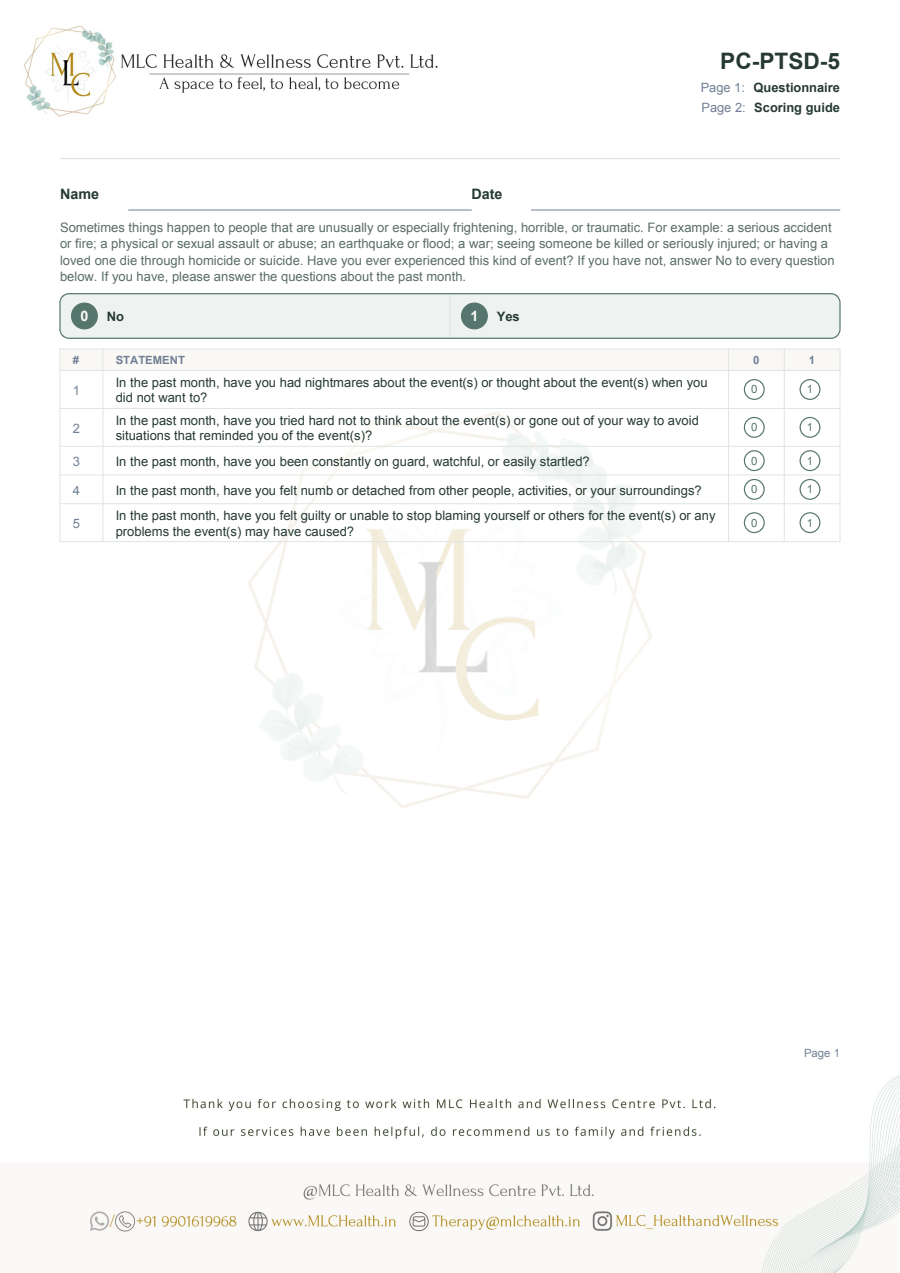
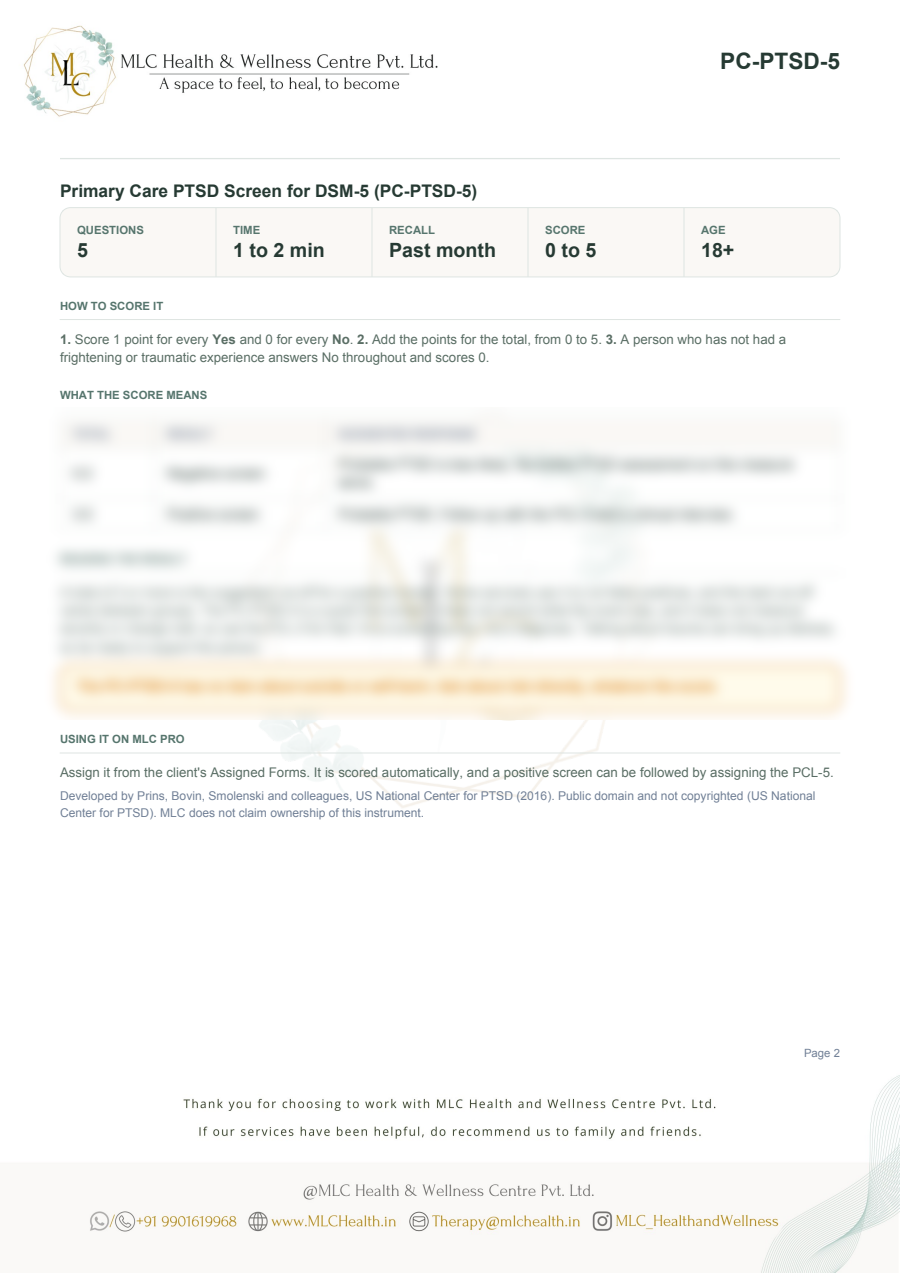
This is the PC-PTSD-5 as an MLC form: the questions on page 1, and how to score it on page 2. It is shown here for reference only, with credit to its authors, and the score table on page 2 is blurred. MLC does not sell it or offer it as a download. Therapists with MLC Pro can use it with their clients online.
- Assign it from the client's file in your dashboard, under Assigned Forms.
- The client completes it securely in their own portal.
- The total and the level are calculated for you, and you can download a PDF report that lists each answer.
What is the PC-PTSD-5?
The Primary Care PTSD Screen for DSM-5 (PC-PTSD-5) is a very short questionnaire that helps find people who may have post-traumatic stress disorder (PTSD). It starts with a short introduction about very stressful or frightening experiences, then asks five yes/no questions about how the person has felt in the past month: nightmares or unwanted thoughts, avoidance, being on guard, feeling numb, and guilt or self-blame. It was developed by Prins, Bovin, Smolenski and colleagues at the US National Center for PTSD (2016).
It is built to be quick, so it can be used at intake or in a busy service. It is a first step: a positive result is followed by a fuller assessment, such as the PCL-5.
For clients
It is five short yes or no questions about how you have felt over the past month after a very stressful or frightening experience. If nothing like that has happened to you, you answer No throughout. Your answers help your therapist decide whether to ask you more. It is not a test you can pass or fail.
How do therapists use the PC-PTSD-5?
The PC-PTSD-5 supports quick screening for PTSD in adults. A therapist reads it with the person's history, the event itself, current safety and other symptoms such as low mood or substance use.
- Intake: a two-minute screen alongside mood and anxiety measures.
- Triage: decide who needs a full trauma assessment.
- Follow-up: a positive screen leads to the PCL-5 and a clinical interview.
How is the PC-PTSD-5 completed?
The person reads a short introduction describing the kinds of frightening or traumatic events that count, such as a serious accident, an assault, a disaster, a war, or a death by violence. If they have never had such an experience, they answer No to every question. If they have, they answer the five questions about the past month. It takes 1 to 2 minutes.
How is the PC-PTSD-5 scored?
There is one total score, found in three steps.
- Give 1 point for every Yes answer and 0 for every No.
- Add the points. The total runs from 0 to 5.
- Compare the total with the cut-off, below.
Example: if three of the five answers are Yes, the total is 3, which is a positive screen.
What is the PC-PTSD-5 cut-off score?
The score is read against a single cut-off.
| Result | Total score |
|---|---|
| Negative screen | 0 to 2 |
| Positive screen | 3 to 5 |
A score of 3 or more is the suggested cut-off for a positive screen, with good sensitivity and specificity in the original study. Some services use 4 to reduce false positives, and the best cut-off varies between groups and settings.
A positive screen does not diagnose PTSD, and a negative screen does not rule it out. It is a reason to look more closely with the PCL-5 and a clinical interview.
Does the PC-PTSD-5 measure suicide risk?
No. None of its questions asks about suicide or self-harm, so a clinician needs to ask about risk directly, whatever the score is. Talking about trauma can also bring up distress, so a therapist should be ready to support the person.
If you or someone you know is in distress or at risk right now, please see our crisis support page.
What are the limitations of the PC-PTSD-5?
- It is a screen, not a diagnosis. Only a clinical assessment can diagnose PTSD.
- It does not record what the event was, or check that it meets the DSM-5 definition of a traumatic event.
- It does not measure severity, and is not well suited to tracking change. Use the PCL-5 for that.
- It covers the past month only, and relies on the person's own answers.
- The best cut-off differs between populations, settings and languages.
How is the PC-PTSD-5 different from the PCL-5?
The PC-PTSD-5 has 5 yes/no questions and gives a quick positive or negative result. The PCL-5 has 20 questions rated 0 to 4, gives a score from 0 to 80 with four symptom clusters, and can track change over time.
Many services use the two together: the PC-PTSD-5 to screen, and the PCL-5 to assess a positive screen and to monitor treatment.
How well does the PC-PTSD-5 work?
In the validation study (Prins and colleagues, 2016), done with US veterans in primary care, a cut-off of 3 gave good sensitivity and specificity against a structured PTSD interview. Later work (Bovin and colleagues, 2021) reported similar findings. As with any cut-off, how well it works depends on the group tested, so findings from one population should not be assumed to hold for another.
Frequently asked questions
What does PC-PTSD-5 stand for?
PC-PTSD-5 stands for Primary Care PTSD Screen for DSM-5. It is a 5-question yes/no screen for post-traumatic stress disorder.
What does the PC-PTSD-5 measure?
The PC-PTSD-5 screens for post-traumatic stress symptoms over the past month: nightmares or unwanted thoughts, avoidance, being on guard, feeling numb, and guilt or self-blame.
How is the PC-PTSD-5 scored?
Score 1 for every Yes and 0 for every No, and add the five answers. The total runs from 0 to 5.
What is the PC-PTSD-5 cut-off score?
A score of 3 or more is the suggested cut-off for a positive screen. Some services use 4 to reduce false positives.
What does a positive PC-PTSD-5 mean?
It means probable PTSD is possible and a fuller assessment is recommended, for example with the PCL-5 and a clinical interview. It is not a diagnosis.
How long does the PC-PTSD-5 take?
About 1 to 2 minutes.
What if I have not had a traumatic experience?
A person who has not had a frightening or traumatic experience answers No to every question and scores 0.
Is the PC-PTSD-5 a diagnostic test?
No. It is a quick screen. A diagnosis of PTSD needs a full clinical assessment.
Does the PC-PTSD-5 measure suicide risk?
No. None of its questions asks about suicide or self-harm, so a clinician needs to ask about risk directly whatever the score is.
What is the difference between the PC-PTSD-5 and the PCL-5?
The PC-PTSD-5 is a 5-question yes/no screen. The PCL-5 has 20 questions, scores 0 to 80, and tracks change. A positive PC-PTSD-5 is usually followed by the PCL-5.
Is the PC-PTSD-5 free to use?
The PC-PTSD-5 was developed by the US National Center for PTSD and is publicly available. MLC shows its own form on this page for reference and does not sell it. It is available to therapists as an online form on MLC Pro.
How do I get the PC-PTSD-5 on MLC?
Therapists with MLC Pro assign it directly to their clients from the dashboard, and clients complete it in their MLC portal.
Disclaimer and attribution
This page is for information. The PC-PTSD-5 is a screening tool, not a standalone diagnostic instrument, and its results need professional interpretation in context. It is not a substitute for advice from a qualified mental health professional.
The Primary Care PTSD Screen for DSM-5 (PC-PTSD-5) was developed by Prins, Bovin, Smolenski and colleagues at the US National Center for PTSD (2016). MLC does not claim ownership of this instrument.
References
- Prins A, Bovin MJ, Smolenski DJ, et al. The Primary Care PTSD Screen for DSM-5 (PC-PTSD-5): development and evaluation within a veteran primary care sample. Journal of General Internal Medicine, 31(10), 1206-1211 (2016).
- Bovin MJ, Kimerling R, Weathers FW, et al. Diagnostic accuracy and acceptability of the Primary Care Posttraumatic Stress Disorder Screen for the Diagnostic and Statistical Manual of Mental Disorders (Fifth Edition) among US veterans. JAMA Network Open, 4(2), e2036733 (2021).
MLC Pro
Use the PC-PTSD-5 with your clients on MLC Pro
The PC-PTSD-5 is included with MLC Pro. Assign it directly to a client from their file in your dashboard, and the client completes it securely in their own portal.
- Open the client in your dashboard and choose Assigned Forms.
- Assign the PC-PTSD-5 with an optional due date.
- Your client completes it in their portal. The score and the screen result are calculated automatically.
- You review the result and can download it as a PDF report. A positive screen can be followed by assigning the PCL-5.
- Assign it again later if you need another screen.
Results are shared with the therapist who assigned it.