
Assessment
PHQ-15: Somatic Symptom Severity
The PHQ-15 is a 15-item self-report measure of how much common bodily symptoms have bothered a person over the past 4 weeks. It takes about 3 minutes, gives a score from 0 to 30, and a score of 15 or more is generally treated as high somatic symptom severity. It screens and tracks; it does not diagnose.
- Symptoms
- 15
- Time
- About 3 minutes
- Recall period
- Past 4 weeks
- Score range
- 0 to 30
- Age
- 13 and over
Last updated
The MLC form, and using it with MLC Pro
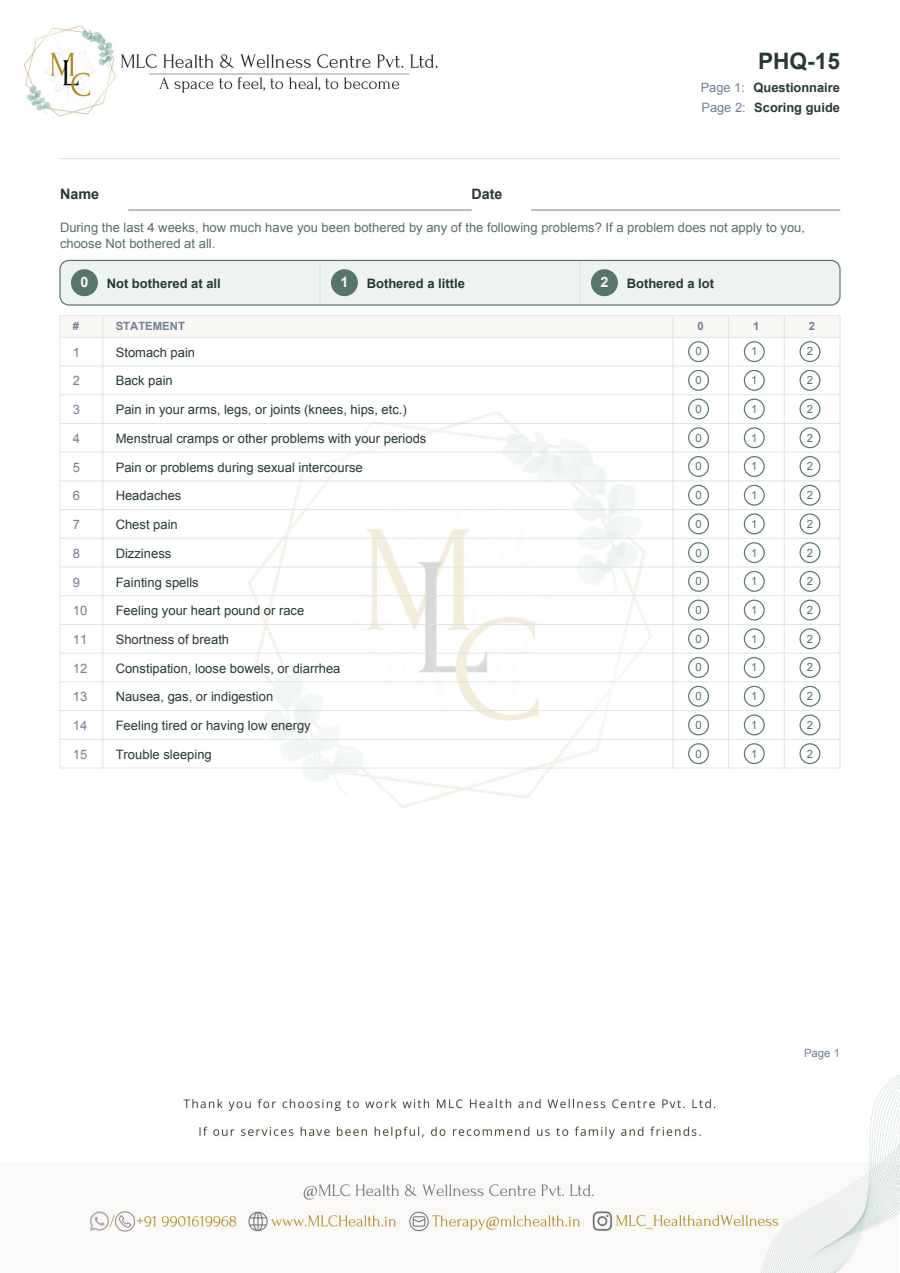
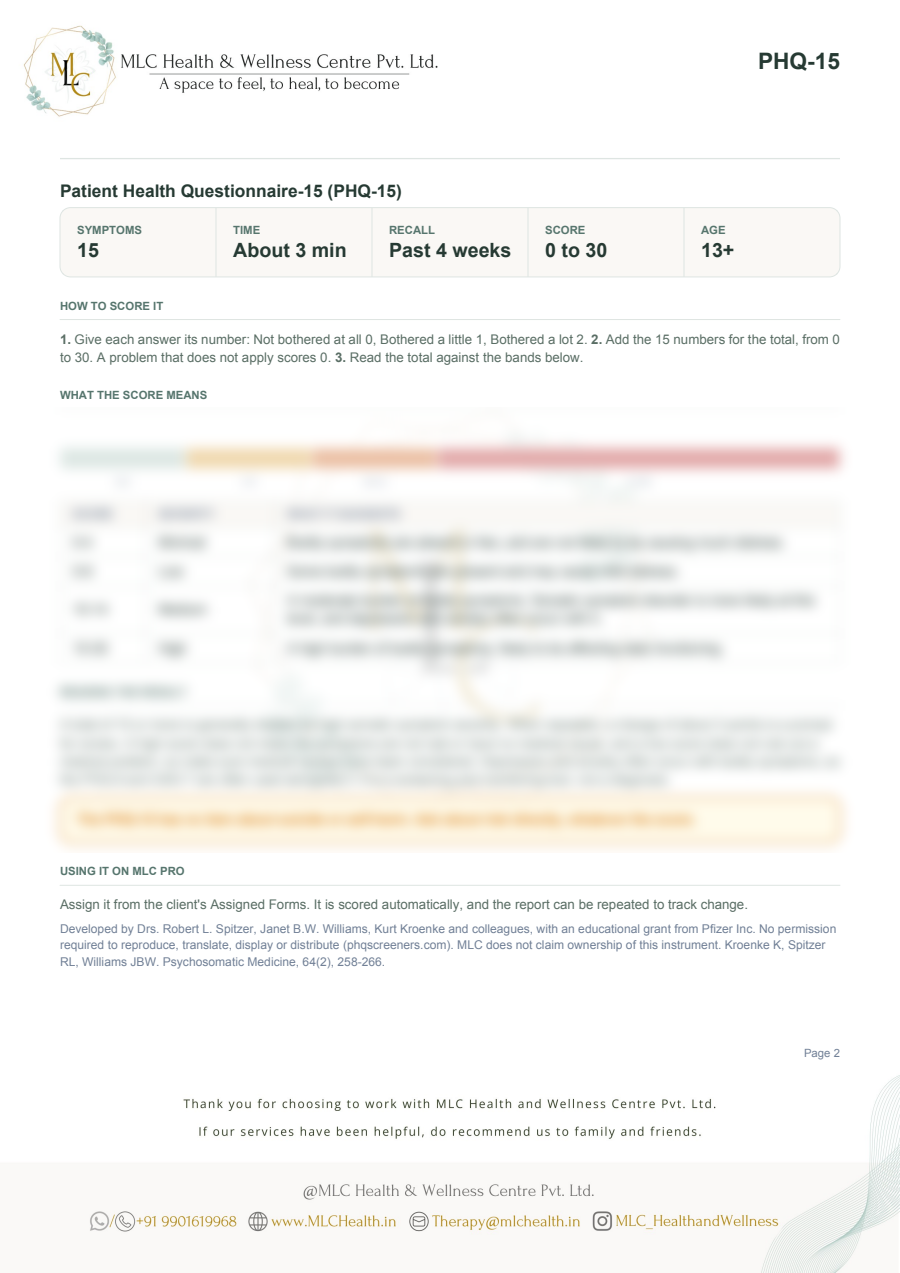
This is the PHQ-15 as an MLC form: the questions on page 1, and how to score it on page 2. It is shown here for reference only, with credit to its authors, and the score table on page 2 is blurred. MLC does not sell it or offer it as a download. Therapists with MLC Pro can use it with their clients online.
- Assign it from the client's file in your dashboard, under Assigned Forms.
- The client completes it securely in their own portal.
- The total and the level are calculated for you, and you can download a PDF report that lists each answer.
What is the PHQ-15?
The Patient Health Questionnaire-15 (PHQ-15) is a short self-report questionnaire about bodily symptoms. Each of its fifteen items is a common physical complaint, such as stomach pain, headaches, dizziness or trouble sleeping, and the person says how much it has bothered them over the last 4 weeks: not bothered at all, bothered a little, or bothered a lot. It was developed by Kroenke, Spitzer and Williams (2002) and is part of the PHQ family that includes the PHQ-9 and GAD-7.
It does not say whether a symptom has a medical cause. It measures how much bodily symptoms are bothering the person, which is useful in therapy because stress, low mood and anxiety often show up in the body.
For clients
It is a list of common aches, pains and body complaints. You say how much each has bothered you in the past four weeks. Your answers help your therapist see how your body and your stress are linked. It does not mean your symptoms are not real.
How do therapists use the PHQ-15?
The PHQ-15 supports screening, a baseline measurement and monitoring of somatic symptom burden in adolescents and adults. A therapist reads it with the person's medical history, stressors, sleep, mood and daily functioning.
- Intake: a baseline when bodily symptoms are part of the presenting concern.
- Screening: flag high symptom burden that may need a fuller assessment.
- Progress monitoring: repeat it and compare scores across sessions.
- Alongside mood: use it with the PHQ-9 and GAD-7, because bodily symptoms often go with depression and anxiety.
How is the PHQ-15 completed?
The person rates each of the fifteen symptoms for how much it has bothered them in the last 4 weeks: 0 = Not bothered at all, 1 = Bothered a little, 2 = Bothered a lot. A symptom that does not apply, such as period problems for someone who does not have periods, is answered as Not bothered at all. It takes about 3 minutes.
How is the PHQ-15 scored?
There is one total score, found in three steps.
- Give each of the fifteen answers its number: Not bothered at all is 0, Bothered a little is 1, Bothered a lot is 2.
- Add the fifteen numbers. The total runs from 0 to 30. There is no reverse scoring.
- Look the total up against the severity bands, below.
Example: if five symptoms are bothered a lot and five a little, and the rest not at all, the total is 15, which falls in the high band.
What do the PHQ-15 severity bands mean?
The total score falls into one of four bands.
| Severity | Total score |
|---|---|
| Minimal somatic symptoms | 0 to 4 |
| Low somatic symptoms | 5 to 9 |
| Medium somatic symptoms | 10 to 14 |
| High somatic symptoms | 15 to 30 |
A score of 15 or more is generally treated as high somatic symptom severity. When the PHQ-15 is repeated, a change of about 3 points is commonly treated as a prompt for review.
These bands are guides, not diagnoses. A high score does not mean the symptoms are not real or that they have no medical cause, and a low score does not rule out a medical problem.
Does the PHQ-15 measure suicide risk?
No. None of its items asks about suicide or self-harm, so a clinician needs to ask about risk directly, whatever the score is. Bodily symptoms often occur with depression, and the PHQ-9 is commonly used alongside the PHQ-15 for that reason.
If you or someone you know is in distress or at risk right now, please see our crisis support page.
What are the limitations of the PHQ-15?
- It is a screening and monitoring tool, not a diagnosis. Only a clinical assessment can diagnose a somatic symptom disorder.
- It does not tell you whether a symptom has a medical cause, so medical causes must be considered separately.
- Two items, about periods and about sexual intercourse, do not apply to everyone.
- It covers the past 4 weeks only, and relies on the person's own answers.
- Physical illness, medicines, pregnancy and menopause can all raise scores.
How is the PHQ-15 different from the PHQ-9 and GAD-7?
The PHQ-9 measures depression and the GAD-7 measures anxiety. The PHQ-15 measures bodily symptoms. They use the same style of questions and the same way of adding up a total, so they are easy to give together.
Many therapists use the PHQ-15 with the PHQ-9 and GAD-7, because bodily symptoms often come with low mood and anxiety, and the three together give a fuller picture.
How well does the PHQ-15 work?
The original study (Kroenke and colleagues, 2002) found the PHQ-15 had good internal consistency and good validity as a measure of somatic symptom severity, in thousands of primary care and obstetrics and gynecology patients. Later work, including a general population study in Germany (Kocalevent and colleagues, 2013), supported its use. As with any cut-off, how well it works depends on the group tested, so findings from one population should not be assumed to hold for another.
Frequently asked questions
What does PHQ-15 stand for?
PHQ-15 stands for Patient Health Questionnaire-15. It is a 15-item questionnaire about bodily symptoms.
What does the PHQ-15 measure?
The PHQ-15 measures how much fifteen common bodily symptoms have bothered a person over the past 4 weeks, giving a total from 0 to 30.
How is the PHQ-15 scored?
Give each answer 0 to 2 (Not bothered at all, Bothered a little, Bothered a lot) and add the fifteen numbers. The total runs from 0 to 30.
What is a high PHQ-15 score?
A score of 15 or more is generally treated as high somatic symptom severity. The bands are 0 to 4 minimal, 5 to 9 low, 10 to 14 medium and 15 to 30 high.
What are the PHQ-15 severity bands?
There are four bands: minimal (0 to 4), low (5 to 9), medium (10 to 14) and high (15 to 30).
How long does the PHQ-15 take?
About 3 minutes.
Is the PHQ-15 a diagnostic test?
No. The PHQ-15 is a screening and monitoring tool. A high score is a reason for a closer conversation, and a diagnosis needs a full clinical assessment.
Does a high PHQ-15 score mean the symptoms are not real?
No. The PHQ-15 measures how much symptoms bother a person. It does not say whether they have a medical cause, so medical causes still need to be considered.
Does the PHQ-15 measure suicide risk?
No. None of its items asks about suicide or self-harm, so a clinician needs to ask about risk directly whatever the score is.
What if a PHQ-15 item does not apply?
A symptom that does not apply, such as period problems for someone who does not have periods, is answered as Not bothered at all and scores 0.
Who can complete the PHQ-15?
Adolescents and adults aged 13 and over. On MLC it is assigned and interpreted by your therapist.
Is the PHQ-15 free to use?
The PHQ family of measures may be used without permission, with credit to its authors. MLC shows its own form on this page for reference and does not sell it. It is available to therapists as an online form on MLC Pro.
How do I get the PHQ-15 on MLC?
Therapists with MLC Pro assign it directly to their clients from the dashboard, and clients complete it in their MLC portal.
Disclaimer and attribution
This page is for information. The PHQ-15 is a screening and progress-monitoring tool, not a standalone diagnostic instrument, and its results need professional interpretation in context. It is not a substitute for advice from a qualified health professional.
The PHQ-15 was developed by Drs. Robert L. Spitzer, Janet B.W. Williams, Kurt Kroenke and colleagues, with an educational grant from Pfizer Inc. No permission is required to reproduce, translate, display or distribute it (phqscreeners.com). MLC does not claim ownership of this instrument.
References
- Kroenke K, Spitzer RL, Williams JBW. The PHQ-15: validity of a new measure for evaluating the severity of somatic symptoms. Psychosomatic Medicine, 64(2), 258-266 (2002).
- Kocalevent RD, Hinz A, Brahler E. Standardization of a screening instrument (PHQ-15) for somatization syndromes in the general population. BMC Psychiatry, 13, 91 (2013).
- Zijlema WL, Stolk RP, Lowe B, et al. How to assess common somatic symptoms in large-scale studies: a systematic review of questionnaires. Journal of Psychosomatic Research, 74(6), 459-468 (2013).
MLC Pro
Use the PHQ-15 with your clients on MLC Pro
The PHQ-15 is included with MLC Pro. Assign it directly to a client from their file in your dashboard, and the client completes it securely in their own portal.
- Open the client in your dashboard and choose Assigned Forms.
- Assign the PHQ-15 with an optional due date.
- Your client completes it in their portal. The score and severity band are calculated automatically.
- You review the result and can download it as a PDF report.
- Assign it again later to track change over time.
Results are shared with the therapist who assigned it.