
Assessment
Satisfaction With Life Scale (SWLS)
The Satisfaction With Life Scale is a 5-statement self-report measure of how a person judges their life as a whole. It takes about a minute and gives a score from 5 to 35, where a higher score means greater life satisfaction. Scores fall into seven published ranges, from extremely dissatisfied to extremely satisfied. It does not diagnose.
- Statements
- 5
- Time
- About 1 minute
- Answers
- 1 to 7
- Score range
- 5 to 35
- Use
- Life satisfaction
Last updated
The MLC form, and using it with MLC Pro
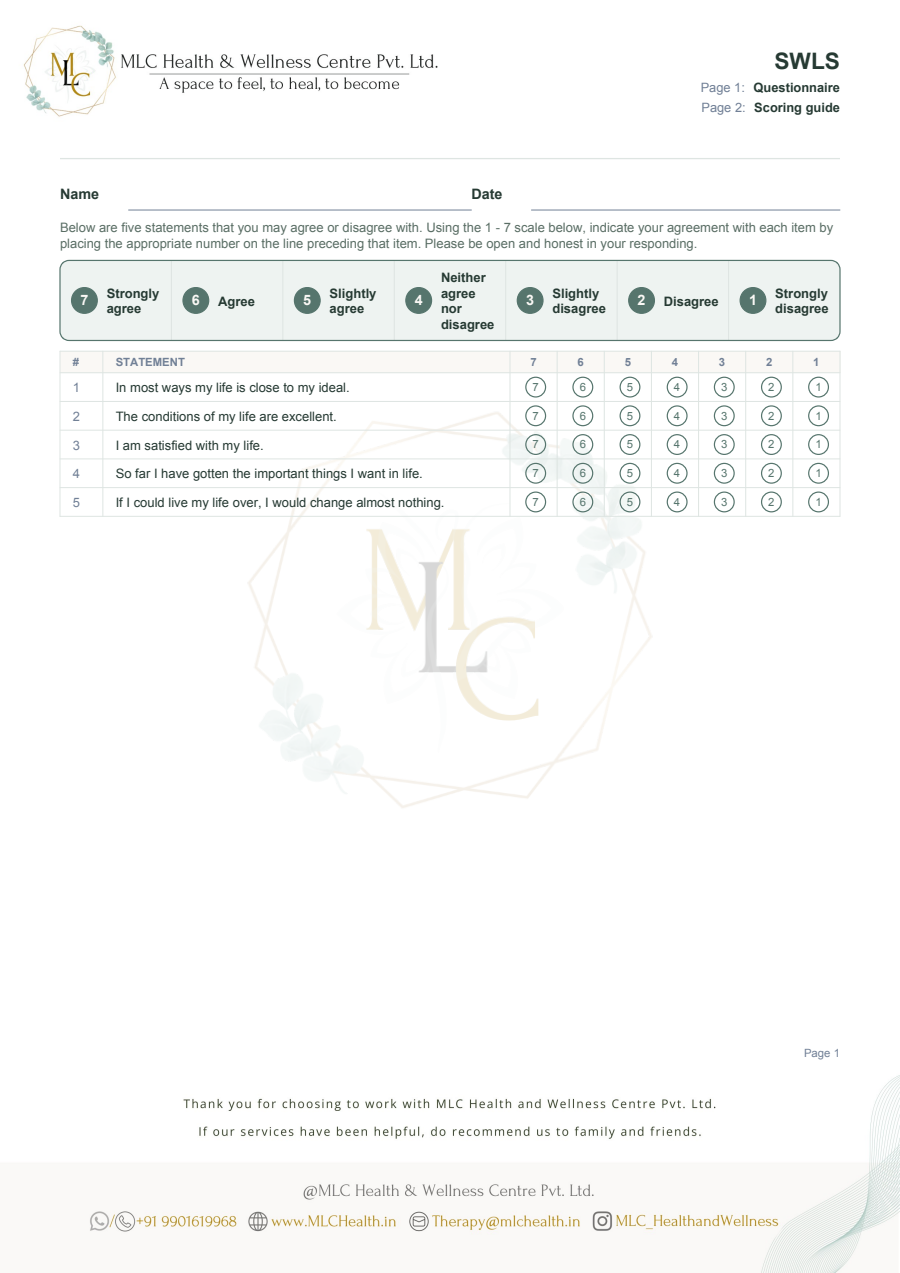
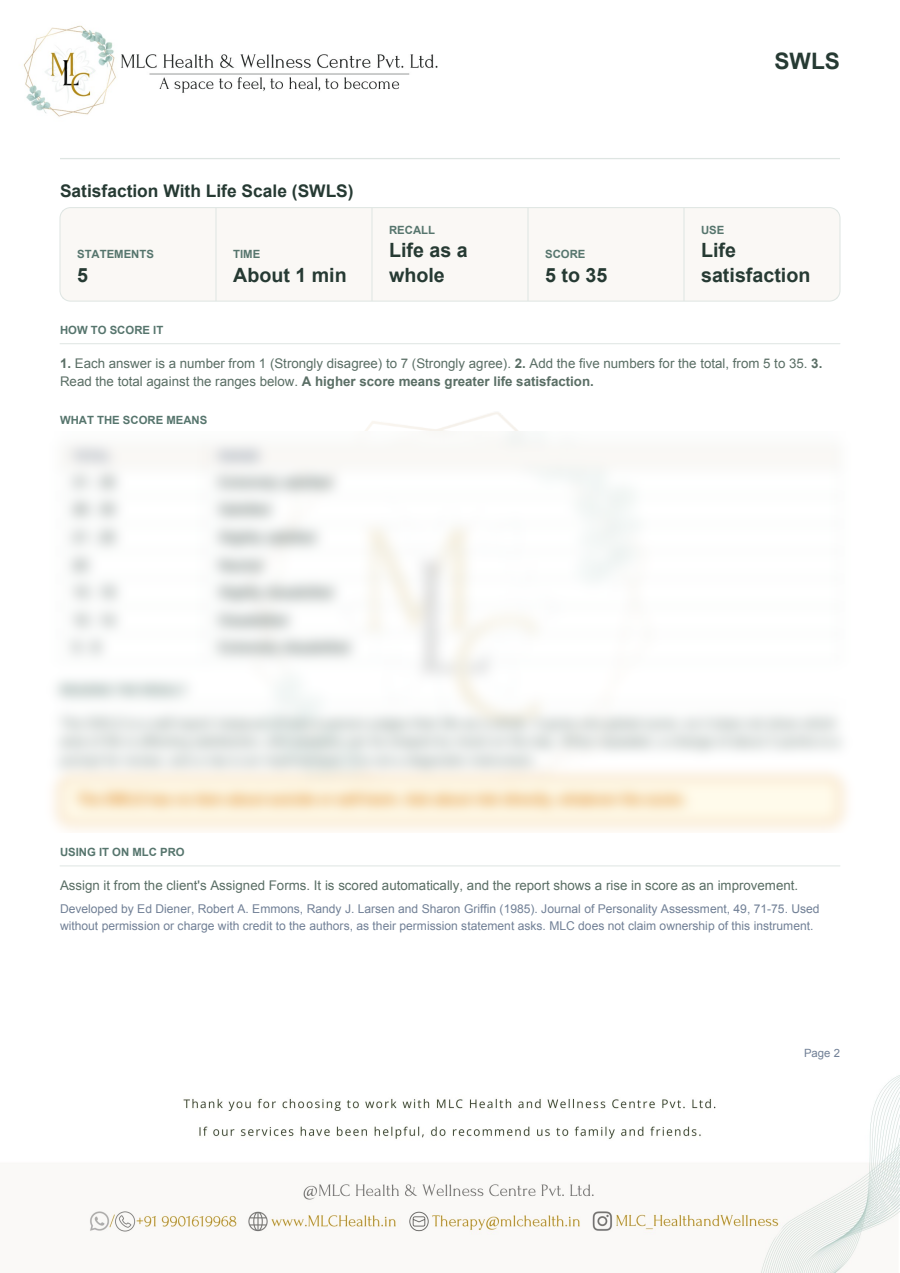
This is the SWLS as an MLC form: the questions on page 1, and how to score it on page 2. It is shown here for reference only, with credit to its authors, and the score table on page 2 is blurred. MLC does not sell it or offer it as a download. Therapists with MLC Pro can use it with their clients online.
- Assign it from the client's file in your dashboard, under Assigned Forms.
- The client completes it securely in their own portal.
- The total and the level are calculated for you, and you can download a PDF report that lists each answer.
What is the Satisfaction With Life Scale?
The Satisfaction With Life Scale (SWLS) is a short questionnaire about how a person judges their life as a whole. Its five statements, such as feeling that one's life is close to ideal or that one is satisfied with life, are each rated on a 7-point scale from strongly disagree to strongly agree. It was developed by Ed Diener, Robert Emmons, Randy Larsen and Sharon Griffin (1985).
It measures an overall judgement about life, not mood or symptoms. That makes it a useful counterpart to measures such as the PHQ-9 and GAD-7, which count problems.
For clients
It is five statements about your life as a whole. You say how far you agree with each. There are no right or wrong answers, and your answers help your therapist see how you view your life and whether that shifts as therapy goes on.
How do therapists use the SWLS?
The SWLS supports a baseline measurement and monitoring of life satisfaction. A therapist reads it with the person's history, mood, relationships, work and circumstances.
- Intake: a baseline of how the person sees their life.
- Treatment planning: see how far dissatisfaction reaches across life.
- Progress monitoring: repeat it and compare scores across sessions, watching for a rise.
- Alongside symptoms: use it with a symptom measure, because satisfaction can improve before symptoms fall.
How is the SWLS completed?
The person reads five statements they may agree or disagree with and rates each from 1 (Strongly disagree) to 7 (Strongly agree). The scale asks them to be open and honest in their responses. It takes about a minute.
How is the SWLS scored?
There is one total score, found in three steps.
- Take the number the person chose for each of the five statements, from 1 to 7.
- Add the five numbers. The total runs from 5 to 35. There is no reverse scoring.
- Look the total up against the seven ranges, below.
Example: if the five answers are 5, 4, 6, 5 and 3, the total is 23, which falls in the slightly satisfied range.
Unlike the PHQ-9 and GAD-7, a higher SWLS score is better, so a rise over time is an improvement.
What do SWLS scores mean?
The total falls into one of seven published ranges.
| Range | Total score |
|---|---|
| Extremely dissatisfied | 5 to 9 |
| Dissatisfied | 10 to 14 |
| Slightly dissatisfied | 15 to 19 |
| Neutral | 20 |
| Slightly satisfied | 21 to 25 |
| Satisfied | 26 to 30 |
| Extremely satisfied | 31 to 35 |
A score of 20 is the neutral point of the scale. There is no single agreed threshold for a meaningful change when it is repeated, so read changes alongside what the person reports.
These ranges are guides, not diagnoses. A high score does not rule out difficulty in one area of life, and a low score is a reason for a closer conversation, not a conclusion.
Does the SWLS measure suicide risk?
No. None of its statements asks about suicide or self-harm, so a clinician needs to ask about risk directly, whatever the score is. Low life satisfaction often occurs with depression, and the PHQ-9 is commonly used alongside the SWLS for that reason.
If you or someone you know is in distress or at risk right now, please see our crisis support page.
What are the limitations of the SWLS?
- It is a self-report measure, not a diagnosis. Low life satisfaction is not itself a mental health condition.
- It gives one global score, so it does not show which area of life is affecting satisfaction.
- Answers can be shaped by mood on the day, and by a wish to appear well.
- Cultural differences can affect how people judge and report satisfaction.
- It is not designed to measure distress or symptoms.
How is the SWLS different from the WHO-5 and Rosenberg scale?
The WHO-5 measures recent wellbeing over 2 weeks, and the Rosenberg scale measures a person's sense of self-worth. The SWLS measures a judgement of life as a whole, with no time window. All three are scored so that a higher score is better.
Many therapists use one of them alongside a symptom measure, to track how a person sees their life as well as how they are feeling.
How well does the SWLS work?
The SWLS has been used in many countries and languages. The original paper (Diener and colleagues, 1985) and a later review (Pavot and Diener, 1993) report good internal consistency and good stability over time. As with any range, how well it works depends on the group tested, so findings from one population should not be assumed to hold for another.
Frequently asked questions
What does the Satisfaction With Life Scale measure?
It measures how a person judges their life as a whole, using five statements rated from 1 to 7, and gives a total from 5 to 35.
How is the SWLS scored?
Add the five numbers the person chose, each from 1 (Strongly disagree) to 7 (Strongly agree). The total runs from 5 to 35.
Is a high or low SWLS score better?
A higher score is better. A higher score means greater life satisfaction, so 35 is the highest possible result and 5 the lowest.
What are the SWLS score ranges?
The published ranges are 31 to 35 extremely satisfied, 26 to 30 satisfied, 21 to 25 slightly satisfied, 20 neutral, 15 to 19 slightly dissatisfied, 10 to 14 dissatisfied and 5 to 9 extremely dissatisfied.
What is a good SWLS score?
A score of 26 to 30 is described as satisfied and 31 to 35 as extremely satisfied. A score of 20 is the neutral point.
How long does the SWLS take?
About a minute.
Is the SWLS a diagnostic test?
No. The SWLS is a self-report measure of life satisfaction. It does not diagnose any condition.
Does the SWLS measure suicide risk?
No. None of its statements asks about suicide or self-harm, so a clinician needs to ask about risk directly whatever the score is.
How much change on the SWLS is meaningful?
There is no single agreed threshold. MLC flags a change of 3 points or more as a prompt for discussion, and a rise means improvement.
Is the SWLS free to use?
According to its author, Ed Diener, the scale may be used without permission or charge by professionals, with credit to its authors. MLC shows its own form on this page for reference and does not sell it. It is available to therapists as an online form on MLC Pro.
How do I get the SWLS on MLC?
Therapists with MLC Pro assign it directly to their clients from the dashboard, and clients complete it in their MLC portal.
Disclaimer and attribution
This page is for information. The SWLS is a self-report measure, not a diagnostic instrument, and its results need professional interpretation in context. It is not a substitute for advice from a qualified health professional.
The Satisfaction With Life Scale was developed by Ed Diener, Robert A. Emmons, Randy J. Larsen and Sharon Griffin (1985), Journal of Personality Assessment, 49, 71-75. MLC does not claim ownership of this instrument.
References
- Diener E, Emmons RA, Larsen RJ, Griffin S. The Satisfaction With Life Scale. Journal of Personality Assessment, 49(1), 71-75 (1985).
- Pavot W, Diener E. Review of the Satisfaction With Life Scale. Psychological Assessment, 5(2), 164-172 (1993).
- Diener E. Scales and permissions. Ed Diener's website, University of Illinois.
MLC Pro
Use the SWLS with your clients on MLC Pro
The Satisfaction With Life Scale is included with MLC Pro. Assign it directly to a client from their file in your dashboard, and the client completes it securely in their own portal.
- Open the client in your dashboard and choose Assigned Forms.
- Assign the SWLS with an optional due date.
- Your client completes it in their portal. The total and the range are calculated automatically.
- You review the result and can download it as a PDF report, which shows a rise in score as an improvement.
- Assign it again later to track change over time.
Results are shared with the therapist who assigned it.