
Assessment
GAD-2: Generalized Anxiety Disorder-2
The GAD-2 is a 2-question screen for anxiety, made of the first two items of the GAD-7. It covers the last 2 weeks, takes under a minute, and gives a score from 0 to 6. A score of 3 or more should prompt the full GAD-7 and a clinical interview. It screens; it does not diagnose.
- Questions
- 2
- Time
- Under 1 minute
- Recall period
- Past 2 weeks
- Score range
- 0 to 6
- Use
- First-step screen
Last updated
The MLC form, and using it with MLC Pro
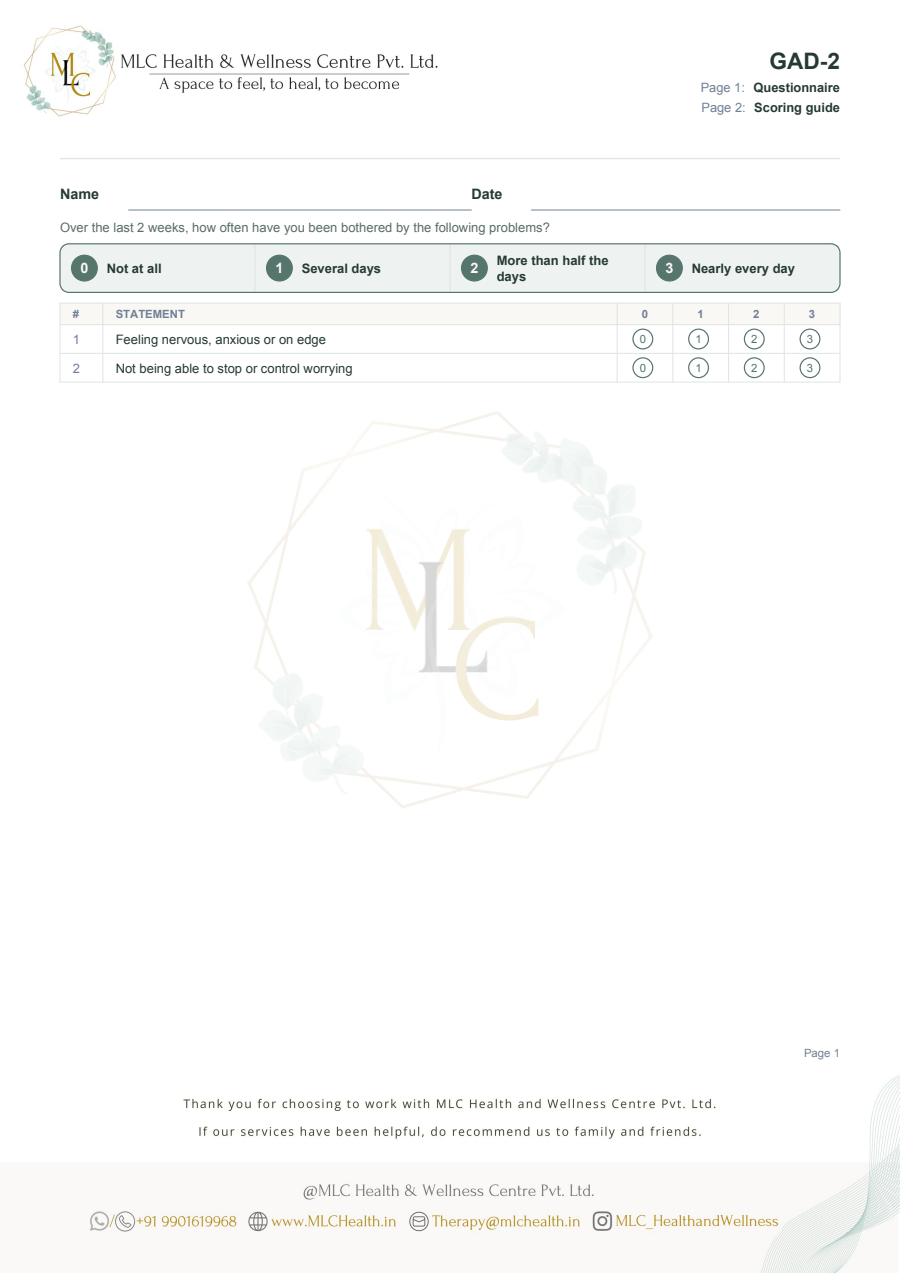
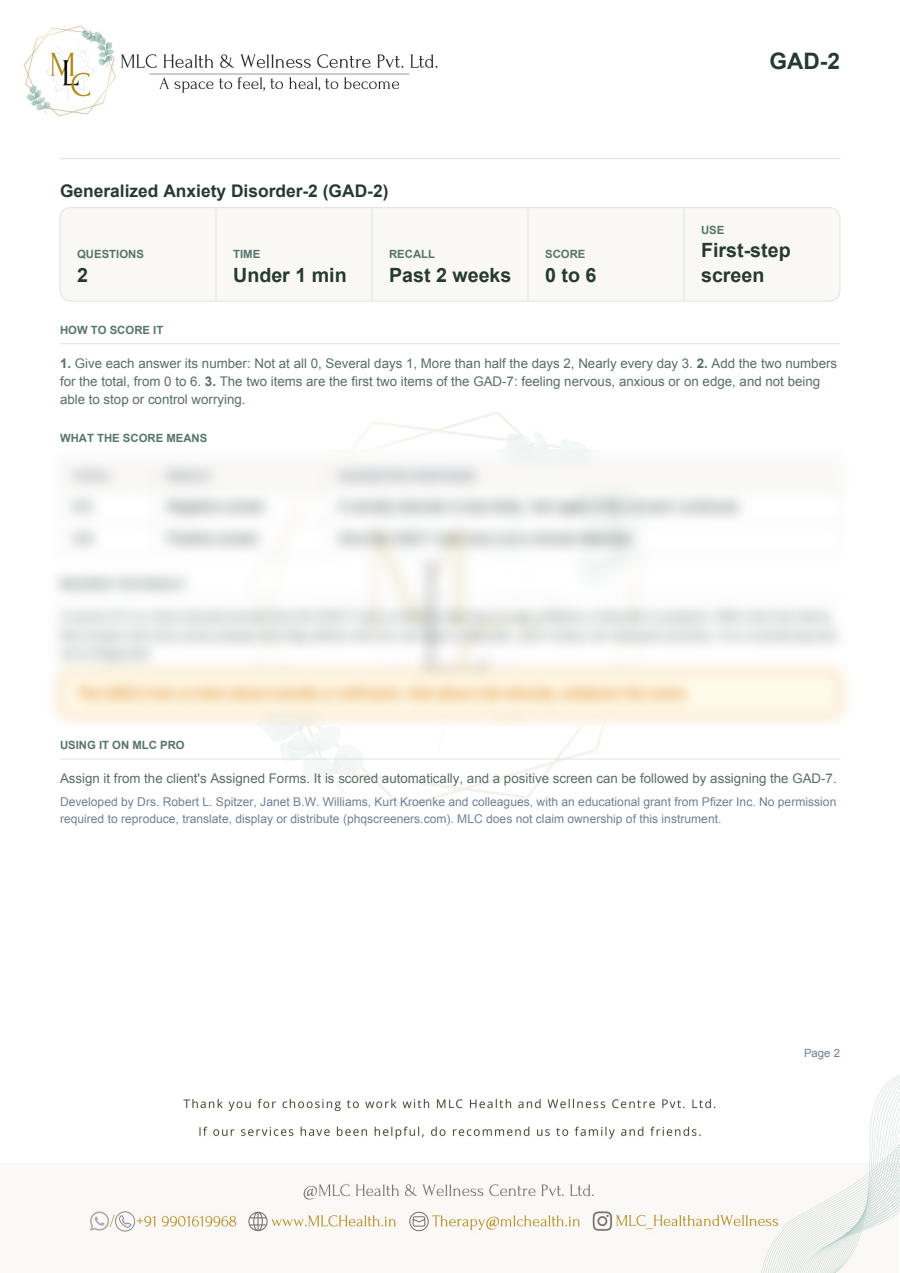
This is the GAD-2 as an MLC form: the questions on page 1, and how to score it on page 2. It is shown here for reference only, with credit to its authors, and the score table on page 2 is blurred. MLC does not sell it or offer it as a download. Therapists with MLC Pro can use it with their clients online.
- Assign it from the client's file in your dashboard, under Assigned Forms.
- The client completes it securely in their own portal.
- The total and the level are calculated for you, and you can download a PDF report that lists each answer.
What is the GAD-2?
The Generalized Anxiety Disorder-2 (GAD-2) is a very short screen for anxiety. Its two questions are the first two items of the GAD-7 and ask how often, over the last 2 weeks, the person has been bothered by feeling nervous, anxious or on edge, and by not being able to stop or control worrying. These are the two core symptoms of generalized anxiety. It was studied by Kroenke, Spitzer, Williams, Monahan and Lowe (2007).
It is built to be answered in seconds, so it can be used in any setting to decide whether the full GAD-7 is needed.
For clients
It is two short questions about worry and nervousness over the past two weeks. Your answers help your therapist decide whether to ask you more. It is not a test you can pass or fail.
How do therapists use the GAD-2?
The GAD-2 supports a quick first screen for anxiety. A therapist reads it with the person's history, sleep, daily functioning and supports.
- Triage: a quick screen alongside mood measures.
- Follow-up: a positive screen leads to the full GAD-7 and a clinical interview.
- Busy settings: it takes under a minute, so it fits where the GAD-7 would not.
How is the GAD-2 completed?
The person rates how often each of the two problems has bothered them in the last 2 weeks: 0 = Not at all, 1 = Several days, 2 = More than half the days, 3 = Nearly every day. It takes under a minute.
How is the GAD-2 scored?
There is one total score, found in three steps.
- Give each of the two answers its number: Not at all is 0, Several days is 1, More than half the days is 2, Nearly every day is 3.
- Add the two numbers. The total runs from 0 to 6.
- Compare the total with the cut-off, below.
Example: if one answer is Several days (1) and the other is More than half the days (2), the total is 3, which is a positive screen.
What is the GAD-2 cut-off score?
The score is read against a single cut-off.
| Result | Total score |
|---|---|
| Negative screen | 0 to 2 |
| Positive screen | 3 to 6 |
The PHQ instruction manual says a score of 3 or more on the ultra-brief measures should prompt giving the full GAD-7 and a clinical interview to see whether an anxiety disorder is present. The GAD-2 does not measure severity.
A positive screen does not diagnose an anxiety disorder, and a negative screen does not rule one out.
Does the GAD-2 measure suicide risk?
No. Neither of its questions asks about suicide or self-harm, so a clinician needs to ask about risk directly, whatever the score is. Anxiety often occurs with low mood, and the PHQ-9 or PHQ-2 is commonly used alongside the GAD-2 for that reason.
If you or someone you know is in distress or at risk right now, please see our crisis support page.
What are the limitations of the GAD-2?
- It is a screen, not a diagnosis. Only a clinical assessment can diagnose an anxiety disorder.
- With only two items it will miss some people who have an anxiety disorder, and it will flag some who do not.
- It does not measure severity or track change well. Use the GAD-7 for that.
- It covers the past 2 weeks only, and relies on the person's own answers.
- The best cut-off differs between populations, settings and languages.
How is the GAD-2 different from the GAD-7?
The GAD-7 has seven questions and gives a score from 0 to 21 with four severity levels. The GAD-2 is its first two questions only, with a score from 0 to 6 and a single cut-off.
Many services use the GAD-2 as a first screen and give the GAD-7 only when the GAD-2 is positive. The PHQ-2 and GAD-2 together make the PHQ-4, a four-question screen for depression and anxiety.
How well does the GAD-2 work?
In the study that tested it (Kroenke and colleagues, 2007), a cut-off of 3 gave a reasonable balance between picking up anxiety disorders and avoiding false alarms in primary care patients. It is less specific than the GAD-7. As with any cut-off, how well it works depends on the group tested, so findings from one population should not be assumed to hold for another.
Frequently asked questions
What does GAD-2 stand for?
GAD-2 stands for Generalized Anxiety Disorder-2. It is a 2-question anxiety screen.
What does the GAD-2 measure?
The GAD-2 measures how often, over the last 2 weeks, a person has felt nervous, anxious or on edge, and has been unable to stop or control worrying, giving a total from 0 to 6.
How is the GAD-2 scored?
Give each answer 0 to 3 (Not at all, Several days, More than half the days, Nearly every day) and add the two numbers. The total runs from 0 to 6.
What is the GAD-2 cut-off score?
A score of 3 or more is a positive screen and should prompt the full GAD-7 and a clinical interview.
What does a positive GAD-2 mean?
It means an anxiety disorder is possible and the full GAD-7 and a clinical interview are recommended. It is not a diagnosis.
How long does the GAD-2 take?
Under a minute.
Is the GAD-2 a diagnostic test?
No. The GAD-2 is a quick screen. A diagnosis of an anxiety disorder needs a full clinical assessment.
What is the difference between the GAD-2 and the GAD-7?
The GAD-2 is the first two questions of the GAD-7. The GAD-7 has seven questions, scores 0 to 21, and measures severity.
Does the GAD-2 measure suicide risk?
No. Neither of its questions asks about suicide or self-harm, so a clinician needs to ask about risk directly whatever the score is.
Is the GAD-2 free to use?
Yes. Its owners state that no permission is required to reproduce, translate, display or distribute the PHQ and GAD-7 screeners, and the GAD-2 is the first two items of the GAD-7. MLC shows its own form on this page for reference and does not sell it. It is available to therapists as an online form on MLC Pro.
How do I get the GAD-2 on MLC?
Therapists with MLC Pro assign it directly to their clients from the dashboard, and clients complete it in their MLC portal.
Disclaimer and attribution
This page is for information. The GAD-2 is a screening tool, not a standalone diagnostic instrument, and its results need professional interpretation in context. It is not a substitute for advice from a qualified health professional.
The GAD-2 was developed by Drs. Robert L. Spitzer, Janet B.W. Williams, Kurt Kroenke and colleagues, with an educational grant from Pfizer Inc. No permission is required to reproduce, translate, display or distribute it (phqscreeners.com). MLC does not claim ownership of this instrument.
References
- Kroenke K, Spitzer RL, Williams JBW, Monahan PO, Lowe B. Anxiety disorders in primary care: prevalence, impairment, comorbidity, and detection. Annals of Internal Medicine, 146(5), 317-325 (2007).
- Spitzer RL, Kroenke K, Williams JBW, Lowe B. A brief measure for assessing generalized anxiety disorder: the GAD-7. Archives of Internal Medicine, 166(10), 1092-1097 (2006).
- Instructions for Patient Health Questionnaire (PHQ) and GAD-7 Measures. Instruction manual, phqscreeners.com.
MLC Pro
Use the GAD-2 with your clients on MLC Pro
The GAD-2 is included with MLC Pro. Assign it directly to a client from their file in your dashboard, and the client completes it securely in their own portal.
- Open the client in your dashboard and choose Assigned Forms.
- Assign the GAD-2 with an optional due date.
- Your client completes it in their portal. The score and the screen result are calculated automatically.
- You review the result and can download it as a PDF report. A positive screen can be followed by assigning the GAD-7.
- Assign it again later if you need another screen.
Results are shared with the therapist who assigned it.